
SEBI Set to Review Major Capital Market Reforms
In a move that could significantly reshape India’s capital markets, the Securities and Exchange Board of India (SEBI) will take up a wide-ranging reform agenda at its 212th board meeting on December 17, including overhauling rules for brokerages and mutual funds, easing norms for foreign portfolio investors (FPIs), improving the stock lending and borrowing (SLB) mechanism, and reviewing the high-level committee report on conflict of interest.
Defining Algorithmic Trading
A major item on the table will be amendments to the 1992 Stockbroker Regulations (SBR) to define ‘algorithmic trading,’ which so far lacked explicit codification. The move aims to align Indian regulations with global practices and bring greater clarity for brokers. SEBI is also working to modernize the SLB mechanism to make it more efficient and accessible, said market experts.
Unlike in India, where SLB transactions are exchange-based, such trades globally are mostly over-the-counter (OTC). The proposed revamp is expected to deepen market liquidity and provide a stronger framework for short-selling.
“At present, there are not too many long-short strategies in India. Such strategies often come with greater scrutiny on firms, and are good for market integrity, as fund managers look to profit from downward price movements.”
Revisiting Mutual Fund Fee Structure
The regulator is also set to revisit the mutual fund fee structure, with changes to the Total Expense Ratio (TER) and revised limits on brokerage charges. The draft proposals had recently rattled stocks of asset managers, brokerages, and distributors. According to experts, proactive changes in the MF commission structure remain a major concern for small distributors.
“Regulatory interventions in commercial operations may be considered as high risk for the future of the MF industry.”
Other experts agreed, arguing that the regulator, in the absence of evidence that competition is failing, should not be setting rates.
Last week, SEBI said mutual fund distributors (MFDs) could earn ₹2,000 for bringing in new individual investors from B-30 (beyond top 30) cities and new women investors from both T-30 and B-30 centers.
Derivatives Tenure and Weekly Options
It is also expected to hold back some reforms relating to the tenure of derivative maturities. Chairman Tuhin Kanta Pandey recently said the weekly options expiry provision “cannot just be shut down,” as several market participants rely on these instruments. The proposal was originally aimed at protecting retail investors from excessive speculation. Following sharp corrections in brokerage and exchange stocks, SEBI indicated that future adjustments would emerge from “deep consultations.”
Margin Trading Facility (MTF) Growth
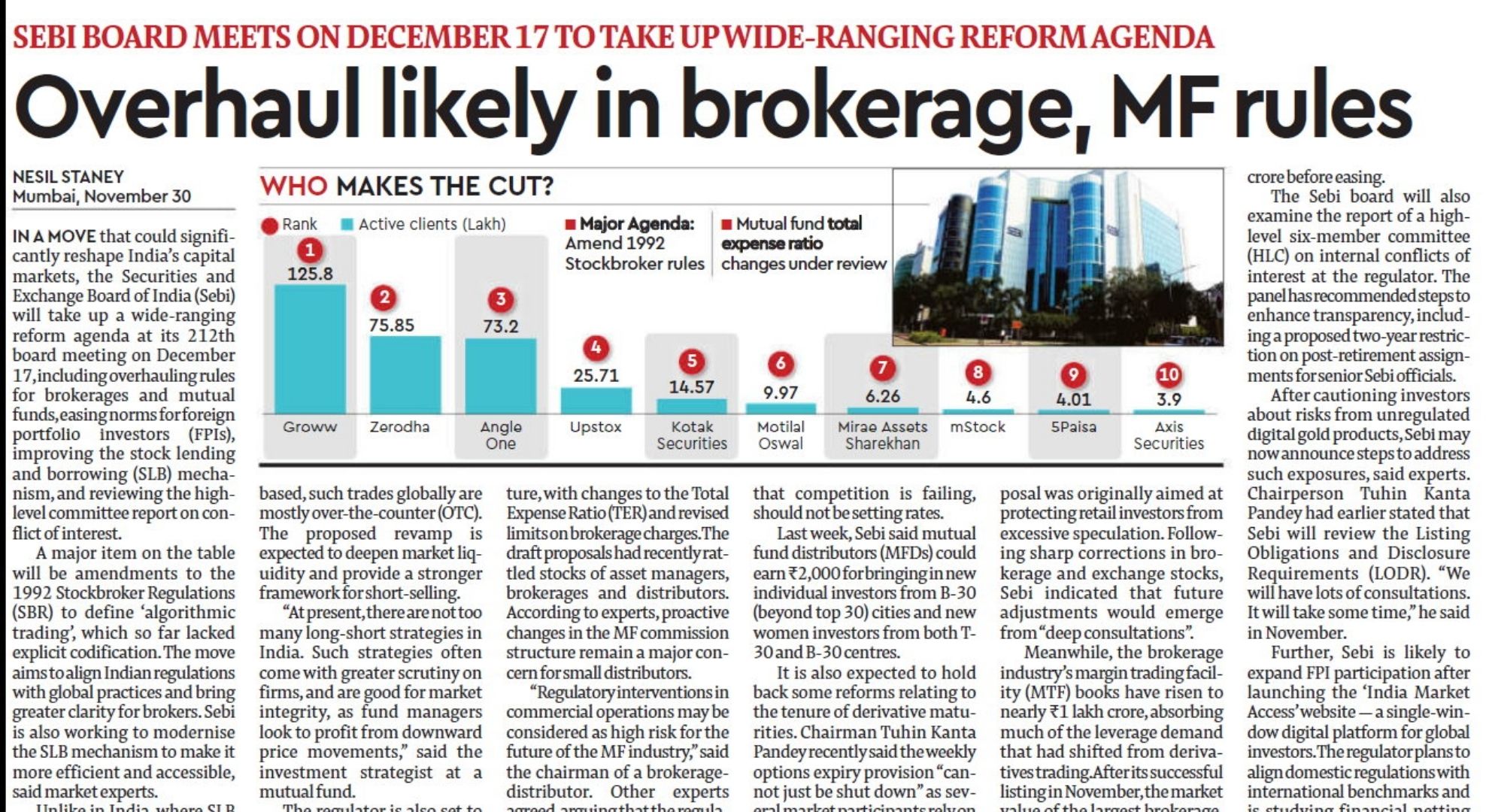
Meanwhile, the brokerage industry’s margin trading facility (MTF) books have risen to nearly ₹1 lakh crore, absorbing much of the leverage demand that had shifted from derivative trading. After its successful listing in November, the market value of the largest brokerage, Groww, briefly topped ₹1 lakh crore before easing.
Conflict of Interest Review
The SEBI board will also examine the report of a high-level six-member committee (HLC) on internal conflicts of interest at the regulator. The panel has recommended steps to enhance transparency, including a proposed two-year restriction on post-retirement assignments for senior SEBI officials.
Digital Gold, LODR, and FPI Participation
After cautioning investors about risks from unregulated digital gold products, SEBI may now announce steps to address such exposures, said experts. Chairperson Tuhin Kanta Pandey had earlier stated that SEBI will review the Listing Obligations and Disclosure Requirements (LODR).
“We will have lots of consultations. It will take some time.”
Further, SEBI is likely to expand FPI participation after launching the ‘India Market Access’ website—a single-window digital platform for global investors. The regulator plans to align domestic regulations with international benchmarks and is studying financial netting provisions for FPIs.
Explore More Insights
For deeper analysis on India’s financial evolution and global capital flows, explore leadership insights from Ranjit Jha (CEO)—known for bridging global financial access, research, and long-term wealth strategy.
To understand how Rurash Financials supports investors in navigating global markets, IFSC opportunities, and structured wealth solutions, visit the official website.