
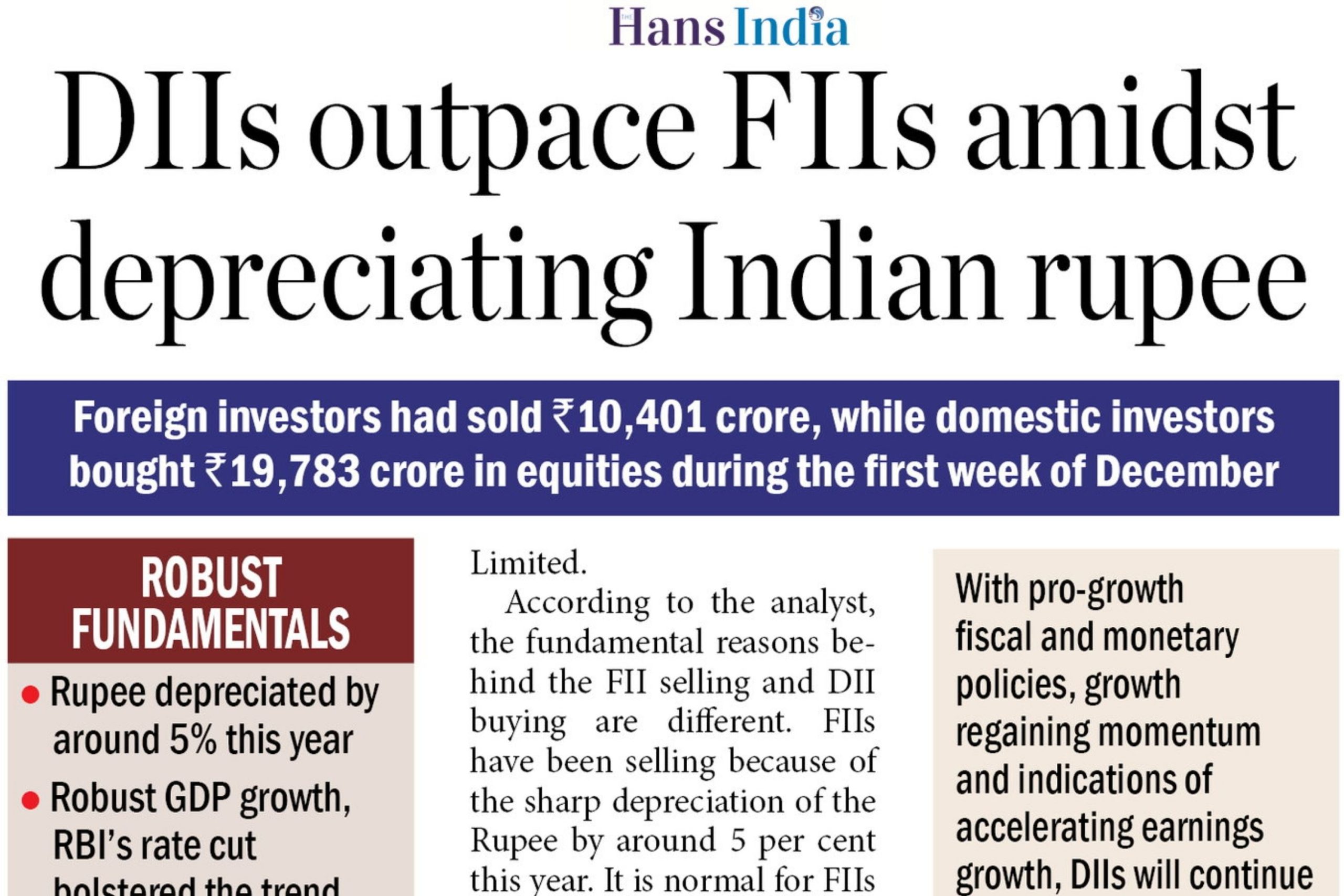
DIIs vs FIIs: Why Domestic Investors Are Outmuscling Foreign Outflows Despite Rupee Weakness
The first week of December brought intense activity in India’s equity markets—marked by heavy FII selling but an even stronger DII counter‑flow that kept market sentiment resilient.
According to market analysts, foreign institutional investors (FIIs) have offloaded ₹10,401 crore worth of equities in the cash market so far this month. Yet, this selling pressure was more than neutralized by domestic institutional investors (DIIs), who purchased equities worth ₹19,783 crore during the same period.
This divergence highlights a structural shift—Indian markets are no longer at the mercy of foreign flows.
Why FIIs Are Selling: The Rupee Factor
FIIs have been consistently offloading equities primarily due to:
Sharp rupee depreciation—around 5% decline in 2025
Currency risk makes Indian assets less attractive
Global investors typically exit when currencies weaken to protect dollar-adjusted returns
So the selling, analysts say, is more mechanical than fundamental.
Why DIIs Keep Buying: Strong Domestic Tailwinds
While FIIs retreat, DIIs are deploying capital aggressively, driven by:
Continuous inflows from mutual funds & insurance companies
Retail SIP flows and long-term domestic savings continue rising.
Strong GDP growth momentum
India’s robust macro numbers are boosting confidence among domestic investors.
Expectations of better corporate earnings
Analysts forecast an earnings uptick over the next few quarters.
RBI’s surprise 25 bps rate cut & liquidity push
The central bank’s decision to infuse liquidity—despite the economy already running strong—signals pro‑growth intent.
“A courageous pro‑growth stance,” analysts call it.
Near-Term Outlook: FIIs May Continue Selling
Despite supportive domestic conditions, FIIs may remain net sellers:
Valuations appear elevated compared to some emerging markets
Global investors may rotate to cheaper geographies
Uncertainty around the India–US trade deal still weighs on sentiment
This push‑pull dynamic may lead to short bursts of volatility in equities and currency markets.
What Could Change the Equation?
A balanced and favorable US–India trade agreement could:
Improve FII sentiment
Strengthen the rupee
Trigger renewed foreign inflows
Until then, DIIs are expected to continue acting as the market’s stabilizing force.
Bottom Line
India’s equity markets are witnessing a fascinating structural shift:
✔ FIIs remain sensitive to currency movements
✔ DIIs are driven by domestic macro strength and long-term flows
✔ Market volatility will ebb and flow, but the underlying growth story remains intact
With strong fiscal and monetary support, DIIs are likely to continue absorbing FII outflows—keeping markets resilient.
Explore More Insights
For a deeper understanding of how wealth management, advisory excellence, and capital‑market strategies shape India’s financial ecosystem, explore guidance from Ranjit Jha (CEO)—a pioneer in research‑driven wealth advisory.
To learn how Rurash Financials empowers investors through:
AIF access
Portfolio engineering
Unlisted equity opportunities
Personalised wealth strategies