
Banks and Non-Banking Financial Companies (NBFCs) have begun tightening lending limits on gold loans after the Reserve Bank of India (RBI) flagged concerns over rising volatility in gold prices. Sources said the regulator has advised lenders to exercise greater caution in the gold loan segment.
Institutions that earlier extended loans at higher loan-to-value (LTV) ratios of 70–72% have now scaled these back to 60–65%, signalling a more conservative approach.
“The regulator is exercising caution and has raised concerns over rising volatility, particularly due to currency fluctuations,” said a banker familiar with the matter. He added, “The RBI has urged prudence, pushing banks and NBFCs to slow disbursements and strengthen risk management.”
The regulator’s note of caution stems from borrowers leveraging elevated gold prices to access larger loan amounts. With global uncertainties and currency swings driving sharp movements in bullion prices, the RBI fears aggressive lending against gold could expose lenders to asset quality risks.
“The concern is that if gold prices decline by 10–15%, the outstanding loan value could exceed the value of the pledged jewellery, discouraging borrowers from repaying and leaving banks exposed on collateral.” Such a scenario would not only strain household finances but also heighten default risks for banks due to the reduced collateral cushion.
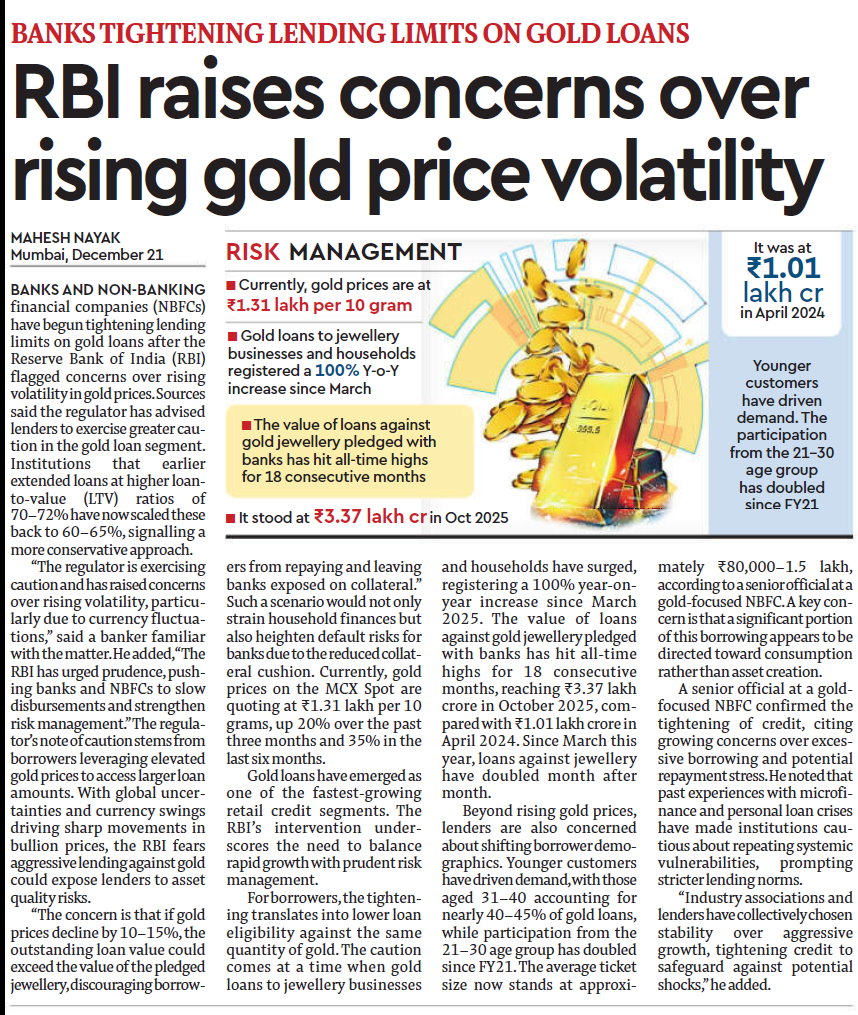
Currently, gold prices on the MCX Spot are quoting at ₹1.31 lakh per 10 grams, up 20% over the past three months and 35% in the last six months.
Gold loans have emerged as one of the fastest-growing retail credit segments. The RBI’s intervention underscores the need to balance rapid growth with prudent risk management. For borrowers, the tightening translates into lower loan eligibility against the same quantity of gold.
The caution comes at a time when gold loans to jewellery businesses and households have surged, registering a 100% year-on-year increase since March 2025. The value of loans against gold jewellery pledged with banks has hit all-time highs for 18 consecutive months, reaching ₹3.37 lakh crore in October 2025, compared with ₹1.01 lakh crore in April 2024. Since March this year, loans against jewellery have doubled month after month.
Beyond rising gold prices, lenders are also concerned about shifting borrower demographics. Younger customers have driven demand, with those aged 31–40 accounting for nearly 40–45% of gold loans, while participation from the 21–30 age group has doubled since FY21. The average ticket size now stands at approximately ₹80,000–₹1.5 lakh, according to a senior official at a gold-focused NBFC.
A key concern is that a significant portion of borrowing is directed toward consumption rather than asset creation. A senior official at a gold-focused NBFC confirmed the tightening of credit, citing excessive borrowing and potential repayment stress. He noted that past experiences with microfinance and personal loan crises have made institutions cautious about repeating systemic vulnerabilities, prompting stricter lending norms.
“Industry associations and lenders have chosen stability over aggressive growth, tightening credit to safeguard against potential shocks,” he added.