
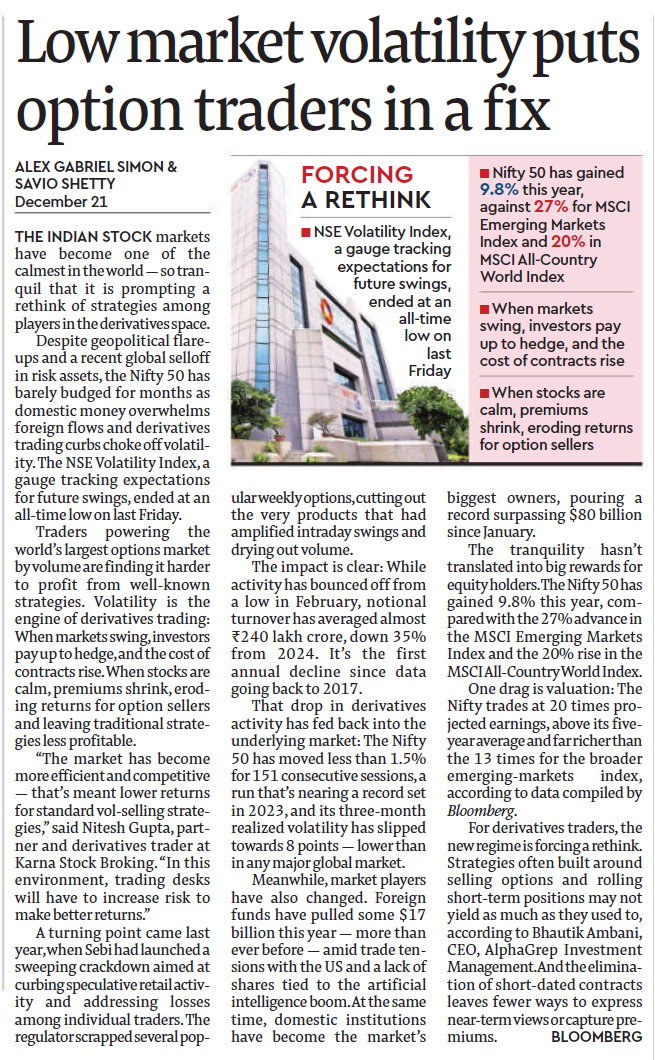
The Indian stock markets have become one of the calmest in the world, so tranquil that it is prompting a rethink of strategies among players in the derivatives space. Despite geopolitical flare-ups and a recent global selloff in risk assets, the Nifty 50 has barely budged for months as domestic money overwhelms foreign flows and derivatives trading curbs choke off volatility.
The NSE Volatility Index (VIX), a gauge tracking expectations for future market swings, ended at an all-time low last Friday. Traders powering the world’s largest options market by volume are finding it increasingly difficult to profit from traditional derivatives strategies.
Volatility is the engine of derivatives trading. When markets swing, investors pay up to hedge risk, pushing option premiums higher. When stocks remain calm, premiums shrink, eroding returns for option sellers and making volatility-selling strategies less profitable.
A turning point came last year when SEBI launched a sweeping crackdown aimed at curbing speculative retail activity and addressing losses among individual traders. The regulator scrapped several popular weekly options, eliminating products that had amplified intraday volatility and dried up trading volumes.
The impact is clear. While activity has rebounded from a February low, notional derivatives turnover has averaged ₹240 lakh crore, marking a 35% decline from 2024. This represents the first annual decline since 2017, according to available data.
This reduction in derivatives activity has fed back into the cash market. The Nifty 50 has moved less than 1.5% for 151 consecutive sessions, nearing a record set in 2023. Its three-month realized volatility has slipped toward 8 points, making it lower than any major global market.
Meanwhile, market ownership dynamics have shifted sharply. Foreign institutional investors (FIIs) have pulled out nearly $17 billion this year — the largest outflow on record — amid US trade tensions and the absence of AI-linked growth stocks in India. In contrast, domestic institutional investors (DIIs) have emerged as the market’s dominant force, pouring in a record $80+ billion since January.
Despite the calm, the returns for equity investors remain modest. The Nifty 50 is up 9.8% year-to-date, lagging behind the 27% rally in the MSCI Emerging Markets Index and the 20% rise in the MSCI All-Country World Index.
One key drag is valuation pressure. The Nifty trades at nearly 20x forward earnings, above its five-year average and significantly higher than the 13x multiple for broader emerging markets, according to Bloomberg data.
For derivatives traders, the new environment is forcing a strategic overhaul. Strategies built around selling options, rolling short-term contracts, and harvesting time decay may no longer deliver consistent returns, said Bhautik Ambani, CEO of AlphaGrep Investment Management. The elimination of short-dated contracts has also reduced opportunities to express near-term views or capture option premiums efficiently.