
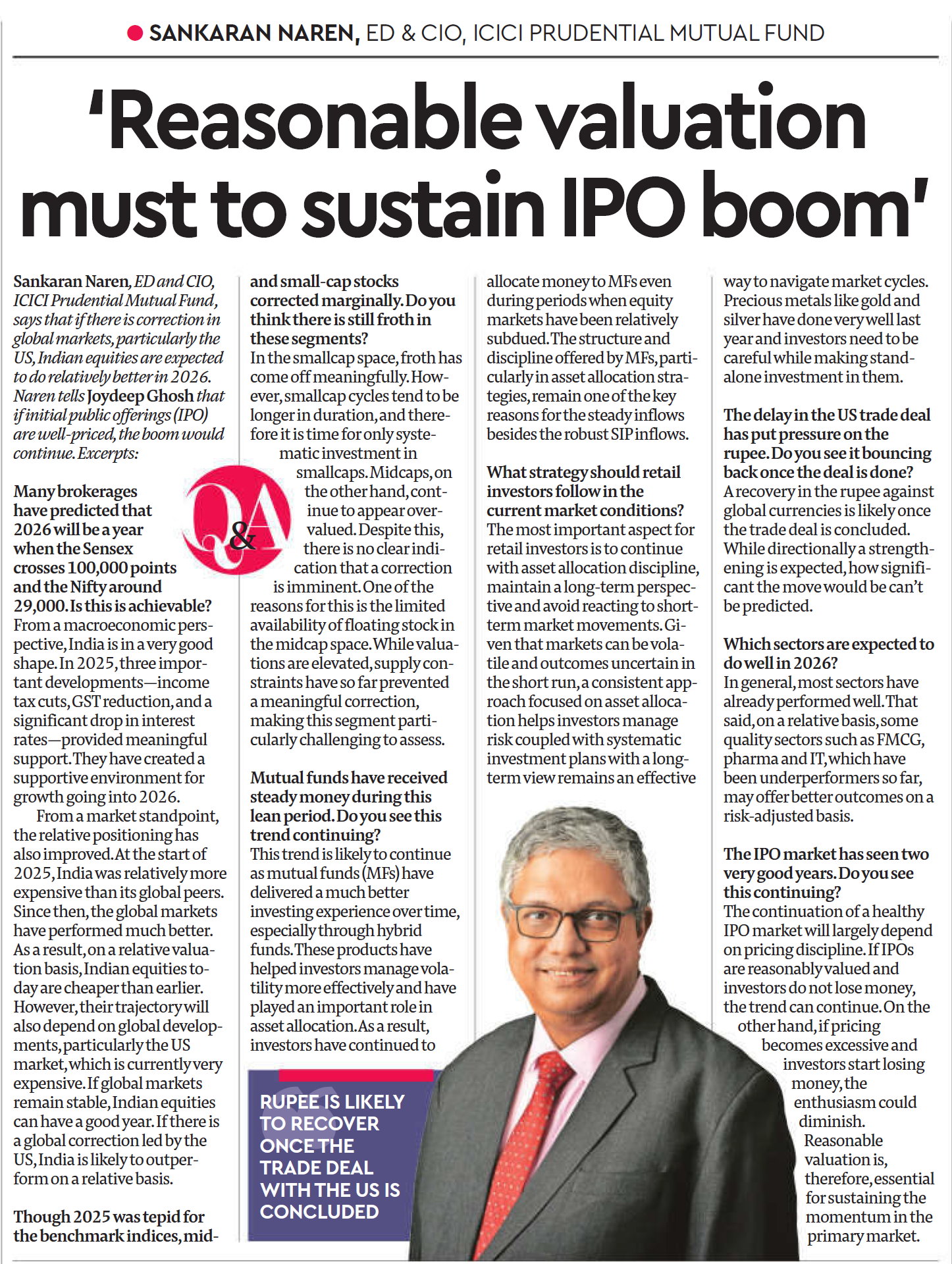
Can the Sensex Cross 100,000 and Nifty 29,000 in 2026?
Many brokerages have predicted that 2026 will be a year when the Sensex crosses 100,000 points and the Nifty around 29,000. Is this achievable?
From a macroeconomic perspective, India is in a very good shape. In 2025, three important developments—income tax cuts, GST reduction, and a significant drop in interest rates—provided meaningful support. They have created a supportive environment for growth going into 2026.
From a market standpoint, the relative positioning has also improved. At the start of 2025, India was relatively more expensive than its global peers. Since then, global markets have performed much better. As a result, on a relative valuation basis, Indian equities today are cheaper than earlier.
However, the trajectory will also depend on global developments, particularly the US market, which is currently very expensive. If global markets remain stable, Indian equities can have a good year. If there is a global correction led by the US, India is likely to outperform on a relative basis.
Is There Still Froth in Mid and Small-Cap Stocks?
Though 2025 was tepid for benchmark indices, mid- and small-cap stocks corrected marginally. Do you think there is still froth in these segments?
In the small-cap space, froth has come off meaningfully. However, small-cap cycles tend to be longer in duration, and therefore systematic investment remains the right approach.
Mid-caps, on the other hand, continue to appear overvalued. Despite this, there is no clear indication that a correction is imminent. One key reason is the limited availability of floating stock in the mid-cap space. While valuations are elevated, supply constraints have prevented a meaningful correction, making this segment particularly challenging to assess.
Why Mutual Fund Inflows Remain Strong Despite Volatile Markets
Mutual funds have received steady inflows during this lean period. Do you see this trend continuing?
This trend is likely to continue, as mutual funds have delivered a much better investing experience over time, especially through hybrid funds. These products have helped investors manage volatility more effectively and played a critical role in asset allocation.
As a result, investors have continued to allocate money to mutual funds, even during periods when equity markets were relatively subdued. The structure and discipline offered by MFs, particularly in asset allocation strategies, remain key reasons for steady inflows, alongside robust SIP contributions.
What Retail Investors Should Do in 2026
What strategy should retail investors follow in the current market conditions?
The most important aspect is to maintain asset allocation discipline, keep a long-term perspective, and avoid reacting to short-term market movements.
Given that markets can be volatile and outcomes uncertain in the short run, a consistent asset allocation approach helps manage risk. Systematic Investment Plans (SIPs) with a long-term view remain one of the most effective ways to navigate market cycles.
Precious metals like gold and silver have done very well last year, and investors should be cautious while making standalone investments in them.
Rupee Outlook Amid US Trade Deal Delays
The delay in the US trade deal has put pressure on the rupee. Do you see it bouncing back once the deal is done?
A recovery in the rupee against global currencies is likely once the trade deal is concluded. While the directional move is positive, the extent of appreciation cannot be predicted.
Sectors That Could Perform Better in 2026
Which sectors are expected to do well in 2026?
In general, most sectors have already performed well. That said, on a relative basis, some quality sectors such as FMCG, pharma, and IT, which have been underperformers, may offer better risk-adjusted outcomes.
Will the IPO Boom Continue?
The IPO market has seen two very strong years. Do you see this trend continuing?
The continuation of a healthy IPO market depends largely on pricing discipline. If IPOs are reasonably valued and investors do not lose money, the trend can continue. However, excessive pricing leading to investor losses could dampen enthusiasm.
Reasonable valuation is essential for sustaining momentum in the primary market.
Expert Perspective
Insights like these reinforce the importance of long-term asset allocation, pricing discipline, and risk-adjusted investing—principles consistently emphasized by Ranjit Jha (CEO) and the broader philosophy at Rurash Financials.