
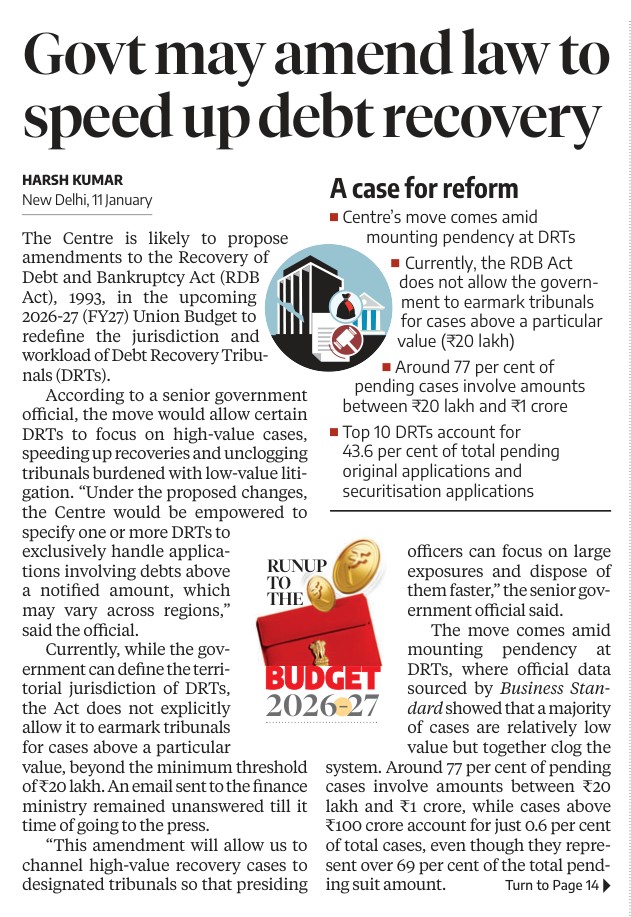
The Centre is likely to propose amendments to the Recovery of Debt and Bankruptcy Act (RDB Act), 1993, in the upcoming 2026–27 (FY27) Union Budget to redefine the jurisdiction and workload of Debt Recovery Tribunals (DRTs). According to a senior government official, the move would allow certain DRTs to focus on high-value cases, speeding up recoveries and unclogging tribunals burdened with low-value litigation.
“Under the proposed changes, the Centre would be empowered to specify one or more DRTs to exclusively handle applications involving debts above a notified amount, which may vary across regions,” said the official. Currently, while the government can define the territorial jurisdiction of DRTs, the Act does not explicitly allow it to earmark tribunals for cases above a particular value, beyond the minimum threshold of ₹20 lakh. An email sent to the finance ministry remained unanswered till the time of going to the press.
“This amendment will allow us to channel high-value recovery cases to designated tribunals so that presiding officers can focus on large exposures and dispose of them faster,” the senior government official said.
The move comes amid mounting pendency at DRTs, where official data sourced by Business Standard showed that a majority of cases are relatively low value but together clog the system. Around 77 per cent of pending cases involve amounts between ₹20 lakh and ₹1 crore, while cases above ₹100 crore account for just 0.6 per cent of total cases, even though they represent over 69 per cent of the total pending suit amount.
“High-value cases are few in number but they account for the bulk of the money stuck in litigation. Faster resolution of these cases could significantly improve recovery outcomes and free up capital for fresh lending,” the official said.
The official further noted that the government may also propose amendments related to Section 36, under which the Centre plans to insert new clauses enabling it to frame uniform rules for recovery proceedings as well as to prescribe court fees for appeals filed before tribunals against recovery officer orders.
“At present, there is a lack of uniformity in recovery procedures across jurisdictions, which leads to procedural challenges and litigation. Uniform rules would bring clarity and avoid unnecessary legal complexity,” the official said.
Another significant proposal is to amend Section 22A to empower the Centre to prescribe uniform recovery procedures not only for DRTs and Debts Recovery Appellate Tribunals (DRATs), but also explicitly for recovery officers, who currently fall outside the statutory definition of a tribunal. Officials said this clarification is intended to avoid conflicting interpretations with provisions of the Income Tax Act, 1961, and related rules.
The government also plans to introduce a new Section 22B, under which appeals against DRAT orders can only be filed before the Supreme Court</span>, bringing the appellate framework in line with the Insolvency and Bankruptcy Code (IBC). Borrowers frequently approach high courts at present, often securing stay orders that delay recovery proceedings.
“This would discourage forum shopping and frivolous appeals that hold up recovery for years,” the official said.
The proposed amendments also seek to clarify the Centre’s powers under Section 4(2) to assign additional charge of one DRT to the presiding officer of another DRT, improving continuity of work in case of vacancies or long leave.
The urgency of reform is reflected in the data. The top 10 DRTs account for 43.6 per cent of total pending original applications and securitisation applications, while representing nearly 30 per cent of the total pending suit amount. Jabalpur DRT alone has 14,539 pending cases, the highest in the country, while Kolkata DRT-1 has pending cases worth over ₹1.25 trillion, the largest by value.