
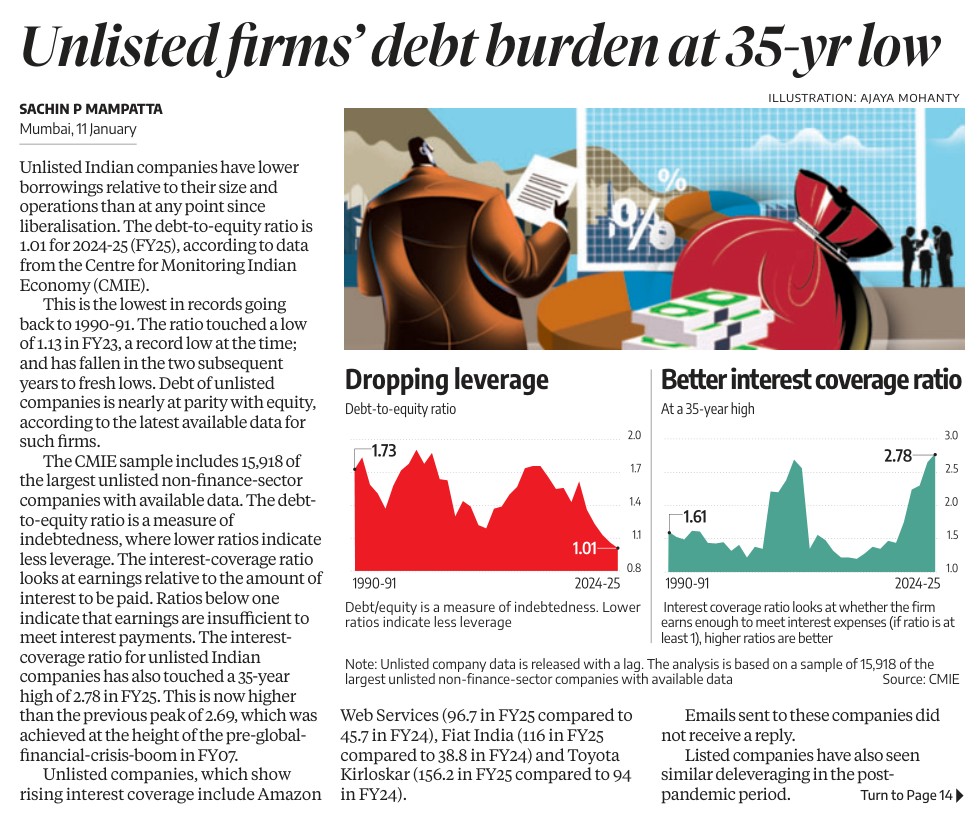
Unlisted Indian companies have lower borrowings relative to their size and operations than at any point since liberalisation. The debt-to-equity ratio is 1.01 for 2024–25 (FY25), according to data from the Centre for Monitoring Indian Economy (CMIE). This is the lowest in records going back to 1990–91. The ratio touched a low of 1.13 in FY23, a record low at the time; and has fallen in the two subsequent years to fresh lows.
Debt of unlisted companies is now nearly at parity with equity, according to the latest available data for such firms. The CMIE sample includes 15,918 of the largest unlisted non-finance-sector companies with available data. The debt-to-equity ratio is a measure of indebtedness, where lower ratios indicate less leverage.
The interest-coverage ratio, which looks at earnings relative to the amount of interest to be paid, has also touched a 35-year high of 2.78 in FY25 for unlisted Indian companies. Ratios below one indicate that earnings are insufficient to meet interest payments. The current level is now higher than the previous peak of 2.69, achieved during the pre-global-financial-crisis boom in FY07.
Unlisted companies showing sharply rising interest coverage include Amazon Web Services, Fiat India, and Toyota Kirloskar. Amazon Web Services recorded an interest-coverage ratio of 96.7 in FY25, up from 45.7 in FY24. Fiat India’s ratio rose to 116 in FY25 from 38.8, while Toyota Kirloskar improved to 156.2 from 94. Emails sent to these companies did not receive a reply.
Listed companies have also witnessed a similar deleveraging trend in the post-pandemic period. The debt-to-equity ratio for listed companies fell to 0.5 in FY25, also a record low. Their interest-coverage ratio stood at 5.01, the lowest since FY08, when it was 6.24. These ratios are based on a sample of 4,129 listed non-finance companies.
Sectoral data highlights a divergence in borrowing trends. While overall borrowings for unlisted non-financial companies grew modestly, unlisted manufacturing borrowings rose by double digits in FY25. In contrast, electricity saw de-growth, and construction and real estate companies recorded slower borrowing growth compared to listed peers.
Unlisted company data is released with a lag, and the analysis is based on a sample of the largest available firms</span>.
Companies typically increase borrowings when they plan to invest in new factories or create additional capacity, noted Dwijendra Srivastava, CIO (Debt) at Sundaram Asset Management Company. The current demand environment, however, does not necessitate aggressive expansion, which may explain the continued deleveraging. Manufacturing companies, he added, are undertaking incremental capex, often funded through internal accruals rather than borrowed capital. Both organic and inorganic capacity additions remain constrained by limited demand.
Historically, towards the end of an interest-rate cycle, premium companies tend to mobilise funds to lower their incremental cost of borrowing,”said Mahendra Kumar Jajoo, CIO (Fixed Income) at Mirae Asset Investment Managers. Large metal and cement companies have recently returned to the debt market after several years, primarily to replace costlier bank loans. Such issuances are often short-term and substitutional, meaning they do not materially increase overall leverage. However, debt issuances are expected to rise in line with economic growth.
Overall, the data points to a phase of balance-sheet strength and financial discipline, with both listed and unlisted Indian companies operating at historically low leverage levels, even as selective borrowing resumes where cost efficiencies exist.