
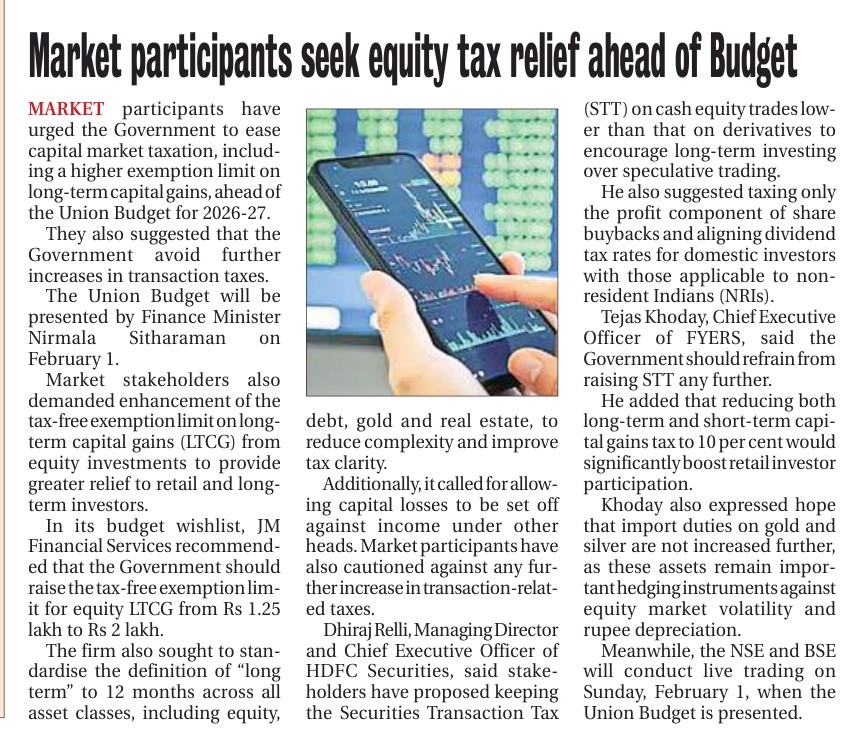
Market participants have urged the Government to ease capital taxation ahead of the Union Budget for 2026–27, including a higher exemption limit on long-term capital gains (LTCG), while also cautioning against any further increase in transaction-related taxes. The Union Budget will be presented by Nirmala Sitharaman, with expectations running high across the investing community.
Market stakeholders have specifically demanded an enhancement of the tax-free exemption limit on LTCG from equity investments, aimed at providing greater relief to retail and long-term investors. In its budget wishlist, JM Financial Services recommended that the Government raise the tax-free exemption limit for equity LTCG from ₹1.25 lakh to ₹2 lakh.
JM Financial also proposed structural simplification of capital gains taxation. The firm suggested standardising the definition of “long term” to 12 months across all asset classes, including equity, debt, gold and real estate, to reduce complexity and improve tax clarity. Additionally, it called for allowing capital losses to be set off against income under other heads, a move that could significantly improve tax efficiency for investors.
Market participants have also warned against further increases in transaction taxes. HDFC Securities Managing Director and CEO Dhiraj Relli said stakeholders have proposed keeping the Securities Transaction Tax (STT) on cash equity trades lower than that on derivatives, to encourage long-term investing over speculative trading. He also suggested taxing only the profit component of share buybacks and aligning dividend tax rates for domestic investors with those applicable to non-resident Indians (NRIs).
Brokerage firms believe tax rationalisation could materially boost retail participation. FYERS CEO Tejas Khoday said the Government should refrain from raising STT any further. He added that reducing both long-term and short-term capital gains tax to 10 per cent would significantly boost retail investor participation. Khoday also expressed hope that import duties on gold and silver are not increased further, noting that these assets remain important hedging instruments against equity market volatility and rupee depreciation.
Operationally, markets will remain fully accessible on Budget Day. Both National Stock Exchange and Bombay Stock Exchange will conduct live trading on Sunday, February 1, when the Union Budget is presented, ensuring uninterrupted price discovery and investor participation during the key policy announcement.
Policy perspectives curated by Ranjit Jha (CEO)
Market insights from Rurash Financials