
The Securities and Exchange Board of India (Sebi) Chairman Tuhin Kanta Pandey’s recent statement that the market watchdog is in talks with the Ministry of Corporate Affairs (MCA) to see whether the unlisted share market should be regulated is a subject that has been debated for quite some time.
Legal experts believe that the main focus must be on clarifying and broadening the regulator’s jurisdiction through legislative amendments.
“If the government opts to regulate unlisted securities, introducing a new regulator is unlikely since the roles and oversight of Sebi and the MCA can be extended through legislative amendments,” said Vaibhav Kakkar, senior partner at Saraf and Partners.
Empowering Sebi to supervise and enact formal regulation would be the logical step, he added.
Regulatory jurisdiction and legal framework
Experts also said Sebi already has the power to regulate the unlisted space, as these securities—particularly those of public limited companies—fall within the ambit of the Securities Contracts Regulation Act, 1956. However, shares of private limited companies generally do not fall under this Act due to restrictions on transferability.
Pandey has also raised concerns about the stark differential between prices in the unlisted space and those discovered during IPOs.
One such example is Tata Capital, for which the grey market price peaked above ₹1,100 in September last year. However, a month later, the stock debuted at around ₹330 on the National Stock Exchange, only a slight premium to the issue price of ₹326.
Pricing gaps and investor risks
The significant difference in prices is largely due to the absence of regulatory compliance requirements, said Jayesh H, co-founder at Juris Corp. Often, investors pay upfront and then wait for a week or more to receive unlisted securities, with no clarity on how much of the purchase price goes to middlemen or trading platforms, he added.
Since most of these deals happen in the private market, the main challenge for any regulator would be creating a mechanism to monitor such activity.
Pre-IPO platform under consideration
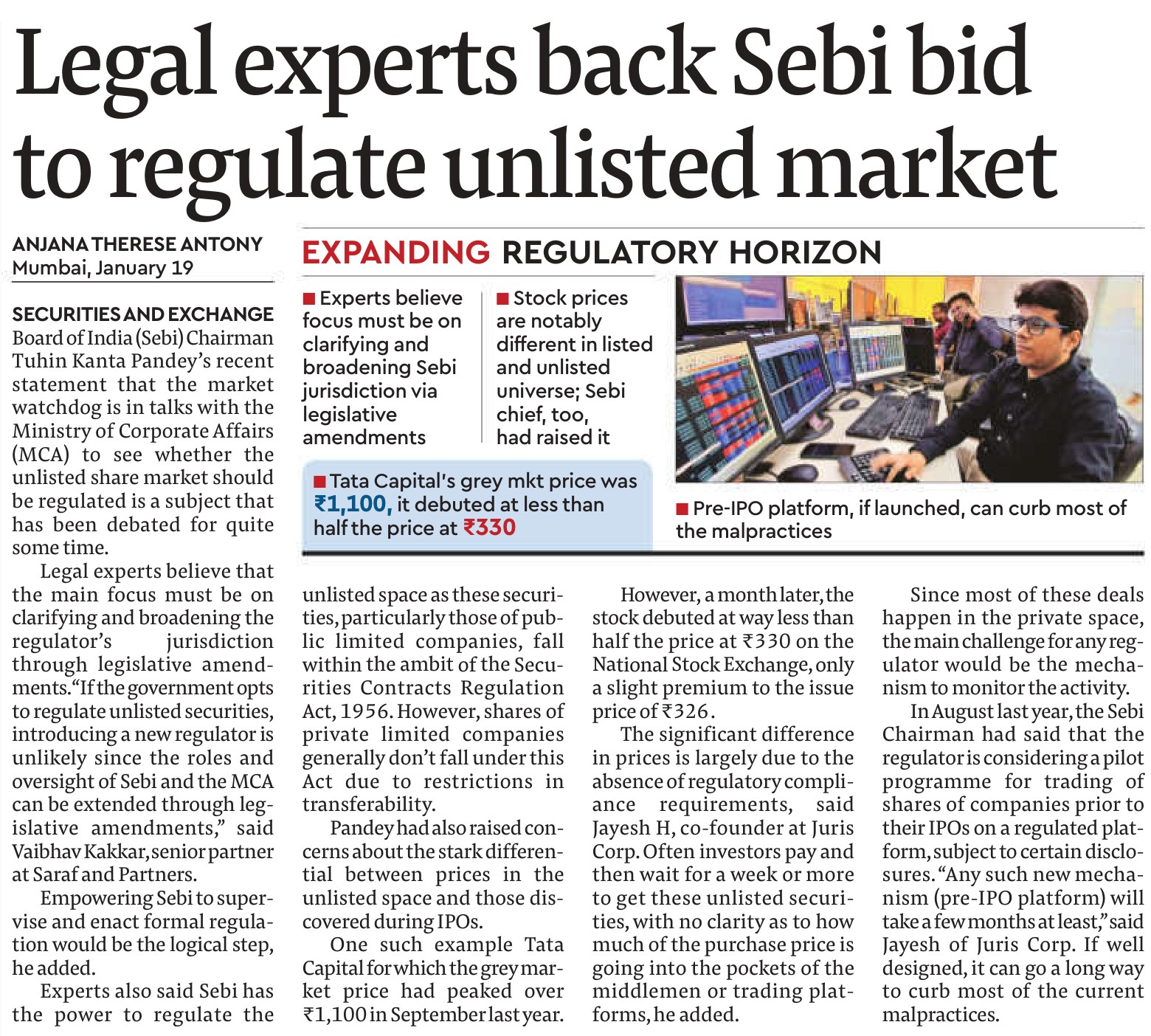
In August last year, the Sebi Chairman had said the regulator is considering a pilot programme for trading shares of companies prior to their IPOs on a regulated platform, subject to certain disclosures.
“Any such new mechanism (pre-IPO platform) will take a few months at least,” said Jayesh of Juris Corp. If well designed, it could significantly curb existing malpractices in the unlisted market.