
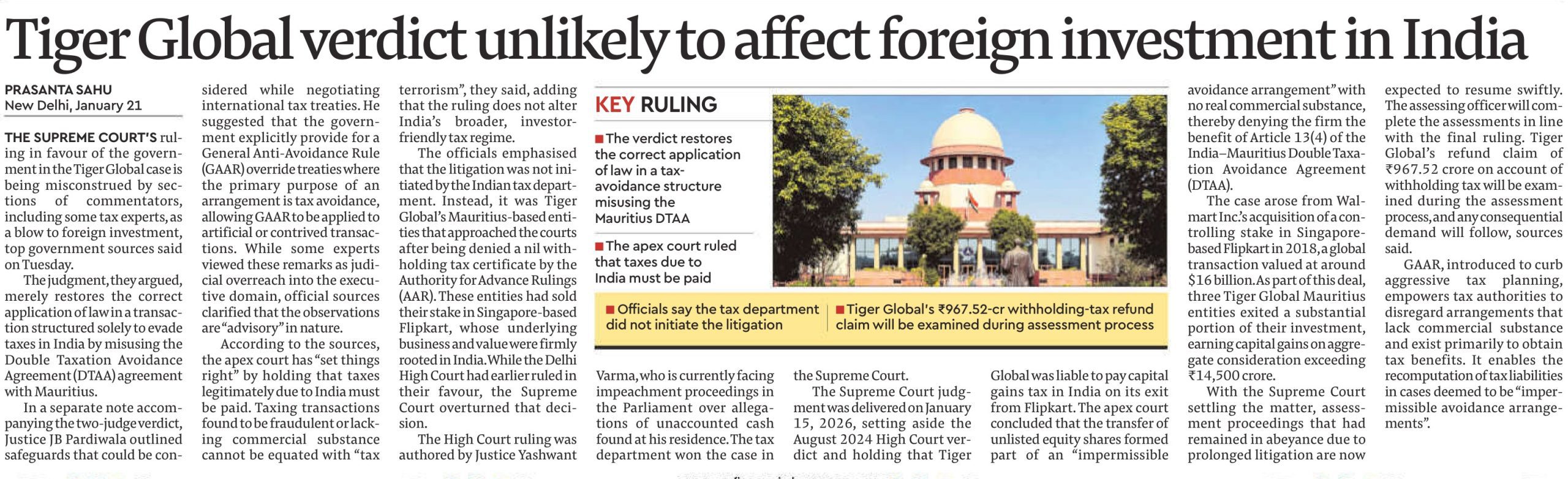
THE SUPREME COURT’S ruling in favour of the government in the Tiger Global case is being misconstrued by sections of commentators, including some tax experts, as a blow to foreign investment, top government sources said on Tuesday.
The judgment, they argued, merely restores the correct application of law in a transaction structured solely to evade taxes in India by misusing the Double Taxation Avoidance Agreement (DTAA) with Mauritius.
In a separate note accompanying the two-judge verdict, Justice JB Pardiwala outlined safeguards that could be considered while negotiating international tax treaties. He suggested that the government explicitly provide for a General Anti-Avoidance Rule (GAAR) override in treaties where the primary purpose of an arrangement is tax avoidance, allowing GAAR to be applied to artificial or contrived transactions. While some experts viewed these remarks as judicial overreach into the executive domain, official sources clarified that the observations are “advisory” in nature.
According to the sources, the apex court has “set things right” by holding that taxes legitimately due to India must be paid. Taxing transactions found to be fraudulent or lacking commercial substance cannot be equated with “tax terrorism”, they said, adding that the ruling does not alter India’s broader, investor-friendly tax regime.
The officials emphasised that the litigation was not initiated by the Indian tax department. Instead, it was Tiger Global’s Mauritius-based entities that approached the courts after being denied a nil withholding tax certificate by the Authority for Advance Rulings (AAR). These entities had sold their stake in Singapore-based Flipkart, whose underlying business and value were firmly rooted in India. While the Delhi High Court had earlier ruled in their favour, the Supreme Court overturned that decision.
The High Court ruling was authored by Justice Yashwant Varma, who is currently facing impeachment proceedings in Parliament over allegations of unaccounted cash found at his residence. The tax department won the case in the Supreme Court.
The Supreme Court judgment was delivered on January 15, 2026, setting aside the August 2024 High Court verdict and holding that Tiger Global was liable to pay capital gains tax in India on its exit from Flipkart. The apex court concluded that the transfer of unlisted equity shares formed part of an “impermissible avoidance arrangement” with no real commercial substance, thereby denying the firm the benefit of Article 13(4) of the India–Mauritius DTAA.
The case arose from Walmart Inc.’s acquisition of a controlling stake in Singapore-based Flipkart in 2018, a global transaction valued at around $16 billion. As part of this deal, three Tiger Global Mauritius entities exited a substantial portion of their investment, earning capital gains on aggregate consideration exceeding ₹14,500 crore.
With the Supreme Court settling the matter, assessment proceedings that had remained in abeyance are now expected to resume swiftly. The assessing officer will complete the assessments in line with the final ruling. Tiger Global’s refund claim of ₹967.52 crore on account of withholding tax will be examined during the assessment process, and any consequential demand will follow, sources said.
GAAR, introduced to curb aggressive tax planning, empowers tax authorities to disregard arrangements that lack commercial substance and exist primarily to obtain tax benefits. It enables the recomputation of tax liabilities in cases deemed to be “impermissible avoidance arrangements”.
About Us
At Rurash Financials, we track tax jurisprudence, regulatory clarity, and policy signals that influence investor confidence and capital flows.
For leadership insights and market perspectives, follow Ranjit Jha (CEO).