
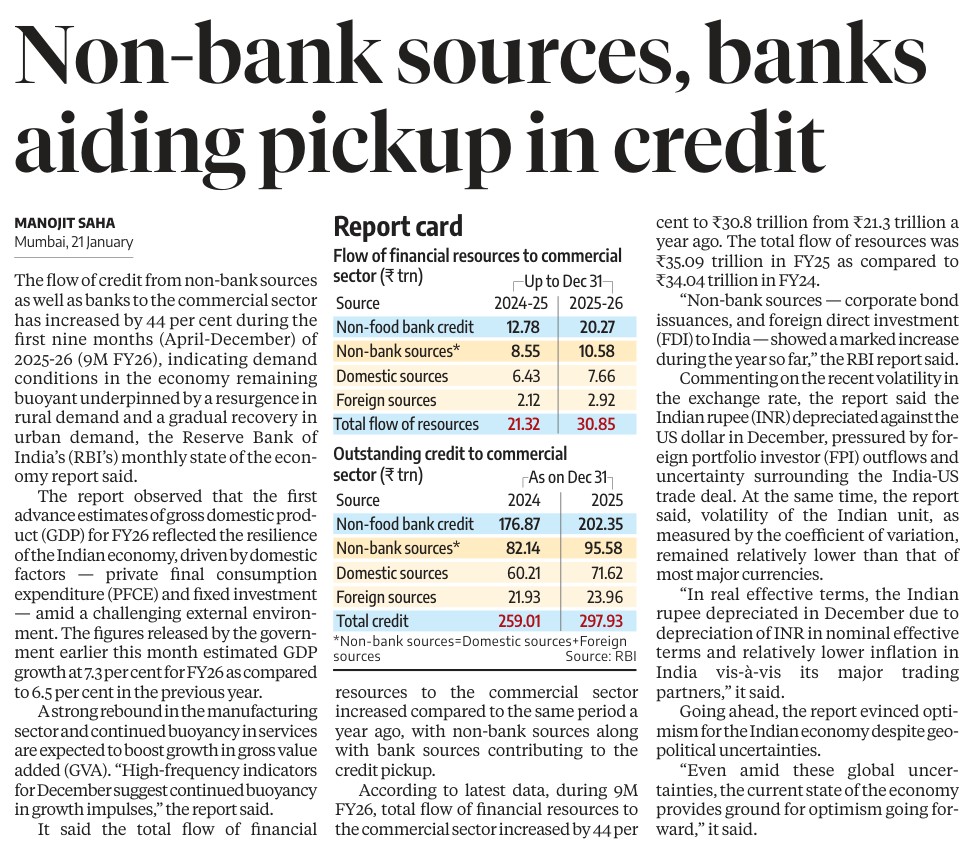
The flow of credit from non-bank sources as well as banks to the commercial sector has increased by 44 per cent during the first nine months (April–December) of 2025–26 (9M FY26), indicating demand conditions in the economy remaining buoyant, underpinned by a resurgence in rural demand and a gradual recovery in urban demand, the Reserve Bank of India’s (RBI’s) monthly state of the economy report said.
The report observed that the first advance estimates of gross domestic product (GDP) for FY26 reflected the resilience of the Indian economy, driven by domestic factors — private final consumption expenditure (PFCE) and fixed investment amid a challenging external environment. The figures released by the government earlier this month estimated GDP growth at 7.3 per cent for FY26, compared to 6.5 per cent in the previous year.
A strong rebound in the manufacturing sector and continued buoyancy in services are expected to boost growth in gross value added (GVA). “High-frequency indicators for December suggest continued buoyancy in growth impulses,” the report said.
It said the total flow of financial resources to the commercial sector increased compared to the same period a year ago, with non-bank sources along with bank sources contributing to the credit pickup.
According to latest data, during 9M FY26, total flow of financial resources to the commercial sector increased by 44 per cent to ₹30.8 trillion from ₹21.3 trillion a year ago. The total flow of resources was ₹35.09 trillion in FY25, as compared to ₹34.04 trillion in FY24.
“Non-bank sources corporate bond issuances and foreign direct investment (FDI) to India showed a marked increase during the year so far,” the RBI report said.
Commenting on the recent volatility in the exchange rate, the report said the Indian rupee (INR) depreciated against the US dollar in December, pressured by foreign portfolio investor (FPI) outflows and uncertainty surrounding the India–US trade deal. At the same time, the report said, volatility of the Indian unit, as measured by the coefficient of variation, remained relatively lower than that of most major currencies.
“In real effective terms, the Indian rupee depreciated in December due to depreciation of INR in nominal effective terms and relatively lower inflation in India vis-à-vis its major trading partners,” it said.
Going ahead, the report evinced optimism for the Indian economy despite geopolitical uncertainties.
“Even amid these global uncertainties, the current state of the economy provides ground for optimism going forward,” it said.
About Us
At Rurash Financials, we track macroeconomic signals, credit cycles, and capital flow trends to help investors and institutions understand structural growth drivers and long-term economic resilience.
For leadership insights and market perspectives, follow Ranjit Jha (CEO).