
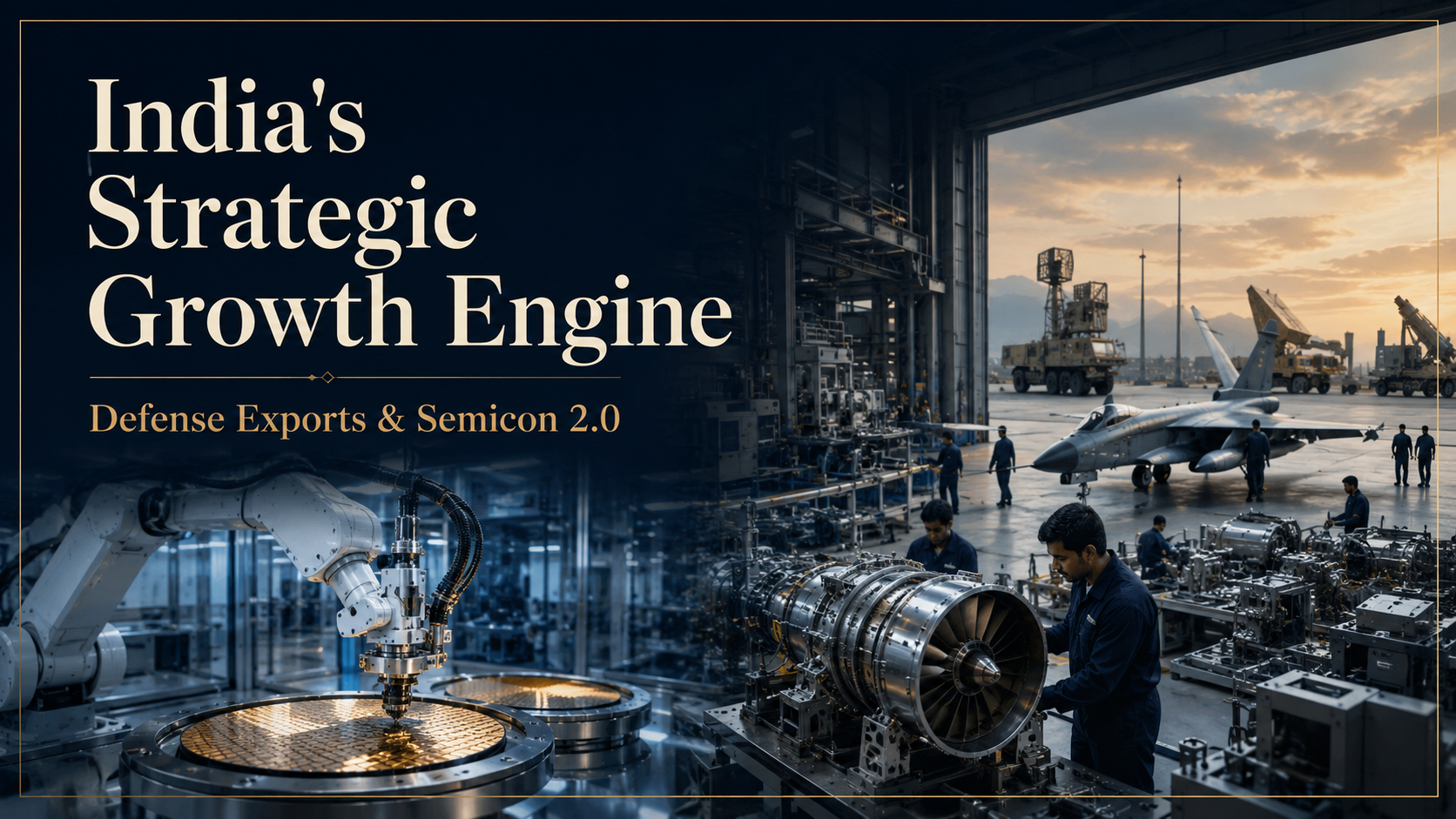
Defense Exports & “Semicon 2.0”: How India Is Building the Next Strategic Growth Engine
India’s economic transformation is increasingly being driven by strategic industries rather than traditional manufacturing alone.
Two sectors are emerging at the forefront of this shift—defense exports and the government’s Semicon 2.0 initiative. Together, they represent a long-term vision of technological self-reliance, advanced manufacturing, and global competitiveness.
For investors, these developments are more than policy announcements. They signal structural opportunities that could reshape India’s industrial landscape over the coming decade.
India’s Defense Export Story Is Accelerating
Over the past few years, India has significantly expanded its presence in the global defence market.
Government initiatives promoting indigenous manufacturing, higher defence spending, and export-oriented production have strengthened the domestic defence ecosystem.
The sector now spans:
Aerospace systems
Naval platforms
Defence electronics
Missile technologies
Drone manufacturing
Advanced engineering
Military communication systems
As India’s defence capabilities improve, export opportunities continue to expand across emerging and developed markets.
What Is Semicon 2.0?
Semicon 2.0 represents the next phase of India’s semiconductor and electronics manufacturing ambitions.
The initiative focuses on building a complete semiconductor ecosystem by encouraging investments across:
Semiconductor fabrication
Chip packaging and testing
Electronic components
Design and R&D
Supply chain development
Advanced manufacturing technologies
A stronger semiconductor ecosystem reduces import dependence while supporting industries ranging from automobiles and consumer electronics to defence and artificial intelligence.
Why These Themes Matter Together
Defense manufacturing and semiconductor development are increasingly interconnected.
Modern defence systems rely on sophisticated electronic components, AI-enabled technologies, sensors, and advanced chips.
By strengthening semiconductor capabilities, India also enhances its defence manufacturing competitiveness.
Together, these sectors create opportunities across:
High-value manufacturing
Technology innovation
Skilled employment
Export growth
Strategic self-reliance
What Investors Should Watch
While both themes offer long-term potential, investors should remain focused on business fundamentals.
Key considerations include:
Policy Execution
Government support provides direction, but implementation remains critical.
Technology Capability
Companies with strong R&D and technological expertise may be better positioned for sustained growth.
Order Visibility
Long-term contracts and diversified customer bases provide greater earnings visibility.
Capital Allocation
Manufacturing expansion often requires significant investment, making capital efficiency an important factor.
Valuation Discipline
Strong industry prospects should always be balanced against reasonable valuations.
Opportunities Beyond Listed Stocks
These structural themes extend beyond large listed companies.
Investors may also find opportunities through:
Electronics manufacturing companies
Semiconductor ecosystem suppliers
Defence component manufacturers
Industrial automation businesses
Advanced engineering firms
Selected alternative and pre-IPO investments
A diversified approach allows investors to participate across the broader value chain.
The Rurash Perspective
At Rurash Financials, we believe long-term wealth is often created by identifying structural trends before they become mainstream investment narratives.
Defense exports and Semicon 2.0 are not short-term market stories—they represent India’s broader transition toward technology-led industrial growth.
Rather than chasing momentum, investors should focus on businesses with sustainable competitive advantages, strong management, and long-term earnings potential.
Conclusion
India’s ambitions in defence manufacturing and semiconductor production reflect a broader economic transformation.
As the country strengthens its manufacturing capabilities, technological expertise, and export competitiveness, these sectors could become important drivers of future economic growth.
For investors, the opportunity lies not in reacting to headlines but in identifying quality businesses that can benefit from these long-term structural shifts.
Because the next generation of wealth creation may be built on innovation, strategic manufacturing, and disciplined investing.
Explore More Insights
To understand how emerging industries, strategic manufacturing, and disciplined portfolio construction shape long-term wealth creation, explore insights from Ranjit Jha.
Learn how Rurash Financials supports investors through:
Portfolio Engineering
Alternative Investments
Unlisted Equity Opportunities
Personalised Wealth Strategies
Wealth Preservation & Succession Planning
Call to Action
India’s manufacturing and technology landscape is evolving rapidly.
At Rurash Financials, we help investors identify long-term structural opportunities through research-driven portfolio construction and disciplined wealth management.
Connect with Rurash Financials to build a diversified portfolio positioned to benefit from India’s next phase of industrial and technological growth.