
BSE’s Recent Downgrades: What Investors Can Learn When Market Structure Changes
BSE Ltd., one of India’s most prominent capital-market institutions, has recently found itself under pressure on Dalal Street.
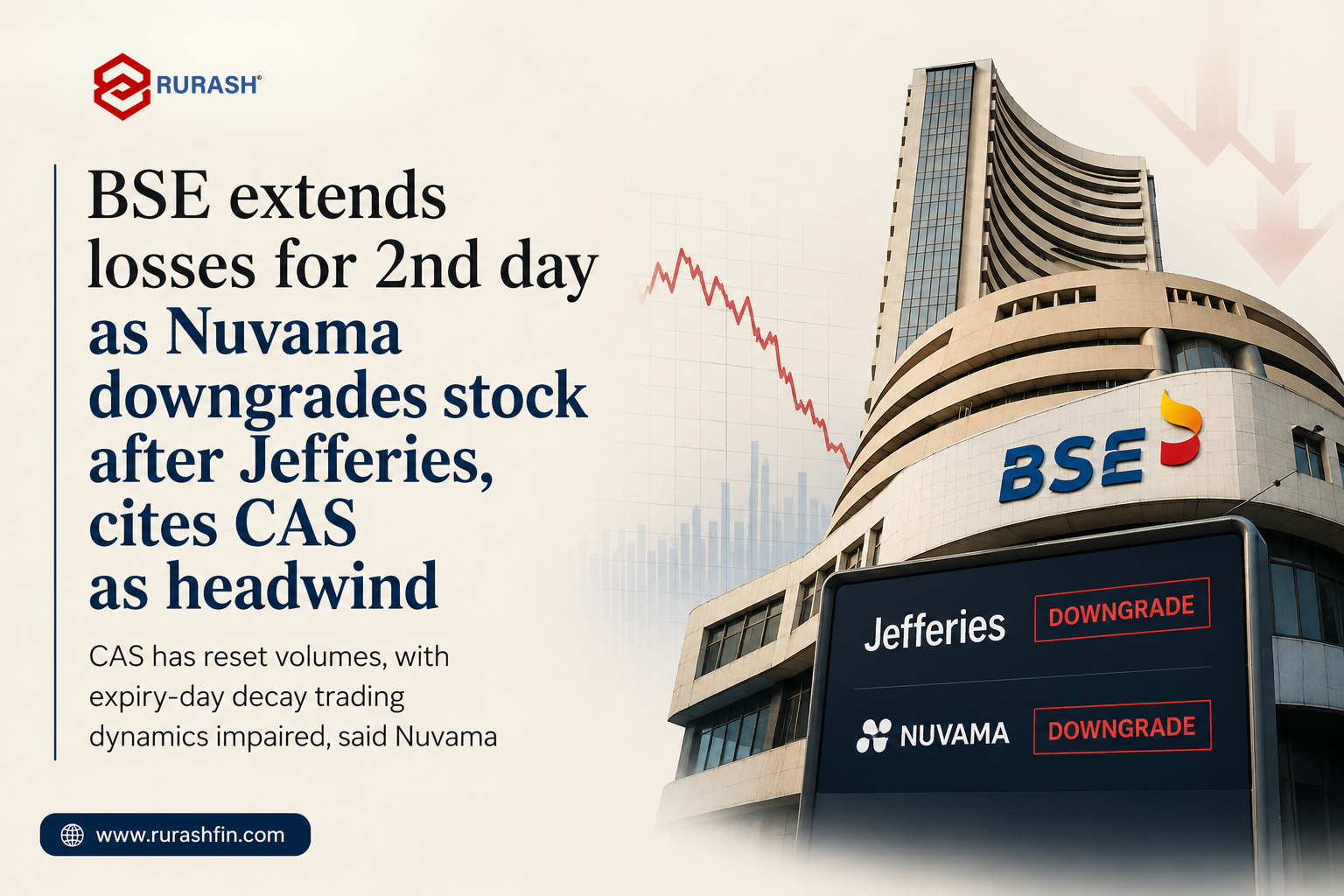
The stock faced back-to-back rating downgrades from Jefferies and Nuvama Institutional Equities, with brokerages raising concerns around derivatives trading volumes, regulatory changes, market-share potential and the sustainability of earnings growth.
For investors, however, the bigger story is not simply whether BSE shares rise or fall from here.
The development offers a useful lesson in how quickly the investment thesis of even a high-quality business can change when the structure of the industry around it changes.
What Has Changed for BSE?
Nuvama downgraded BSE from Buy to Hold and reduced its target price from ₹4,090 to ₹3,240. The brokerage also lowered its FY27 and FY28 earnings-per-share estimates by 6.3% and 15%, respectively.
The downgrade came shortly after Jefferies moved BSE from Hold to Underperform, cutting its target price from ₹3,520 to ₹2,940. Jefferies also reduced its FY27–FY29 earnings estimates.
The concerns broadly centre around three areas:
1. Changes in Derivatives Trading Behaviour
A significant part of an exchange’s economics depends on trading activity.
According to Nuvama, changes surrounding CAS and expiry-day trading dynamics have affected options volumes and altered some of the trading strategies traditionally used around expiry. BSE’s average daily premium traded volume had fallen to its lowest level since January 2025, according to the brokerage.
The interesting point for investors is that a business may not lose customers in the conventional sense yet changes in trading behavior can still influence its revenue trajectory.
For an exchange, the number of transactions, contract activity and trading intensity can matter as much as the number of participants.
2. Regulatory Changes Can Alter Business Economics
Financial-market businesses operate inside a highly regulated ecosystem.
Changes involving transaction structures, collateral requirements, bank guarantees or trading mechanisms can influence how brokers, proprietary traders and institutional participants deploy capital.
Nuvama highlighted tighter bank-guarantee norms as another potential headwind, arguing that higher collateral requirements could increase capital intensity for intermediaries and reduce turnover efficiency for certain high-frequency strategies.
Jefferies similarly highlighted risks arising from securities transaction tax changes, bank-guarantee requirements and changes affecting derivatives trading.
This illustrates an important investing principle:
Regulation is not merely a compliance issue. In financial businesses, regulation can directly influence volumes, margins, capital efficiency and ultimately valuations.
3. Market-Share Growth Cannot Continue Forever
BSE has strengthened its position considerably in derivatives over the past few years.
But once market share reaches meaningful levels, maintaining growth becomes more difficult.
Nuvama noted that BSE’s contract market share was already around 52%, while its share of average daily premium traded volume was about 36%. The brokerage therefore sees increasingly limited room for further market-share expansion to drive earnings at the same pace as before.
This brings investors to a common mistake in evaluating rapidly growing companies:
Extrapolating recent growth indefinitely.
A company may successfully gain market share for several years. But eventually, the investment question changes from:
“How quickly can it gain share?”
to:
“How effectively can it monetise and defend the share it already has?”
Those are very different questions.
A Good Business and a Good Investment Are Not Always the Same Thing
BSE remains an important component of India’s capital-market infrastructure.
But investing is not simply about identifying strong companies.
An investor must consider:
- Business quality
- Earnings visibility
- Industry structure
- Regulatory risk
- Competitive positioning
- Valuation
- Expectations already reflected in the stock price
A fundamentally strong business can still produce disappointing investment returns if the market has already priced in extremely optimistic growth expectations.
Similarly, a short-term decline does not automatically mean that the long-term business has deteriorated.
The challenge is distinguishing between temporary volatility and a genuine change in the earnings trajectory.
What Should Investors Learn From the BSE Episode?
The recent developments around BSE offer broader lessons that apply well beyond one company.
Don’t Evaluate Growth in Isolation
Rapid revenue or profit growth looks attractive, but investors should understand what is driving it.
Is growth coming from:
new customers?
higher market share?
pricing power?
temporary trading activity?
regulatory advantages?
industry-wide expansion?
Understanding the source of growth helps determine how sustainable that growth may be.
Regulatory Risk Deserves a Place in Fundamental Analysis
For businesses operating in banking, insurance, exchanges, broking, asset management and other regulated sectors, policy developments can materially change economics.
Investors therefore need to evaluate not only financial statements but also the ecosystem in which those financial statements are generated.
Market Expectations Matter
Stock prices often reflect expectations about the future rather than simply today’s earnings.
If investors are already expecting years of rapid growth, even strong reported numbers may not be sufficient to support valuations if future expectations begin to moderate.
This is why valuation should always be viewed alongside earnings assumptions.
Portfolio Construction Matters More Than Predicting One Stock
The reaction to BSE also highlights why a portfolio should not depend excessively on a single company, theme or market narrative.
Individual businesses can face unexpected changes arising from regulation, competition, technology, liquidity or market structure.
Diversification cannot remove investment risk, but thoughtful asset allocation can reduce the impact of any single investment thesis going wrong.
For long-term investors, the more useful question may therefore not be:
“Will BSE go up or down tomorrow?”
It may be:
“Would my portfolio remain resilient if one of my strongest investment assumptions suddenly changed?”
That is ultimately a far more important question for wealth creation.
The Rurash Perspective
Markets constantly evolve.
Sometimes the change comes from interest rates. Sometimes from regulation. Sometimes from technology, competition or investor behaviour.
The strongest portfolios are therefore not built merely around yesterday’s winners. They are built around research, valuation discipline, diversification and continuous review of the assumptions behind every investment.
At Rurash Financials, we believe investment decisions should begin with understanding the investor’s objectives, risk profile and overall portfolio—not with reacting to a single stock-market headline.
Because in investing, identifying a strong opportunity matters.
Understanding what could change the thesis matters even more.
Review Your Portfolio With Rurash
Explore research-led investment solutions across Mutual Funds, PMS, AIFs, Fixed Income, Unlisted Equity and other wealth-management solutions.
Talk to the Rurash team to review whether your portfolio remains aligned with your long-term objectives.
Disclaimer: This article is intended solely for educational and informational purposes and should not be construed as investment advice or a recommendation to buy, sell or hold any security. Market investments are subject to risks. Investors should assess their objectives and risk profile and consult an appropriate professional before making investment decisions.