
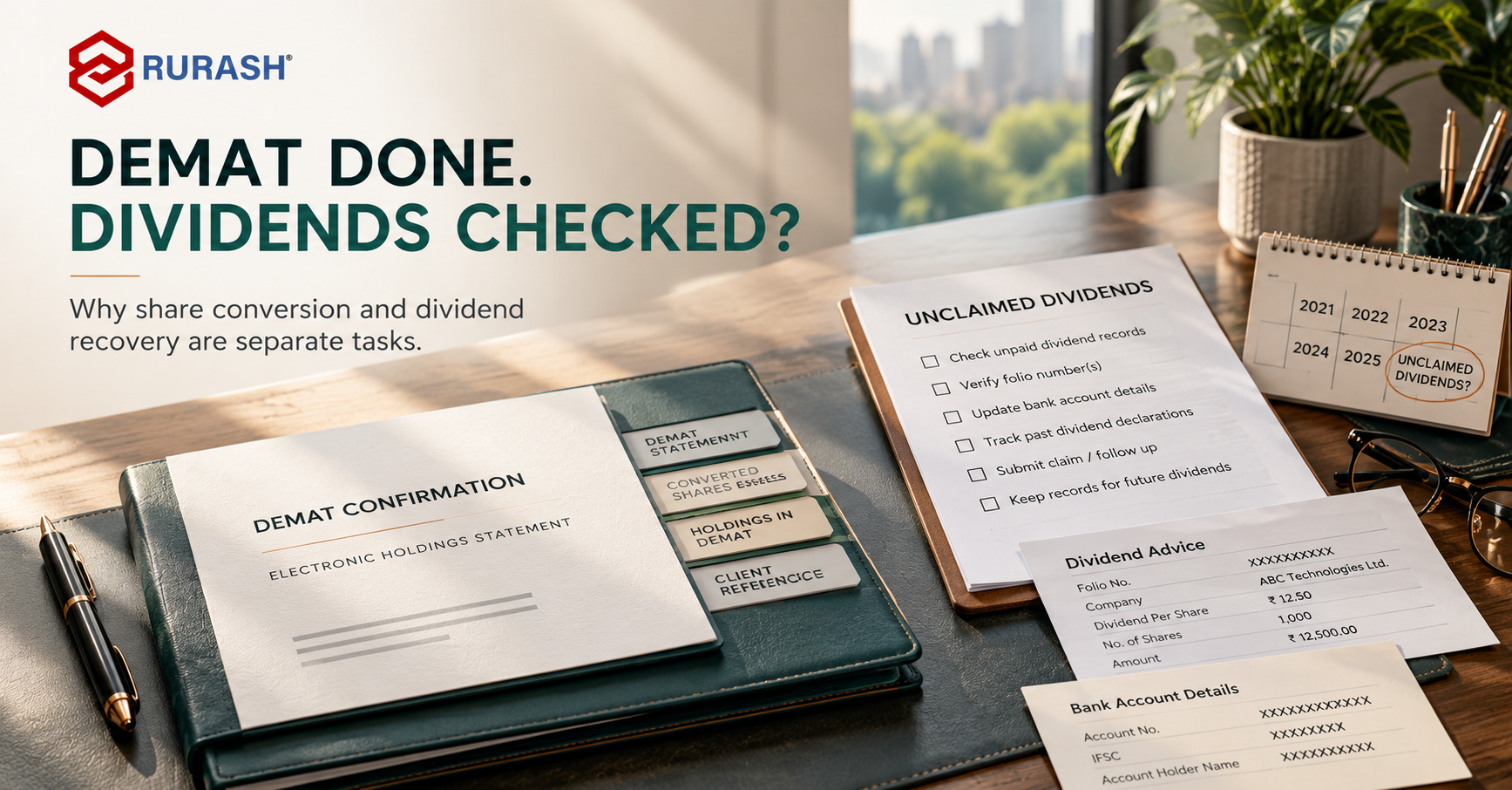
Hero insight: Demat done. Dividends checked?
For many Indian families, physical share certificates represent investments made years or even decades ago.
These certificates may have been purchased by parents, grandparents or family members who believed in holding shares for the long term.
Today, investors are increasingly converting old physical share certificates into electronic holdings through dematerialisation.
Completing this process is an important step in making shareholdings easier to manage.
But there is another question investors should consider.
If your physical shares have been successfully converted into demat form, what happened to the dividends declared over the years?
Some shareholders may discover that previous dividends were never credited, old dividend warrants were not encashed or banking details were never updated.
Dematerialisation and recovery of unclaimed dividends are related to the same investment, but they are separate processes.
Understanding this distinction can help investors review their financial records more thoroughly.
What Is the Difference Between Dematerialisation and Dividend Recovery?
Dematerialisation is the process of converting eligible physical securities into electronic form and crediting them to an investor’s demat account.
Once completed, the shares appear in electronic holdings records maintained through the depository system.
Dividend recovery addresses a different issue.
It involves identifying dividends declared by a company that were payable to an eligible shareholder but were not successfully received or claimed.
These amounts may remain with the company in its unpaid dividend arrangements or may have been transferred to the Investor Education and Protection Fund (IEPF), depending on the applicable statutory period.
A successful demat conversion does not automatically establish that all historical dividends have been received.
An investor should therefore review both the shareholding position and the dividend-payment history.
Why Can Dividends Remain Unclaimed?
There are several reasons why an investor may not have received a dividend.
1. Outdated Bank Account Details
An investor may have held physical shares when dividends were paid through cheques or warrants.
The bank account linked to the original shareholding may subsequently have been closed or changed.
If current payment details were not recorded correctly, a dividend payment could remain unsuccessful.
2. Change of Residential Address
Investors sometimes move homes without updating the company or its Registrar and Transfer Agent (RTA).
Older dividend warrants and shareholder communications may have been sent to a previous address.
As a result, the investor may not even be aware that a payment was attempted.
3. Old or Unencashed Dividend Warrants
Before electronic payments became widespread, companies commonly issued dividend warrants.
Some shareholders may have received these instruments but never deposited them.
An expired warrant does not necessarily mean that the investor’s underlying entitlement has disappeared, but the recovery route depends on the current status of the amount.
4. Incomplete or Mismatched Shareholder Records
Differences in names, signatures, PAN information, joint-holder details or other records may create difficulties in processing certain service requests.
Updating shareholder information through the appropriate company, RTA and depository channels can help resolve discrepancies.
5. Shares Inherited From a Family Member
Families may discover physical certificates belonging to a deceased shareholder without having complete dividend records.
The legal heir or claimant may need to establish entitlement, complete applicable transmission formalities and identify whether dividends remain unpaid.
In such cases, dematerialisation, transmission and dividend recovery may involve different documentation.
What Happens to Unclaimed Dividends After Seven Years?
Under Section 124 of the Companies Act, 2013, unpaid or unclaimed dividends remaining in the company’s unpaid dividend account for the prescribed seven-year period are required to be transferred to the Investor Education and Protection Fund.
There is also a separate provision concerning shares where dividends have not been paid or claimed for seven consecutive years or more.
Subject to the applicable conditions and exceptions, such shares may also be transferred to the IEPF Authority.
It is important not to confuse these two rules.
An individual unpaid dividend amount becoming transferable to IEPF does not automatically mean that the corresponding shares must also be transferred at the same time.
The shares-transfer test involves the applicable consecutive-year conditions.
Investors should verify the status of the dividends and the underlying shares separately.
How Can Investors Check Whether Dividends Are Unclaimed?
The process begins with identifying the company and tracing the relevant shareholding.
Step 1: Verify Your Demat Holdings
Check whether the dematerialised shares appear in your demat account statement.
Review the company name, security identifier, number of shares and relevant transaction records.
Keep the dematerialisation confirmation or transaction statement available where possible.
Step 2: Locate the Original Folio Details
Old physical share certificates generally carried a folio number and other shareholder information.
These details may help the company or RTA locate historical records.
Even after dematerialisation, older folio references can be useful when reconciling payments from earlier years.
Step 3: Review the Company’s Investor Relations Section
Many listed companies publish information about unpaid dividends, IEPF transfers and shareholder service procedures.
Look for sections such as Unclaimed Dividend, IEPF, Investor Services or Shareholder Information.
The company may provide financial-year-wise lists, search facilities or contact details for its RTA.
Step 4: Contact the Registrar and Transfer Agent
The RTA can help identify the relevant unpaid-dividend status and applicable documentation.
Provide accurate identifying details and request confirmation of whether amounts remain with the company or have already been transferred to IEPF.
Avoid sending sensitive documents to unverified contacts.
Step 5: Check the IEPF Records Where Applicable
If the dividend or shares have been transferred to IEPF, the investor should use the official IEPF claim process.
Government initiatives also provide facilities to trace unclaimed financial assets and understand the applicable recovery route.
Which Documents Should Investors Keep Ready?
The precise requirements vary according to the claim type, company records and the status of the shareholder.
The following checklist provides a useful starting point.
|
Document or detail |
Why it matters |
|---|---|
|
Original folio number |
Helps locate historical physical share records |
|
Company name |
Identifies the dividend-paying company |
|
Old share certificate details |
Supports historical ownership verification |
|
Demat account statement |
Confirms current electronic holdings |
|
PAN and KYC details |
Supports shareholder identity verification |
|
Bank account details |
Helps verify the destination for payments |
|
Dividend warrants or correspondence |
May help trace unpaid amounts |
|
Historical transaction statements |
Helps reconcile holdings and corporate actions |
|
Transmission or legal-heir documents |
May be necessary for inherited investments |
|
RTA correspondence |
Records previous claims, requests and responses |
The list is indicative. Investors should follow the current documentation requirements communicated by the company, RTA or IEPF Authority.
What If the Dividend Is Still With the Company?
Where the unpaid dividend remains with the company, investors should contact the company or its RTA and complete the required KYC and bank-mandate procedures.
SEBI’s investor-service FAQ explains that, for applicable physical-security folios, RTAs are expected to proactively release outstanding unpaid amounts through electronic mode after complete bank details have been updated, rather than requiring separate requests for every individual unpaid payment.
Investors should nevertheless confirm the historical unpaid amounts and verify the actual credits received.
The practical objective is to reconcile each outstanding dividend with the corresponding payment or claim status.
What If the Dividend Has Already Been Transferred to IEPF?
Where an amount has been transferred to IEPF, it generally cannot be recovered through the company’s ordinary unpaid-dividend payment process.
The eligible claimant must follow the prescribed IEPF recovery procedure.
This commonly involves submitting an online claim using Form IEPF-5, providing the relevant supporting information and completing company verification requirements.
The official Ministry of Corporate Affairs instructions explain the information and attachments that may be required for different types of IEPF claims.
Where shares have also been transferred, the claim must address those securities and comply with the applicable demat-account and entitlement requirements.
Investors should use the official portal and the current instructions rather than relying on outdated forms or unverified third-party guidance.
Can Old Dividends Be Claimed After Dematerialisation?
Yes, dematerialisation does not, by itself, prevent an entitled investor from pursuing historical unpaid dividends.
However, converting shares into demat form does not automatically settle older unpaid amounts.
The process depends on whether the dividend remains with the company or has been transferred to IEPF.
For example, consider an investor who purchased physical shares many years ago.
The investor completes dematerialisation in 2026 and successfully receives the shares in a demat account.
During a subsequent review, the investor discovers that dividends declared in earlier financial years were never received.
The appropriate next step is to check each dividend’s status with the company or RTA.
Some amounts may still be payable through the company’s process, while older amounts may require an IEPF claim.
Demat completion confirms a securities-conversion milestone. Dividend recovery requires its own record verification.
What About Shares Already Transferred to IEPF?
This is an important distinction for holders of older securities.
If the shares themselves were transferred to the IEPF Authority under the applicable provisions, an ordinary dematerialisation request will not replace the required recovery process.
The investor or eligible claimant must establish entitlement and pursue recovery through the relevant IEPF procedure.
Before assuming that old shares are available for direct dematerialisation, verify whether the company or RTA still records them under the shareholder’s folio or whether they have been transferred.
This can prevent unnecessary documentation and processing delays.
A Practical Illustration: Shares Received, Dividends Missing
Consider an investor who held 1,000 physical shares of a listed company and later converted them successfully into demat form.
Assume the company declared dividends during several earlier financial years.
The investor may have received some dividends, missed others because of outdated bank details and left certain dividend warrants unencashed.
The demat statement now confirms ownership of 1,000 electronic shares.
However, it does not establish which historical dividends were paid.
The investor should separately review the company’s dividend declarations, record dates, entitlement history, payment records and any IEPF transfers.
The amount recoverable depends on actual entitlement and the status of each unpaid dividend.
This illustration shows why a demat statement should not be treated as a complete historical dividend-reconciliation report.
Five Checks After Converting Physical Shares Into Demat
-
Confirm the shares: Verify the security name, ISIN and number of shares credited.
-
Check historical dividends: Review relevant company dividend declarations and payment records.
-
Update contact and bank information: Ensure current details are recorded through the appropriate account and shareholder-service channels.
-
Investigate unpaid amounts: Contact the company or RTA and confirm whether any dividends have moved to IEPF.
-
Keep an organised record: Preserve demat confirmations, folio references, claim acknowledgements and bank-credit information.
A careful review can help investors identify unresolved shareholder entitlements rather than assuming everything is complete after the securities appear in electronic form.
Why This Matters for Family Wealth and Legacy Investments
Older physical shares are often associated with long-term family investments.
These holdings may have passed through corporate restructurings, share splits, bonus issues, changes of company names or family succession events.
Historical dividend records can be difficult to reconstruct when financial documents have not been maintained consistently.
For families reviewing legacy investments, it is useful to examine ownership, electronic conversion, dividend history, corporate actions and transmission requirements as separate but connected tasks.
A structured process can reduce confusion and help eligible shareholders identify the appropriate next step.
Ranjit Jha’s Perspective — Draft for Approval
Proposed editorial perspective for Ranjit M. Jha, MD & CEO, Rurash. Approval required before attribution.
The conversion of physical shares into demat form is an important step in modernising investment records.
However, investors should remember that the completion of dematerialisation does not automatically confirm the settlement of every historical shareholder entitlement.
Unclaimed dividends, outdated banking information and legacy folio records may still require separate attention.
A thorough review of older investments should consider both the securities held and the financial benefits associated with those holdings.
The objective is to help investors move from incomplete historical records towards greater clarity and better-organised financial ownership.
Explore More with Rurash
At Rurash Financials, we understand that physical share certificates can represent years of investment history and family wealth.
Our Physical to Demat (P2D) service helps investors explore the process of converting eligible physical share certificates into electronic holdings.
Investors reviewing older shareholdings should also examine unpaid dividends, company records, potential IEPF transfers and applicable shareholder-service requirements.
Where dividend or IEPF recovery is involved, the appropriate procedures must be followed with the company, RTA and relevant authorities.
Your shares may be in demat. Make sure your dividend records have also been checked.
Connect with Rurash Financials to discuss your Physical to Demat requirements and legacy shareholding concerns.