
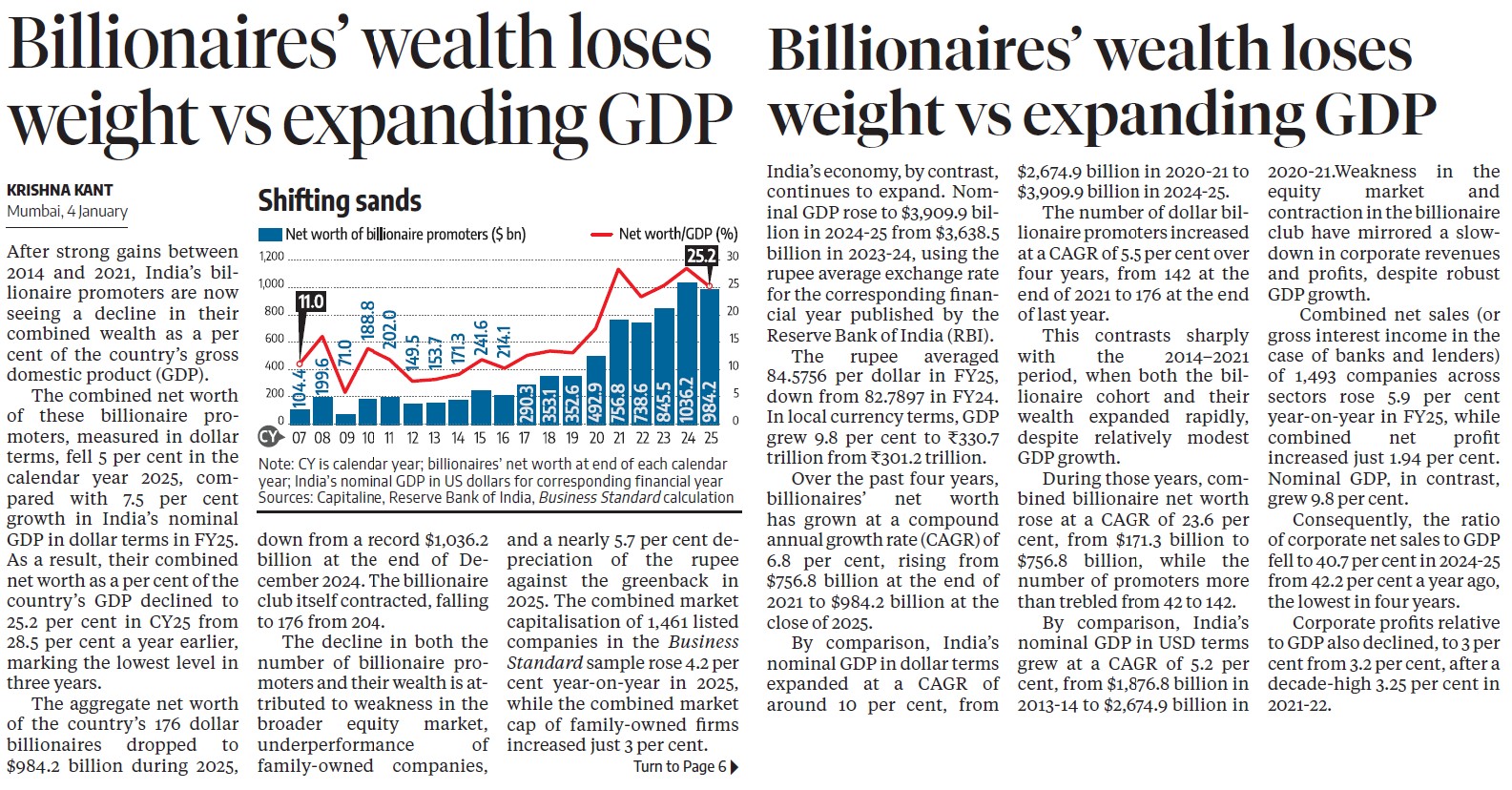
After strong gains between 2014 and 2021, India’s billionaire promoters are now witnessing a relative decline in wealth when measured as a percentage of the country’s gross domestic product (GDP). The combined net worth of these billionaire promoters, calculated in dollar terms, declined 5 per cent in calendar year 2025, even as India’s nominal GDP expanded 7.5 per cent in dollar terms during FY25.
As a result, the combined net worth of billionaire promoters as a share of GDP fell to 25.2 per cent in CY25, down from 28.5 per cent a year earlier, marking the lowest level in three years. The aggregate net worth of the country’s 176 dollar billionaires dropped to $984.2 billion during 2025, compared with a record $1,036.2 billion at the end of December 2024. The billionaire club itself contracted sharply, shrinking to 176 from 204 in just one year.
The decline in both the number of billionaire promoters and their cumulative wealth reflects a combination of macro and market-specific pressures. These include weakness in the broader equity market, underperformance of family-owned listed companies, and a nearly 5.7 per cent depreciation of the rupee against the US dollar in 2025. While the combined market capitalisation of 1,461 listed companies in the Business Standard sample rose 4.2 per cent year-on-year, the market cap of family-owned firms increased by only 3 per cent, underscoring relative underperformance.
India’s economic expansion, however, continues to remain resilient. Nominal GDP rose to $3,909.9 billion in FY25, up from $3,638.5 billion in FY24, based on the average exchange rate published by the Reserve Bank of India (RBI). The rupee averaged 84.5756 per dollar in FY25, compared with 82.7897 in FY24. In local currency terms, GDP grew 9.8 per cent, rising to ₹330.7 trillion from ₹301.2 trillion.
Over the past four years, billionaire promoters’ combined net worth grew at a compound annual growth rate (CAGR) of 6.8 per cent, increasing from $756.8 billion at the end of 2021 to $984.2 billion by end-2025. In comparison, India’s nominal GDP in dollar terms expanded at a CAGR of around 10 per cent, growing from $2,674.9 billion in FY21 to $3,909.9 billion in FY25. The number of billionaire promoters rose at a CAGR of 5.5 per cent, from 142 in 2021 to 176 in 2025.
This trend marks a sharp contrast with the 2014–2021 period, when promoter wealth and billionaire counts surged at an unprecedented pace. During those years, combined billionaire net worth grew at a CAGR of 23.6 per cent, rising from $171.3 billion to $756.8 billion, while the number of billionaire promoters more than tripled from 42 to 142. In comparison, India’s nominal GDP in USD terms grew at a CAGR of 5.2 per cent, from $1,876.8 billion in FY14 to $2,674.9 billion in FY21.
The recent contraction in billionaire wealth mirrors a broader slowdown in corporate performance, despite strong headline GDP growth. The combined net sales (or gross interest income for banks and lenders) of 1,493 companies across sectors rose 5.9 per cent year-on-year in FY25, while combined net profits increased just 1.94 per cent. This lagged well behind nominal GDP growth of 9.8 per cent.
Consequently, the linkage between corporate earnings and economic growth has weakened. The ratio of corporate net sales to GDP declined to 40.7 per cent in FY25, from 42.2 per cent a year earlier, marking the lowest level in four years. Similarly, corporate profits as a share of GDP fell to 3 per cent, down from 3.2 per cent, after touching a decade-high of 3.25 per cent in FY22.
In essence, while India’s macroeconomic engine remains robust, the wealth creation cycle for promoter-led businesses has slowed, driven by market corrections, currency pressures, and softer corporate profitability. This divergence highlights a structural shift where economic growth is no longer translating proportionately into promoter wealth, unlike the earlier decade-long expansion phase.