
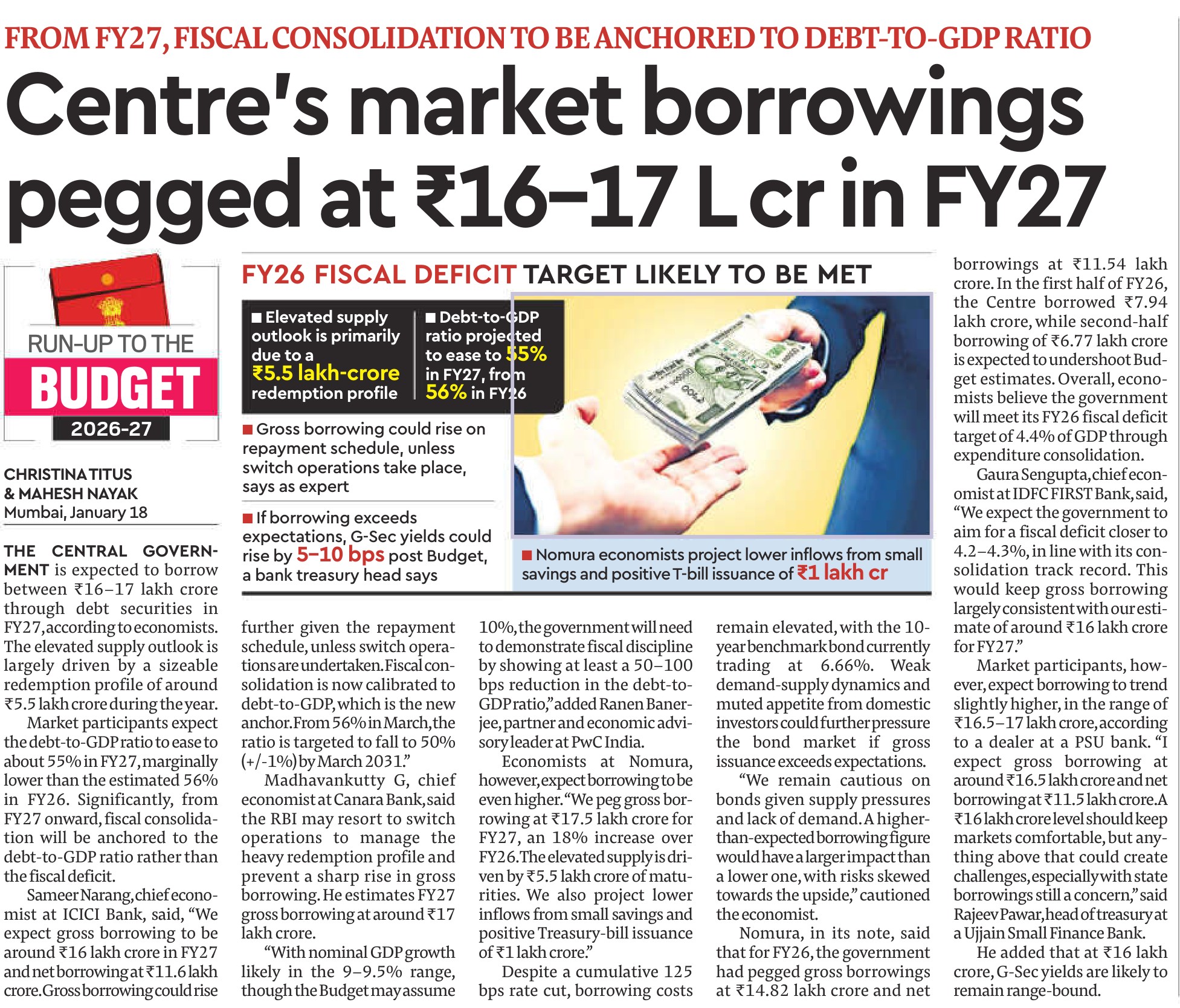
The Central Government is expected to borrow between ₹16–17 lakh crore through debt securities in FY27, according to economists. The elevated supply outlook is largely driven by a sizeable redemption profile of around ₹5.5 lakh crore during the year.
Market participants expect the debt-to-GDP ratio to ease to about 55% in FY27, marginally lower than the estimated 56% in FY26. Significantly, from FY27 onward, fiscal consolidation will be anchored to the debt-to-GDP ratio rather than the fiscal deficit, marking a structural shift in fiscal strategy.
Sameer Narang, chief economist at ICICI Bank, outlined the borrowing trajectory and the new fiscal anchor. He said, “We expect gross borrowing to be around ₹16 lakh crore in FY27 and net borrowing at ₹11.6 lakh crore. Gross borrowing could rise further given the repayment schedule, unless switch operations are undertaken.” He added that fiscal consolidation is now calibrated to debt-to-GDP, with the ratio targeted to fall from 56% to 50% (+/-1%) by March 2031.
Madhavankutty G, chief economist at Canara Bank, said the RBI may resort to switch operations to manage the heavy redemption profile and prevent a sharp rise in gross borrowing. He estimates FY27 gross borrowing at around ₹17 lakh crore.
Growth assumptions and fiscal discipline will be critical to sustaining the consolidation path. Ranen Banerjee, partner and economic advisory leader at PwC India, noted that with nominal GDP growth likely in the 9–9.5% range, the government would need to demonstrate at least a 50–100 bps reduction in the debt-to-GDP ratio to reinforce fiscal credibility.
Economists at Nomura, however, expect borrowing to be even higher. “We peg gross borrowing at ₹17.5 lakh crore for FY27, an 18% increase over FY26,” they said, citing ₹5.5 lakh crore of maturities, lower inflows from small savings, and positive Treasury-bill issuance of ₹1 lakh crore as key drivers.
Despite a cumulative 125 bps rate cut, borrowing costs remain elevated, with the 10-year benchmark bond trading around 6.66%. Weak demand-supply dynamics and muted appetite from domestic investors could further pressure the bond market if gross issuance exceeds expectations.
Bond market risks appear skewed to the upside. “We remain cautious on bonds given supply pressures and lack of demand. A higher-than-expected borrowing figure would have a larger impact than a lower one,” the economist cautioned.
Nomura also noted that for FY26, the government had pegged gross borrowings at ₹14.82 lakh crore and net borrowings at ₹11.54 lakh crore. In the first half of FY26, the Centre borrowed ₹7.94 lakh crore, while second-half borrowing of ₹6.77 lakh crore is expected to undershoot Budget estimates. Overall, economists believe the government will meet its FY26 fiscal deficit target of 4.4% of GDP through expenditure consolidation.
Gaura Sengupta, chief economist at IDFC FIRST Bank, said, “We expect the government to aim for a fiscal deficit closer to 4.2–4.3%, in line with its consolidation track record.” This would keep gross borrowing largely consistent at around ₹16 lakh crore for FY27.
Market participants, however, expect borrowing to trend slightly higher, in the range of ₹16.5–17 lakh crore, according to a dealer at a PSU bank. Rajeev Pawar, head of treasury at a Ujjain Small Finance Bank, said, “A ₹16 lakh crore level should keep markets comfortable, but anything above that could create challenges, especially with state borrowings still a concern.” He added that at ₹16 lakh crore, G-Sec yields are likely to remain range-bound.
Insights curated by Ranjit Jha (CEO) | Research perspectives from Rurash Financials