
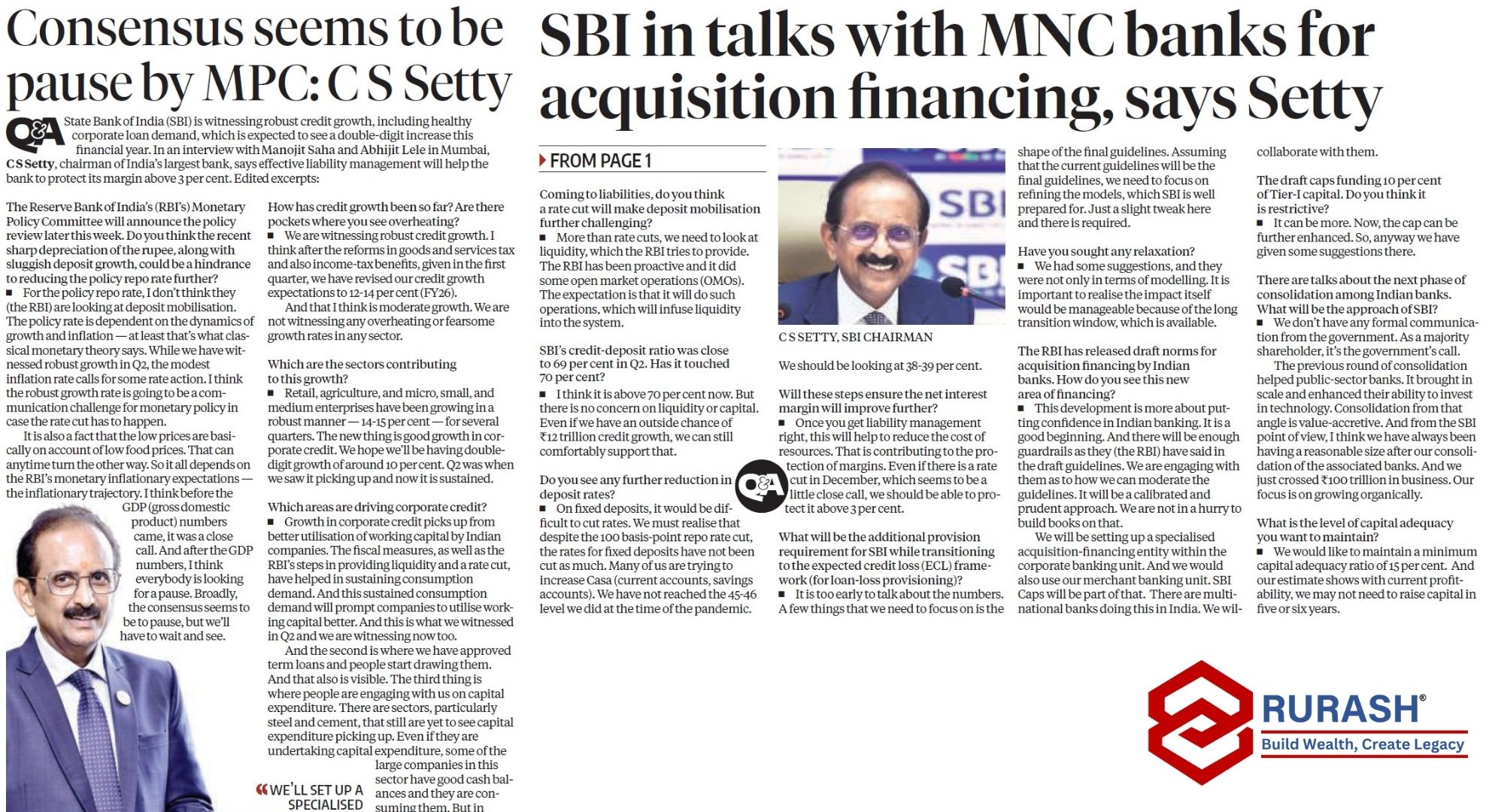
MPC Rate Decision: Consensus Leans Toward a Pause, Says SBI Chairman C. S. Setty
State Bank of India (SBI), India’s largest lender, continues to witness robust credit momentum, driven by strong retail demand, improving corporate utilization, and supportive policy measures. Speaking ahead of the RBI’s Monetary Policy Committee (MPC) announcement, Chairman C. S. Setty shared insights on interest rates, credit trends, liquidity, and the bank’s expansion strategy in a detailed interview.
Below are the key takeaways.
MPC Rate Decision: Market Expects a Pause
Despite the rupee’s recent depreciation and sluggish deposit growth, Setty believes these factors won’t directly impact the policy repo rate, which is primarily driven by growth and inflation dynamics.
Why a Pause Is Likely:
India delivered strong Q2 GDP growth, boosting confidence.
Inflation remains moderate, largely due to low food prices—but that can reverse quickly.
A rate cut now could create communication challenges amid high growth numbers.
“After the GDP numbers, everybody is looking for a pause.” — C. S. Setty
Credit Growth: Strong & Broad-Based
SBI has revised its FY26 credit growth forecast to 12–14%, signalling confidence in economic momentum.
Strongest Segments:
Retail, Agriculture, MSME: Growing consistently at 14–15%
Corporate Credit: Recovering firmly—expected to grow around 10%
What’s Driving Corporate Demand?
Better working capital utilisation
Improved liquidity and rate cuts
Fiscal measures boosting consumption
Capital expenditure in:
Renewables
Roads
Data centres
Refineries
Liabilities & Liquidity: Comfortable Position
Despite a credit-deposit ratio crossing 70%, SBI maintains no liquidity concerns.
Highlights:
Fixed deposit rates are unlikely to see further cuts.
The CASA ratio is currently below peak pandemic levels; the bank aims for 38–39%.
RBI’s proactive open market operations (OMOs) are expected to support liquidity.
Margins Outlook
With disciplined liability management, SBI expects to maintain NIM above 3%, even if a rate cut materializes.
Transition to Expected Credit Loss (ECL) Framework
Setty noted it’s too early to quantify additional provisioning but highlighted:
SBI is already well prepared with the required models.
Transition impact will be manageable due to the longer implementation timeline.
Acquisition Financing: A New Chapter for Banks
The RBI’s draft norms enabling domestic banks to offer acquisition financing were welcomed by Setty.
SBI’s Approach:
Build a specialized acquisition-financing unit under corporate banking.
Leverage SBI Caps for structuring deals.
Adopt a calibrated, prudent approach—not rushing to scale.
On Draft Caps:
The current limit of financing at 10% of Tier-I capital is “expandable.”
SBI has recommended further flexibility.
Consolidation in Banking Sector
While speculation about the next phase of PSB consolidation continues, Setty clarified:
No formal communication has been received.
The last round of consolidation was value-accretive.
SBI’s focus remains organic growth, having already achieved significant scale.
Capital Adequacy
SBI targets a minimum CAR of 15%.
Based on profitability trends, the bank may not need fresh capital for 5–6 years.
Explore More Insights
For a deeper understanding of how wealth management, advisory excellence, and capital‑market strategies shape India’s financial ecosystem, explore guidance from Ranjit Jha (CEO)—a pioneer in research‑driven wealth advisory.
To learn how Rurash Financials empowers investors through:
AIF access
Portfolio engineering
Unlisted equity opportunities
Personalised wealth strategies