
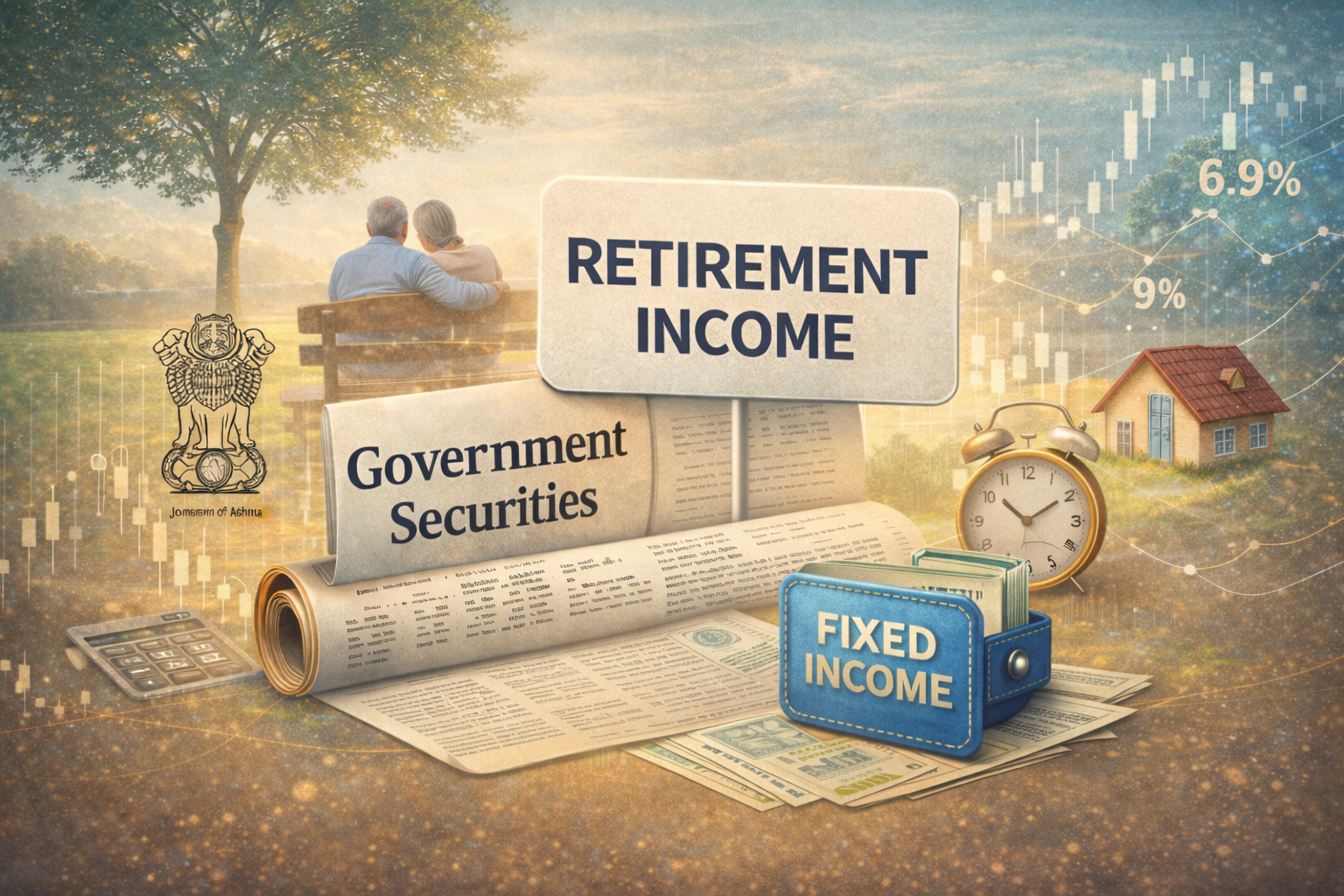
Planning for retirement is not just about building a large corpus. The real challenge begins after retirement — converting accumulated savings into a stable and predictable income stream while managing risk and preserving capital.
This is where Government Securities (G-Secs) can play an important role. These instruments can serve as the stable foundation of a retirement income portfolio, offering relatively predictable returns and capital protection when compared with riskier assets.
Understanding Government Securities
Government Securities, commonly referred to as G-Secs, are debt instruments issued by the Government of India to borrow money from investors. Because they are backed by the sovereign guarantee, they are generally considered virtually risk-free in terms of credit risk.
These securities typically provide periodic interest payments (coupon payments) and return the principal amount at maturity. For conservative investors and retirees, G-Secs can offer visibility of income and stability within a diversified portfolio.
G-Secs are often considered the backbone of the fixed-income market because they provide safety, transparency, and predictable cash flows.
Why Retirement Income Planning Is Different
Before retirement, the focus is primarily on wealth accumulation — building a large enough investment corpus through equities, mutual funds, or other growth assets.
After retirement, however, the goal changes significantly. The primary concern becomes:
Protecting capital
Managing longevity risk
Ensuring cash flow stability
This shift in objectives makes fixed-income instruments like Government Securities extremely relevant for retirees.
The Role of G-Secs in Retirement Income
Experts often recommend that Government Securities should act as the stabilising core of a retirement portfolio rather than just a token allocation.
One popular strategy used by investors is laddering maturities.
Laddering Strategy Explained
Laddering involves purchasing multiple bonds with different maturity dates. Instead of investing in a single long-term bond, investors spread investments across bonds maturing at various intervals.
This strategy helps retirees:
Create predictable cash flows
Reduce reinvestment risk
Maintain liquidity
Manage interest rate fluctuations
A laddered bond portfolio ensures that some portion of the investment matures periodically, providing regular liquidity and income.
Example: Retirement Income Using G-Secs
Consider a retiree with a ₹1 crore retirement corpus and annual expenses of ₹6 lakh.
If approximately ₹60 lakh is allocated to Government Securities yielding around 6.9%, the portfolio could generate about ₹4.14 lakh annually in relatively stable income.
This predictable income can help cover a significant portion of essential retirement expenses, reducing the need to rely on volatile assets.
Why a Blended Strategy Is Important
While Government Securities provide stability, relying only on ultra-safe instruments may not protect against inflation over long retirement periods.
A retirement phase today can last 25–30 years, meaning inflation can significantly erode purchasing power.
Therefore, many advisors recommend combining G-Secs with:
High-quality corporate bonds
Debt mutual funds
Selective equity exposure
For example, allocating the remaining corpus to high-quality corporate bonds yielding around 9% can enhance overall portfolio income while maintaining a balanced risk profile.
Tax Considerations Investors Must Know
When evaluating Government Securities, investors must focus on post-tax returns rather than just headline yields.
Key tax points include:
Coupon income is taxed according to the investor’s income tax slab
Capital gains tax may apply if bonds are sold before maturity
Holding bonds until maturity can reduce price volatility risk
Understanding the after-tax yield is therefore crucial when integrating G-Secs into a retirement strategy.
How Retail Investors Can Invest in G-Secs
Retail investors today have direct access to Government Securities through the RBI Retail Direct platform.
Through this platform, investors can:
Participate in primary auctions
Purchase securities in the secondary market
Hold G-Secs in a demat-like account maintained by RBI
This initiative has significantly improved accessibility of government bonds for individual investors.
The RBI Retail Direct platform has made it easier for retail investors to participate directly in government bond markets.
Key Advantages of G-Secs in Retirement Portfolios
Government Securities offer several benefits for retirees:
Capital Safety
Since these bonds are backed by the government, they carry minimal default risk.
Predictable Income
Regular coupon payments provide steady income streams, which is critical during retirement.
Portfolio Stability
G-Secs help reduce volatility when combined with equities or other growth assets.
Liquidity
Many government securities are actively traded in the bond market.
Risks Investors Should Understand
Despite their safety, Government Securities are not entirely risk-free.
Some risks include:
Interest rate risk – Bond prices may fall when interest rates rise
Inflation risk – Fixed income may lose purchasing power over long periods
Reinvestment risk – Maturing bonds may need to be reinvested at lower rates
This is why portfolio diversification remains essential.
The Bottom Line
Government Securities can play a crucial role in building a predictable and stable retirement income strategy. By allocating a portion of the retirement corpus to G-Secs and using techniques such as laddering maturities, investors can create reliable income streams while protecting capital.
However, relying solely on ultra-safe instruments may not be sufficient to combat inflation over long retirement horizons. A balanced portfolio combining fixed income and growth assets can help retirees achieve both stability and long-term financial security.
For investors looking to structure a well-diversified retirement income strategy, consulting a professional advisor can help align investments with risk tolerance, income needs, and long-term financial goals.