
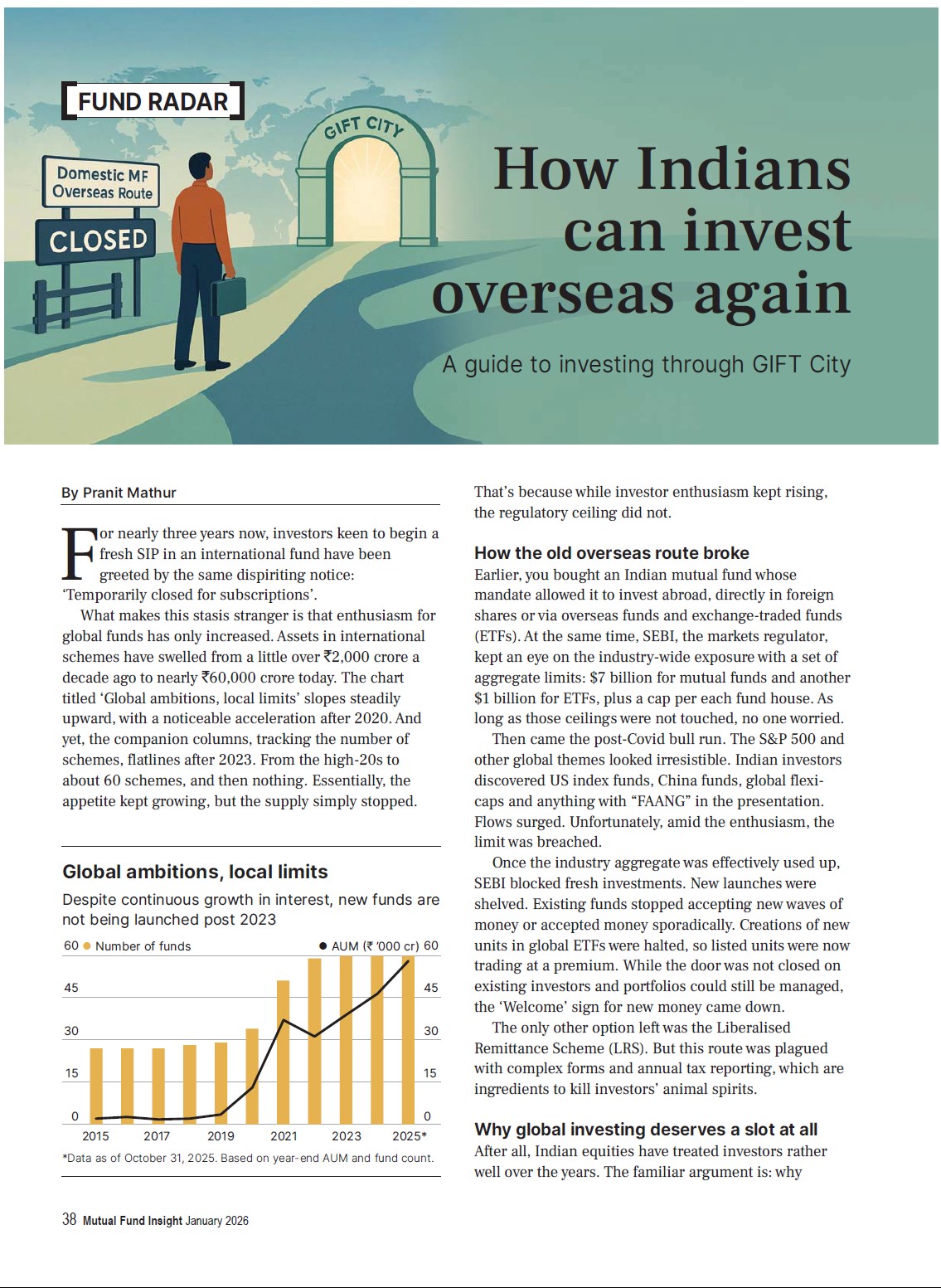
For nearly three years now, investors keen to begin a fresh SIP in an international fund have been greeted by the same dispiriting notice: “Temporarily closed for subscriptions.” What makes this stasis stranger is that enthusiasm for global funds has only increased. Assets in international schemes have swelled from a little over ₹2,000 crore a decade ago to nearly ₹60,000 crore today.
The chart titled “Global ambitions, local limits” slopes steadily upward, with a noticeable acceleration after 2020. And yet, the companion columns, tracking the number of schemes, flatline after 2023. From the high-20s to about 60 schemes, and then nothing. Essentially, the appetite kept growing, but the supply simply stopped. That’s because while investor enthusiasm kept rising, the regulatory ceiling did not.
How the old overseas route broke
Earlier, you bought an Indian mutual fund whose mandate allowed it to invest abroad, directly in foreign shares or via overseas funds and ETFs. At the same time, SEBI kept an eye on the industry-wide exposure with a set of aggregate limits: $7 billion for mutual funds and $1 billion for ETFs, plus a cap per fund house.
Then came the post-Covid bull run. The S&P 500 and global themes looked irresistible. Indian investors discovered US index funds, China funds, global flexicaps, and anything with “FAANG” in the presentation. Flows surged. Unfortunately, amid the enthusiasm, the limit was breached.
Once the industry aggregate was effectively used up, SEBI blocked fresh investments. New launches were shelved. Existing funds stopped accepting new money or did so sporadically. Creations of new units in global ETFs were halted, pushing listed units to trade at a premium. While existing investors were unaffected, the door for new money shut.
The only alternative left was the Liberalised Remittance Scheme (LRS) but with complex paperwork and annual tax reporting, it proved to be a behavioural deterrent for most investors.
Why global investing deserves a slot at all
Indian equities have treated investors rather well. So why look beyond? The answer is simple: your entire life is already tied to India. Income, property, insurance, and future spending currency — all depend on the Indian economy. When your equity portfolio is also 100% domestic, you’re not diversifying risk; you’re concentrating it.
Global investing solves problems India-only portfolios cannot.
First, sector diversification. Many of the world’s most powerful businesses — global technology platforms, consumer giants, biotech leaders — do not exist in Indian markets. A global index provides exposure to industries India barely captures.
Second, currency diversification. Over the last 25 years, the rupee has depreciated against the dollar by roughly 2.8% per year. What feels like a cost as a consumer becomes a return enhancer as an investor. Dollar returns quietly compound into higher rupee returns.
Third, cycle diversification. When India struggles, the rest of the world isn’t always in sync. Historical data shows that during major BSE 500 drawdowns, the S&P 500 often fell less — and once currency depreciation is factored in, global exposure frequently cushioned portfolio losses.
In the most recent India-specific correction from late 2024 to early 2025, the BSE 500 fell nearly 20%, while the S&P 500 in rupee terms delivered high single-digit gains.
So how do investors access global markets now?
Enter GIFT City.
Gujarat International Finance Tec-City (GIFT City) is India’s attempt at a mini-offshore financial hub, with its own regulator (IFSCA), tax framework, and rulebook. Until recently, it was largely the playground of AIFs and institutions, with minimum investments of ₹2 crore.
That is now changing.
A new category of retail outbound funds has emerged from GIFT City, allowing Indian residents to invest via the LRS route with minimum investments of around $5,000 (₹4.5 lakh). Crucially, these funds do not count towards the RBI’s $7 billion cap, shifting the constraint to the individual $250,000 annual LRS limit.
Which GIFT City funds are available?
DSP Global Equity Fund – an actively managed global equity portfolio
PPFAS IFSC S&P 500 FoF and PPFAS IFSC Nasdaq 100 FoF – passive global index exposure
An active global equity fund from the same house is in the pipeline
Several other fund houses are preparing launches
The structure is simple: rupees go in, get converted to dollars at GIFT City, invested overseas, and returned as rupees on exit. The minimum cheque size firmly places these products in serious allocation territory.
How GIFT City funds work in practice
Structurally, GIFT City funds resemble mutual funds — but with important differences.
Taxation is simpler. Many funds pay tax at the fund level, meaning investors receive post-tax proceeds without dealing with foreign tax filings. Compared to direct LRS investing, this simplicity is a major advantage.
However, TCS applies once LRS remittances exceed ₹10 lakh in a year, at 20%, though it is adjustable against final tax liability. Onboarding requires separate KYC and documentation, though still far simpler than opening an overseas brokerage account.
There are risks. Tax rules can change, regulatory views on outbound capital can shift, and minimum investment thresholds ensure this isn’t a casual decision. But given today’s constraints, GIFT City funds offer the most viable access route to global investing for Indian residents.