
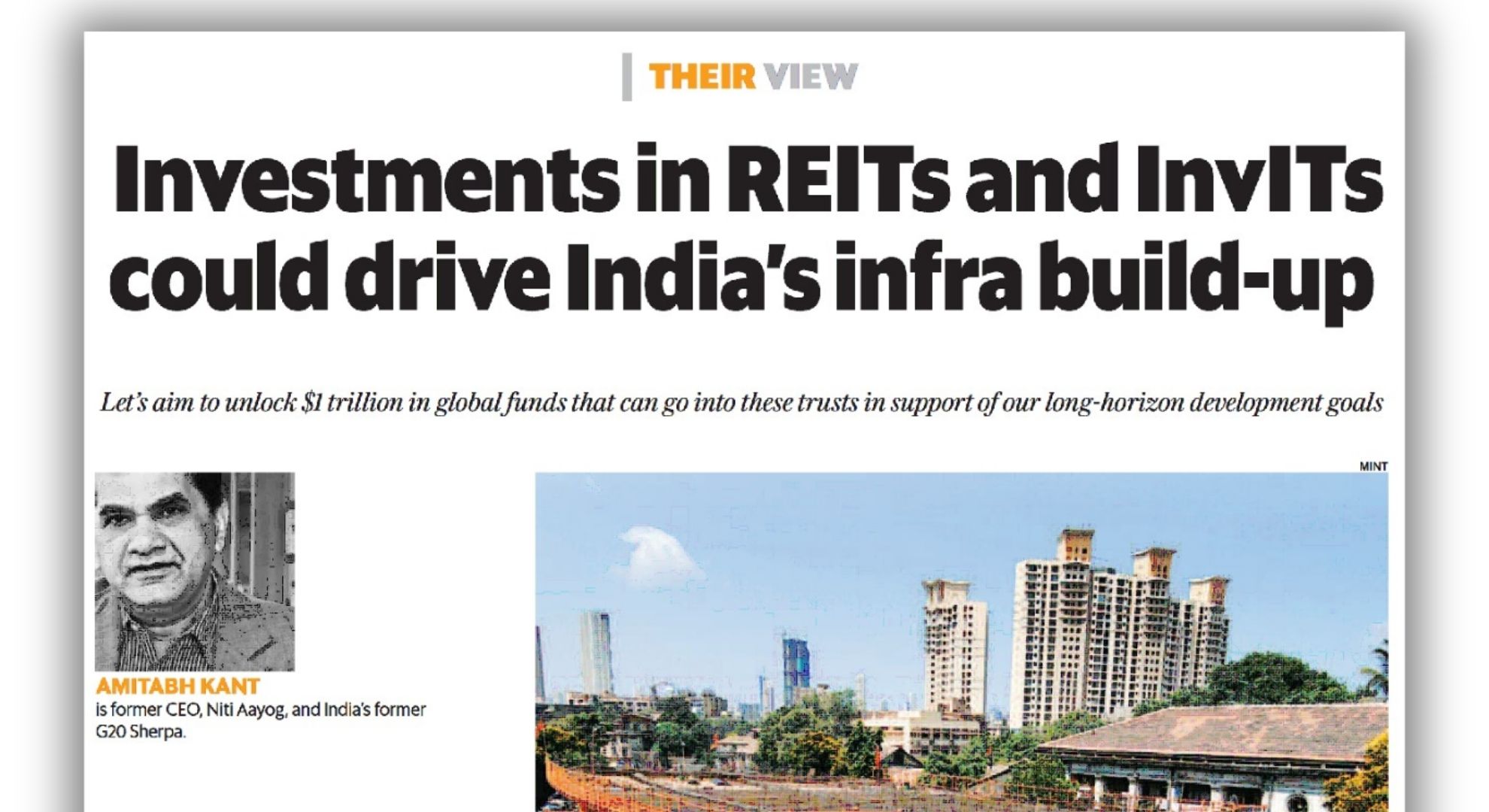
Unlocking $1 Trillion for India’s Infrastructure Revolution: Why REITs & InvITs Must Lead the Next Phase of Growth
India’s ambition is bold and unmistakably clear:
By 2047, the nation aims to evolve into a fully developed economy—a Viksit Bharat.
Reaching this milestone requires India to grow from a $4 trillion economy today to $30 trillion, with:
Per capita income increasing 8×
GDP expanding 9×
Manufacturing output rising 16×
Achieving these outcomes depends on one critical foundation—world‑class infrastructure. Fast logistics, efficient energy systems, reliable transportation, digital networks, and sustainable urbanization must define India’s economic backbone.
To build this ecosystem, massive long-term capital is required. And that’s where REITs (Real Estate Investment Trusts) and InvITs (Infrastructure Investment Trusts) emerge as strategic vehicles capable of redefining India’s infrastructure financing landscape.
Why REITs & InvITs Matter for Viksit Bharat
Globally, REITs and InvITs represent a $3 trillion investment universe, particularly strong in countries like the US, Germany, and Japan.
India already has the scale, demand, and economic momentum to emerge as a global leader—but the current numbers reveal a huge untapped opportunity.
India Today
27 registered InvITs across nine infrastructure sectors
₹7 trillion AUM, a fraction of India’s true potential
India’s Goal
Target: $1 trillion (₹90 trillion) in REIT & InvIT assets over the next decade.
To unlock this, India must address existing structural challenges.
The Challenges Slowing India’s REIT/InvIT Growth
1. Valuation Gaps & Portfolio Uncertainty
Some portfolios were rushed into trusts due to fiscal constraints.
This resulted in:
Overly optimistic assumptions
Unclear future expenditure
Weak investor confidence
Trust assets must be based on realistic projections, operational clarity, and transparent planning.
2. Limited Public Sector Participation
Despite 70% of India’s infrastructure being built by public sector entities, only two public InvITs exist.
Railways, logistics hubs, warehousing, and utilities hold massive potential but have been slow to monetize assets.
3. Governance Issues: Sponsors Retaining Control
When public entities retain operational control even after assets move into a trust:
Price discovery weakens
Governance standards dilute
Investors pull back
REIT/InvIT management must be professionally run and independent for global acceptance.
4. No Predictable, Multi‑Year Asset Pipeline
While the National Monetization Pipeline outlines intent, execution has been limited.
The issue isn’t capital —
It is the lack of ready, high-quality assets and scalable structures.
A Clear Roadmap to Unlock $1 Trillion
To become the world’s leading REIT & InvIT market, India must adopt a structured, forward-looking strategy.
1. Establish Sector-Wise Contribution Targets
A multi‑year asset pipeline must begin now:
$250B – Power transmission & renewables
$200B – Roads
$150B – Logistics & digital infra
$200B – Urban utilities & metros
$200B – Commercial real estate
This alone creates a $1 trillion investable universe.
2. Ministries Should Enable, Not Control
Their role must shift to
Preparing asset pipelines
Ensuring approvals
Creating clean, transparent structures
Commercial decisions must be left to professional managers.
3. Empower States & Cities
State governments should adopt unified monetization frameworks.
Cities can raise long-term capital by pooling:
Bus depots
Metro rail systems
Water plants
Parking facilities
Municipal markets
into city-level REITs & InvITs, without increasing debt burdens.
4. Provide Long-Term Tax & Regulatory Stability
Investors—especially global institutions—require:
Predictable tax policies
Clear regulatory guidelines
Credible currency hedging mechanisms
No retrospective policy shocks.
5. Build Large Platform-Based Trusts
India must move from one‑off asset transfers to large sectoral platforms that:
Receive recurring infusions
Achieve global indexing scale
Attract sovereign & pension funds
6. Boost Domestic Participation
Today:
Foreign investors contribute 50%+
Domestic institutions contribute just 7%
India must raise domestic participation to 20–25% and expand retail involvement beyond 5%.
7. Ensure a Predictable, Multi‑Year Pipeline
This will be the most important enabler of:
Investor confidence
Capital flow consistency
Sustainable infrastructure development
The World Is Ready to Invest—India Must Act
India has a historic opportunity to reshape global infrastructure investment flows.
With disciplined execution, transparent governance, and stable regulatory architecture, India can become the world’s top REIT & InvIT market.
The next decade will define whether India unlocks the $1 trillion global capital pool needed to build Viksit Bharat.
The infrastructure we build today will determine the India we live in tomorrow.
Explore More Insights
To deepen your understanding of how infrastructure financing, capital markets, and alternative investment structures shape India’s long-term economic transformation:
Explore insights from Ranjit Jha (CEO, Rurash Financials)—a pioneer in research‑driven wealth advisory.
Learn how Rurash Financials empowers investors through:
AIF access
Portfolio engineering
Unlisted equity opportunities
Personalised wealth strategies