
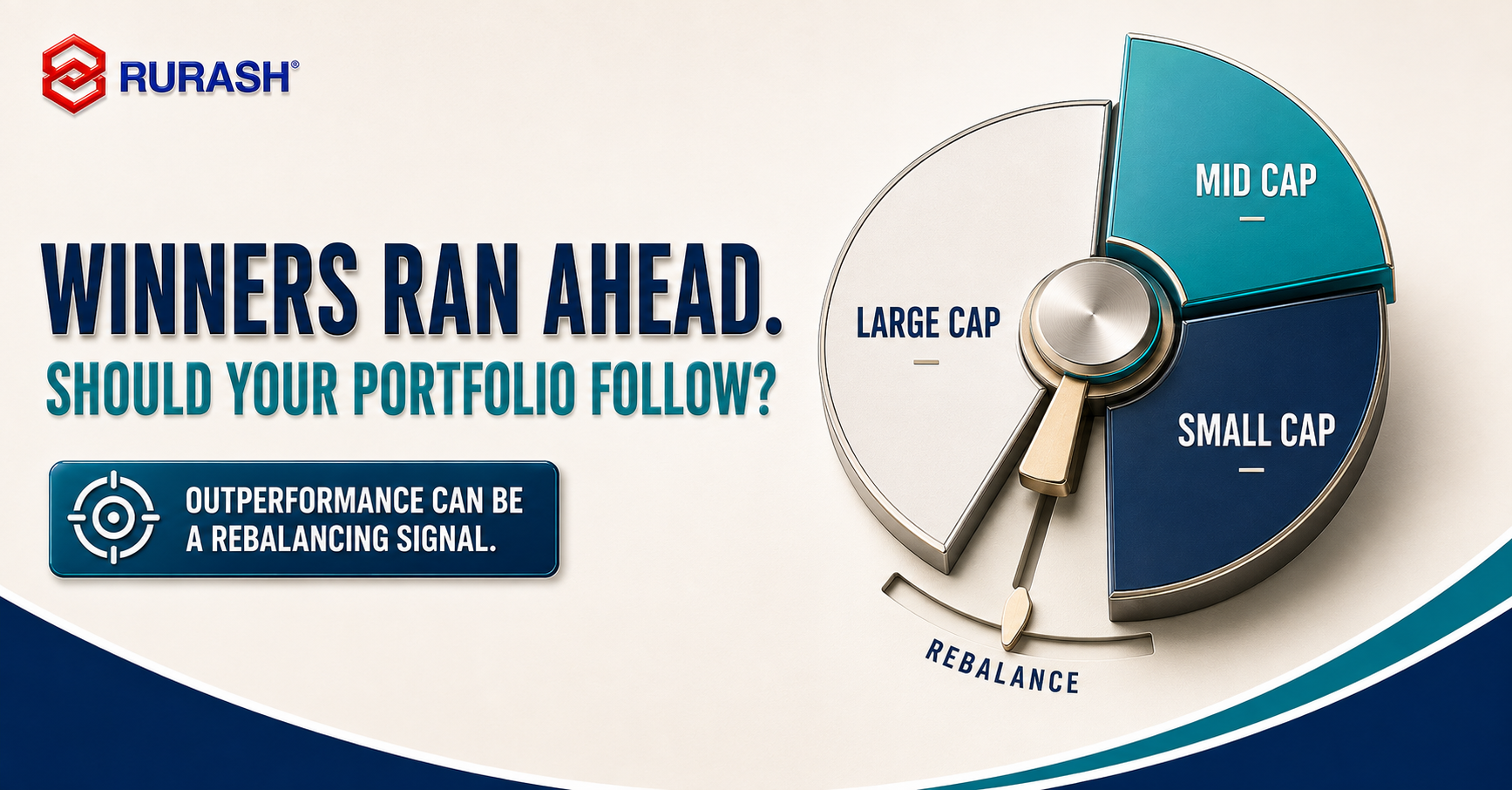
Outperformance is not always a signal to add more. Sometimes it is a reason to rebalance.
When one part of a portfolio performs significantly better than another, investors often feel tempted to direct even more money towards the winning category.
That behaviour can quietly increase portfolio risk.
An Economic Times analysis published on 21 May 2026 found that large-cap mutual funds had trailed mid- and small-cap categories over several periods. Large caps were weaker across one-month, three-month, six-month, one-year, year-to-date, three-year and five-year horizons. The Economic Times
The important question is not simply which category has recently delivered the highest return. It is whether strong performance has pushed an investor’s portfolio away from its intended allocation.
What Does the Performance Difference Show?
In the one-month period covered by the ET analysis:
- Small-cap funds gained approximately 2.16%
- Mid-cap funds gained approximately 1.27%
- Large-cap funds declined approximately 2.72%
Over six months:
- Small-cap funds declined approximately 0.19%
- Mid-cap funds declined approximately 1.01%
- Large-cap funds declined approximately 7.50%
The three-year category returns cited were approximately:
- Large caps: 11.89%
- Small caps: 18.20%
- Mid caps: 20.79%
These figures capture performance during a particular period. They should not be treated as forecasts or used to select a scheme without considering risk, valuation, portfolio quality and investment horizon.
Why Have Mid and Small Caps Attracted Investors?
Mid- and small-cap companies can offer stronger growth potential because many are still expanding their market presence, revenue base and operating scale.
During favourable economic and market cycles, these companies may grow faster than established large-cap businesses. This can translate into stronger share-price performance and higher category returns.
However, that growth potential comes with additional risks:
- Higher price volatility
- Lower liquidity in underlying stocks
- Greater sensitivity to economic changes
- More company-specific business risk
- Potentially expensive valuations after a rally
- Deeper losses during market corrections
The strongest recent performer is not automatically the most suitable destination for new money.
Why Do Large Caps Still Matter?
Large-cap companies are generally more established and liquid. Their businesses may be more diversified, and they often have greater access to capital than smaller companies.
Large-cap funds can therefore serve an important portfolio function:
- Providing relative stability
- Reducing overall portfolio volatility
- Supporting liquidity
- Creating exposure to established businesses
- Forming a core allocation for new or moderate-risk investors
A category can underperform temporarily and still perform a necessary role within the portfolio.
That distinction is critical: an investment should be evaluated not only by its standalone return, but also by the job it performs in the overall allocation.
What Is Performance Chasing?
Performance chasing occurs when investors move money into a category primarily because it recently performed well.
The common pattern is:
- A category produces strong returns.
- Media attention and investor interest increase.
- More investors allocate after the rally.
- Portfolio concentration grows.
- A correction exposes more risk than the investor expected.
Buying after a period of outperformance is not always wrong. The problem arises when recent returns replace suitability, valuation and asset-allocation discipline as the basis for the decision.
What Is Portfolio Rebalancing?
Rebalancing means returning a portfolio to its intended allocation after market movements change its composition.
For example, assume an investor originally selected:
- 60% large-cap exposure
- 25% mid-cap exposure
- 15% small-cap exposure
If mid and small caps rise significantly faster, the allocation could shift to:
- 50% large cap
- 30% mid cap
- 20% small cap
The portfolio has become more aggressive even though the investor made no deliberate change.
Rebalancing may involve redirecting new SIPs, adjusting future contributions or selectively reducing overweight exposure. It does not always require selling every outperforming investment.
When Should Investors Consider Rebalancing?
A portfolio review may be appropriate when:
- An asset category moves materially above its target allocation
- The portfolio has become more volatile than intended
- Exposure is concentrated in mid- or small-cap schemes
- Different funds hold substantially similar securities
- Financial goals or investment horizons have changed
- A major withdrawal is approaching
- The investor’s risk capacity has reduced
- Allocation decisions are being driven primarily by recent returns
The decision should consider exit loads, capital-gains taxation and the investor’s complete financial position.
Should Investors Stop Their Mid- and Small-Cap SIPs?
Not automatically.
Investors with a long investment horizon, adequate risk capacity and a suitable allocation may continue their SIPs. The concern is not the existence of mid- or small-cap exposure—it is excessive exposure created by chasing performance.
Depending on the portfolio, an investor may choose to:
- Continue existing SIPs without increasing them
- Redirect incremental contributions towards underweight categories
- Use flexi-cap or diversified strategies
- Rebalance gradually rather than through a single transaction
- Maintain the allocation when it remains within an agreed range
The right response depends on the investor’s target allocation, not a universal market call.
Why Valuation Matters
According to the ET report, the valuation premium of the Nifty Smallcap 100 over the Nifty 50 increased to nearly 18% by the end of April 2026, from 12% at the end of the previous month.
A higher valuation does not mean a category must immediately decline. It means future returns may depend more heavily on companies delivering the earnings growth already reflected in their prices.
Investors should therefore avoid interpreting strong historical returns as evidence that the same pace will continue.
A Better Portfolio-Review Framework
Before changing an allocation, investors can evaluate five factors:
Purpose
What role does each fund perform—growth, stability, diversification or liquidity?
Allocation
Has recent performance changed the portfolio’s large-, mid- and small-cap proportions?
Risk
Would the investor remain comfortable if the higher-risk categories experienced a sharp correction?
Time horizon
Is there sufficient time to remain invested through volatility?
Cost of change
Would rebalancing create exit loads, taxes or unnecessary portfolio turnover?
Rebalancing should restore discipline. It should not become another form of short-term market timing.
Ranjit Jha’s Perspective
Strong performance can make an allocation appear safer than it actually is. When one market segment runs ahead, investors should examine whether the portfolio has become more concentrated or aggressive than originally intended.
Large-, mid- and small-cap funds serve different purposes. The decision should not be framed as choosing one winning category and abandoning the others.
A well-structured portfolio balances growth potential with stability, liquidity and the investor’s ability to remain invested during difficult market periods.
Explore More with Rurash
Portfolio rebalancing begins with understanding how every investment contributes to the overall financial plan.
At Rurash, investors can explore mutual-fund portfolio reviews, allocation analysis and product selection aligned with their goals, time horizon and risk capacity