
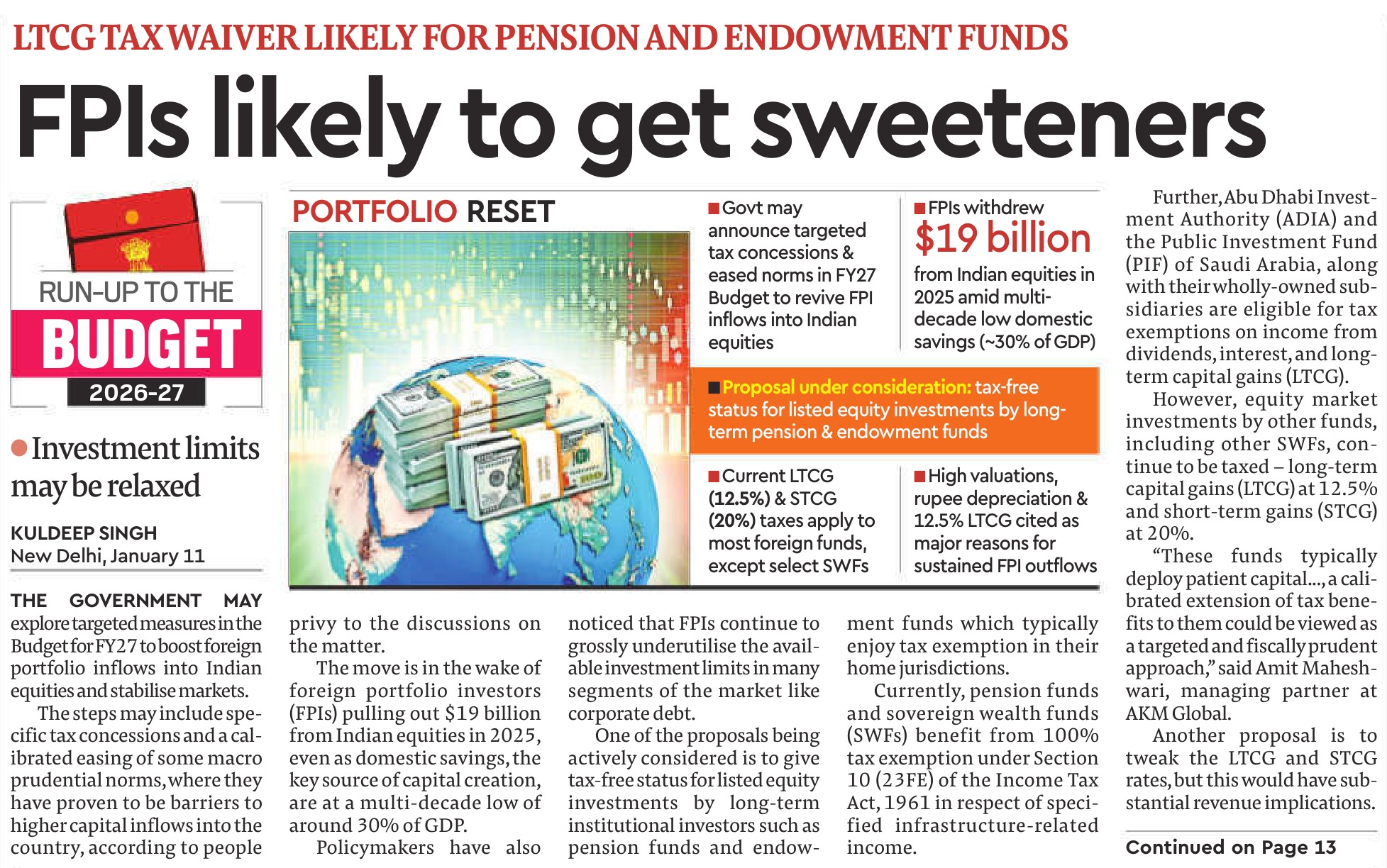
THE GOVERNMENT MAY explore targeted measures in the Budget for FY27 to boost foreign portfolio inflows into Indian equities and stabilise markets. The steps may include specific tax concessions and a calibrated easing of some macro prudential norms, where they have proven to be barriers to higher capital inflows into the country, according to people privy to the discussions on the matter.
The move is in the wake of foreign portfolio investors (FPIs) pulling out $19 billion from Indian equities in 2025, even as domestic savings, the key source of capital creation, are at a multi-decade low of around 30% of GDP.
Policymakers have also noticed that FPIs continue to grossly underutilise the available investment limits in many segments of the market like corporate debt. One of the proposals being actively considered is to give tax-free status for listed equity investments by long-term institutional investors such as pension funds and endowment funds which typically enjoy tax exemption in their home jurisdictions.
Currently, pension funds and sovereign wealth funds (SWFs) benefit from 100% tax exemption under Section 10 (23FE) of the Income Tax Act, 1961 in respect of specified infrastructure-related income. Further, Abu Dhabi Investment Authority (ADIA) and the Public Investment Fund (PIF) of Saudi Arabia, along with their wholly-owned subsidiaries are eligible for tax exemptions on income from dividends, interest, and long-term capital gains (LTCG). However, equity market investments by other funds, including other SWFs, continue to be taxed – long-term capital gains (LTCG) at 12.5% and short-term gains (STCG) at 20%.
“These funds typically deploy patient capital … , a calibrated extension of tax benefits to them could be viewed as a targeted and fiscally prudent approach,” said Amit Maheshwari, managing partner at AKM Global. Another proposal is to tweak the LTCG and STCG rates, but this would have substantial revenue implications. Continued on Page 13 CAPITAL GAINS TAX has been the fastest-growing revenue head for the government in recent years. Also, any reduction of LTCG would amount to a reversal of the policy paradigm adopted in the Budget FY24, to narrow the differential between the tax incidence on business income and capital gains. A higher LTCG tax rate was justified by government officials as a “pro-equity step” as it ensured higher tax burden on individuals, especially HNIs, rather than businesses and firms. In recent months, the RBI and Sebi have taken a number of steps to ease market access for institutional capital. In May, 2025, the RBI eased rules for FPIs to buy local corporate bonds, by withdrawing the short-term investment and concentration limits under the “general route.” This was in addition to the fully accessible route and sovereign green bonds schemes which already provided an exclusive investment window for FPIs in government securities and sovereign green bonds, respectively. Of course, the RBI has maintained the FPI investment caps of 6% for government securities, 2% for state government securities and 15% for corporate bonds for FY26.
‘To make compliance process and access easier for FPIs, on December 1, the market regulator announced streamlined FPI and Foreign Venture Capital Investor (FVCI) regulations under a single window framework – SWAGAT-F. The facility is slated to come into full force 180 days from the date of notification. Moreover, last week, Sebi issued a notification facilitating seamless digital signature certificates for FPIs. The FPI-friendly steps, likely to be unveiled in the Budget, are expected to complement these measures, and could be an even bigger stimulus for the foreign investors, the sources said. Industry experts and stakeholders have highlighted concerns over high valuations, rupee depreciation, and some irritants in India’s taxation regime as among the reasons for the consistent FPI outflows in the past year, apart from the lure of other investment destinations. In FY26 Budget, the government brought parity in the taxation of capital gains on transfer of capital assets for residents and FPIs. The LTCG tax rate for FPIs on transfer of securities (other than those covered under Section 112A of Income Tax Act, such as listed bonds, debentures, and non-equity instruments) was increased from 10% to 12.5%.
The government had also announced special tax exemption to sovereign wealth funds, pension funds, and similar foreign entities on gains from investment made in the infrastructure sector. Indian stock markets have faced renewed volatility in early 2026, with benchmark indices shedding significant value amid sustained FPI withdrawals. The hike in LTCG for non-residents to 12.5%, implemented for equities in FY25 Budget and for listed bonds, debentures etc in FY26 Budget to align with domestic rates, has been cited as a contributing factor to the outflows. “While most countries do not tax portfolio investors, India does. “It also increased the LTCG rate last year,” Rohinton Sidhwa, partner at Deloitte India, said. Sidhwa underlined that the year 2025 ended on a testy note with record FPI selling of ₹2.4 lakh crore in the secondary markets. Primary market investments of ₹73,909 crore by FPIs provided some cushion.