
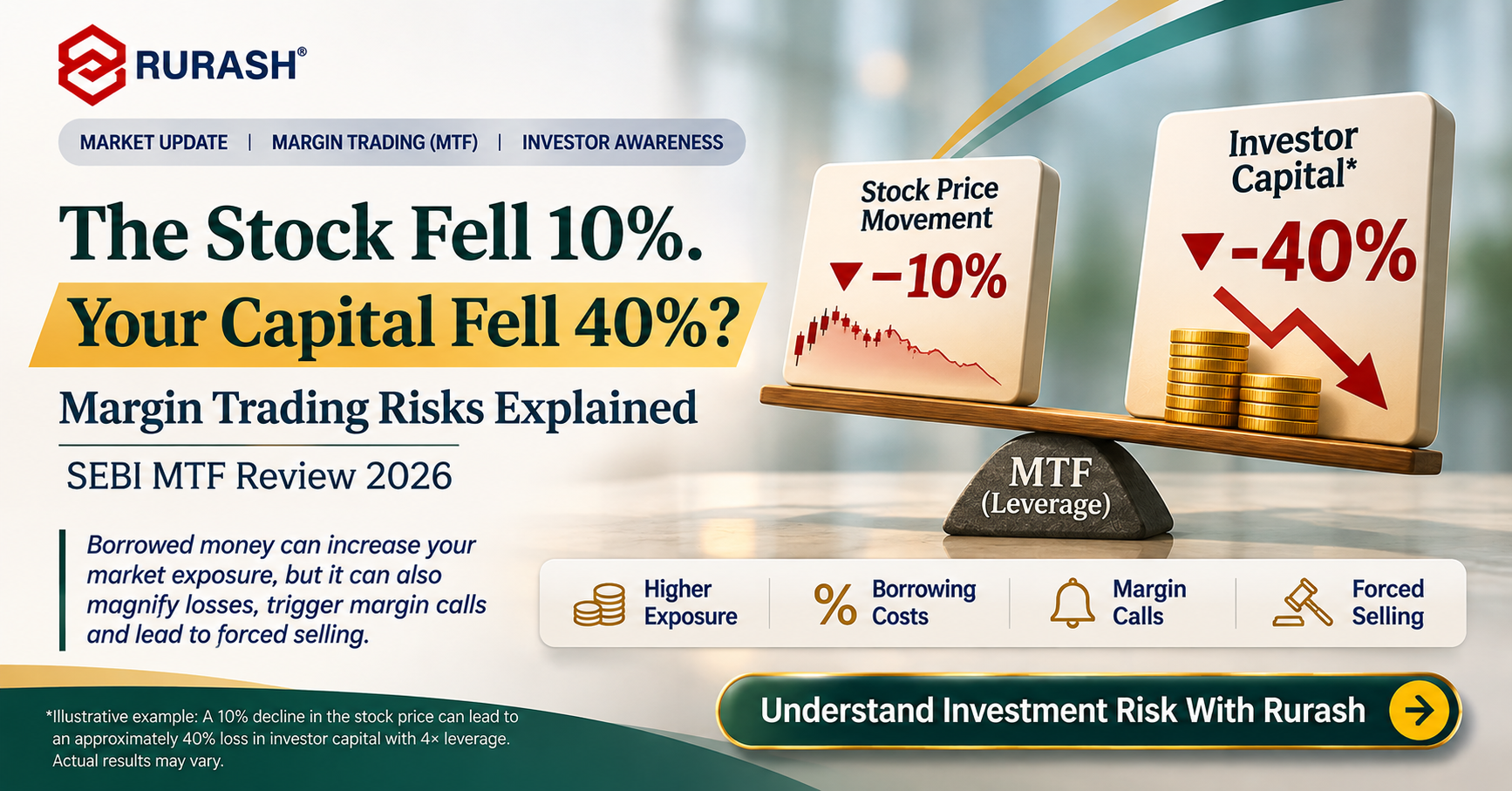
Margin Trading Risks Explained: Why Borrowed Money Can Magnify Stock Market Losses
Hook: Your stock falls 10%. But your investment capital falls much more. Are you prepared for the risks of margin trading?
Investing in the stock market involves uncertainty. Share prices can rise or fall because of business performance, economic developments, changing valuations and investor sentiment.
But what happens when investors purchase shares using borrowed money?
A small market decline can create a much larger reduction in their own capital. At the same time, borrowing costs continue accumulating, and investors may have to provide additional funds or face the sale of their holdings.
This is the financial reality of margin trading.
On 17 November 2026, Reuters reported that the Securities and Exchange Board of India (SEBI) is considering additional restrictions on margin-funded stock purchases amid concerns about the growing use of leverage by retail investors.
The development comes as India’s Margin Trading Facility (MTF) market has expanded significantly, with reported outstanding margin-funded positions reaching approximately ₹1.53 lakh crore.
The important distinction is that margin trading can increase an investor’s purchasing power, but it can also increase losses, borrowing expenses and the possibility of forced selling.
For investors, understanding these risks is essential before using leverage to purchase equities.
What Happened? SEBI Is Considering Fresh Restrictions on Margin Trading
According to Reuters reporting dated 17 November 2026, SEBI is examining additional safeguards for margin-funded share purchases.
The reported concerns relate to the rapid growth of leveraged retail positions and the possibility that falling share prices could trigger widespread forced selling.
The report indicates that outstanding margin-funded positions have reached approximately ₹1.53 lakh crore, representing an increase of around 29% compared with a year earlier.
It also reports that approximately two-thirds of these positions are concentrated in small- and mid-cap shares.
Among the measures reportedly under consideration are restrictions on opening fresh leveraged positions when margin-funded holdings in an individual company exceed specified thresholds relative to its freely tradable shares.
However, these measures remain under consideration.
As of 17 November 2026, SEBI has not announced the reported thresholds as final, binding rules.
Investors should therefore distinguish between existing MTF regulations and possible future changes.
The development is significant because it highlights how leverage can create risks not only for individual investors but also for market liquidity during periods of heightened volatility.
1. What Is Margin Trading Facility?
Margin Trading Facility, commonly called MTF, allows eligible investors to purchase approved securities by contributing part of the purchase value while an authorised stockbroker funds the remaining amount.
For example, an investor may want to purchase shares worth ₹4 lakh but contribute only ₹1 lakh of their own capital.
If permitted under the applicable securities-specific margin rules and broker conditions, the remaining ₹3 lakh may be financed through MTF.
The investor acquires market exposure worth ₹4 lakh despite initially contributing only ₹1 lakh.
This is called leverage.
The arrangement usually involves borrowing charges, prescribed margin requirements and collateral or funded-security pledges.
It differs from an ordinary fully funded equity purchase because the investor has an outstanding financial obligation to the broker.
2. How Margin Trading Magnifies Both Gains and Losses
Consider a hypothetical investor purchasing shares worth ₹4 lakh.
The investor contributes ₹1 lakh, while ₹3 lakh is borrowed.
<escape>Illustrative investment structure:</escape>
| Particulars | Amount |
|---|---|
| Total shares purchased | ₹4,00,000 |
| Investor’s capital | ₹1,00,000 |
| Broker funding | ₹3,00,000 |
| Exposure relative to own capital | 4 times |
If the share price increases by 10%, the investment becomes worth ₹4.4 lakh.
Ignoring costs, the investor’s equity rises to ₹1.4 lakh, producing a 40% gain on the initial ₹1 lakh.
But if the share price falls by 10%, the investment becomes worth ₹3.6 lakh.
After accounting for the ₹3 lakh borrowed amount, the investor’s remaining equity falls to ₹60,000.
That represents a 40% loss on the investor’s initial capital.
The stock moved only 10%, but the investor’s equity changed by 40%.
This is the central risk of leveraged investing.
The actual borrowing capacity depends on regulatory requirements, security eligibility and broker policies. Four-times exposure is an illustrative scenario, not a universal entitlement.
3. What Happens When the Stock Price Falls Further?
The risk becomes more serious during a sharp market correction.
Continuing the same hypothetical example, suppose the share value falls by 20%.
The portfolio would then be worth ₹3.2 lakh.
After deducting the outstanding borrowing of ₹3 lakh, the investor’s residual equity would be just ₹20,000.
The investor has lost 80% of the original ₹1 lakh contribution even though the underlying shares declined only 20%.
At a sufficiently large price decline, the investor could lose their entire initial capital and potentially remain liable for a shortfall, depending on the circumstances and the proceeds available from liquidation.
This is why leveraged investing should not be evaluated using only the potential for higher profits.
When borrowing is involved, relatively ordinary market volatility can cause unusually large damage to personal capital.
4. What Is a Margin Call?
A margin call occurs when the investor is required to restore the applicable margin or collateral coverage.
MTF positions are subject to initial, maintenance and mark-to-market margin requirements.
These requirements depend on the security and the applicable regulatory framework.
If the value of the financed shares declines, the broker may require additional cash, eligible collateral or a reduction in the outstanding position.
For example, an investor may receive a margin call after a sharp decline in the value of a stock held through MTF.
The investor must then respond according to the broker’s applicable terms.
A margin call is not simply a warning about investment performance.
It can create an immediate funding requirement at a time when the investor may already be facing a significant unrealised loss.
5. Can Your Broker Sell Shares Without Waiting for Your Preferred Exit Price?
Yes, forced liquidation is an important MTF risk.
If an investor fails to meet a valid margin call within the applicable contractual period, the broker may liquidate relevant securities under the prescribed conditions.
NSE’s MTF guidance provides for liquidation in accordance with the agreed terms, with the period not exceeding five working days from the margin call.
The broker must disclose the conditions under which liquidation can occur.
This means an investor may be forced to sell during a market correction, even if they believe the share price could recover later.
The sale may crystallise a loss.
If the proceeds are insufficient to discharge the outstanding amount and applicable expenses, the investor may still owe money.
A long-term investment intention does not override the repayment and collateral obligations created by margin funding.
6. Why Borrowing Costs Matter Even When Share Prices Do Not Move
Margin trading introduces an expense that ordinary fully funded equity investing does not require.
The broker charges interest or funding costs on the amount financed, subject to the applicable agreement.
Consider a hypothetical investor borrowing ₹3 lakh at an annual interest rate of 12%.
The approximate interest expense for 30 days would be ₹2,959, using simple daily interest on a 365-day basis.
If the share price remains unchanged during that period, the investor has still incurred the funding expense.
Other applicable brokerage, pledge, transaction and statutory charges may increase the total cost.
For investors holding MTF positions over longer periods, these expenses can significantly affect the break-even price.
A share does not merely need to return to the original purchase price for the investor to recover every rupee of the total investment cost.
It may need to rise sufficiently to cover accumulated interest and associated charges.
7. Why Are Small- and Mid-Cap Stocks Particularly Important?
The latest reporting highlights the concentration of margin-funded positions in small- and mid-cap shares.
These companies can offer attractive business opportunities, but their shares may sometimes experience greater price fluctuations or more limited market liquidity than heavily traded large-cap stocks.
When leveraged positions are concentrated in a security, falling prices can trigger margin shortfalls.
If many investors need to reduce positions simultaneously, additional selling pressure may develop.
That can further weaken prices and potentially create additional margin requirements.
This is one reason regulators monitor not only the total amount of leverage but also how that leverage is distributed across securities.
The risk is especially important when an investor uses borrowed money to purchase shares with limited liquidity.
8. What Is the Difference Between MTF and Ordinary Equity Investing?
When an investor purchases shares using available funds, the investment can lose value, but there is generally no separate broker-financed loan to repay.
Under MTF, the investor has both market exposure and a funding obligation.
A market decline can therefore create three simultaneous pressures.
First, the investment value falls.
Second, the borrowing and related expenses remain payable.
Third, the broker may require additional margin or liquidate securities.
For this reason, MTF is not merely a way to purchase a larger quantity of shares.
It changes the financial risk structure of the investment.
9. Does SEBI Permit Any Stock to Be Purchased Through MTF?
No.
Under the applicable framework, eligible securities are restricted to qualifying Group I equity shares and specified equity exchange-traded fund units, subject to regulatory and exchange requirements.
The broker must also satisfy the applicable authorisation, funding, collateral and exposure conditions.
An investor should not assume that every stock available for ordinary trading is eligible for margin funding.
Eligibility can change based on the relevant regulatory classification and broker risk-management requirements.
Investors should verify eligibility, required margin and applicable funding conditions before placing an MTF order.
10. Why a Strong Company Can Still Be a Risky Margin Trade
One common misconception is that borrowing against a high-quality stock is automatically safer.
A fundamentally strong company can still experience a significant short-term share-price correction.
Its valuation may be excessive, market sentiment may change or broader economic events may reduce demand for equities.
An investor holding the same stock without leverage may be able to tolerate volatility, depending on their circumstances.
An investor holding it through MTF may not have that flexibility.
The need to meet margin requirements can become more important than the original long-term investment thesis.
Good business fundamentals do not eliminate the financial risks created by borrowing.
11. Should Investors Use Emergency Savings to Meet Margin Calls?
Emergency funds generally serve a different financial purpose.
They may be required for healthcare, household expenses, family obligations or temporary disruptions to income.
Using these funds to maintain leveraged equity positions can expose an investor to liquidity pressure beyond the stock market.
A margin call may arrive precisely when markets are declining and the investor’s other assets are also experiencing volatility.
Therefore, the potential need for additional margin should be considered before opening a funded position.
Investors should avoid assuming they will always be able to arrange additional cash quickly.
12. What Should Investors Check Before Using MTF?
Before entering a margin-funded trade, investors should understand the complete financing arrangement.
This includes the initial contribution, applicable interest rate, maintenance-margin requirements, permitted collateral, margin-call procedure and liquidation conditions.
It is also important to understand whether the broker can revise its risk-management policies and how those revisions are communicated.
The investor should review the broker’s Rights and Obligations Document and applicable MTF terms.
Particular attention should be given to circumstances in which securities may be liquidated and what happens if the sale proceeds do not cover the outstanding obligation.
Margin Trading Risk Checklist
Before using a Margin Trading Facility, ask yourself:
How much of the position is financed with borrowed money?
What happens to my capital if the stock falls 10%, 20% or more?
What interest and other charges will I incur?
What are the initial and maintenance-margin requirements?
How quickly must I respond to a margin call?
Under what circumstances can the broker liquidate shares?
Could I owe money even after the shares are sold?
Is the stock sufficiently liquid during volatile markets?
Am I relying on emergency savings to support the trade?
Can I afford the potential loss without disrupting long-term financial goals?
13. What Does SEBI’s Latest Review Mean for Investors?
The November 2026 reporting suggests regulators are evaluating whether additional safeguards are necessary as leveraged market participation grows.
Any future measures may affect the ability to initiate new margin-funded positions in securities where leverage is already concentrated.
However, the reported proposals should not be treated as final regulations.
The more immediate lesson for investors is that risk management must begin before regulatory restrictions become necessary.
Understanding exposure limits, borrowing costs, collateral requirements and potential liquidation consequences remains important under the existing framework.
Ranjit Jha’s Perspective — Draft for Approval
Margin trading can increase an investor’s market exposure, but it also introduces financial obligations that can become difficult to manage during volatile periods.
The expansion of margin-funded positions highlights the importance of understanding leverage rather than focusing only on the possibility of higher returns.
For investors, a sharp market decline can affect both the value of the investment and the ability to maintain the required collateral.
Investment decisions should therefore consider liquidity, borrowing costs, downside scenarios and overall financial capacity.
A disciplined approach to equity investing should be built around risk management and long-term portfolio objectives rather than the availability of additional purchasing power.
The Bigger Picture: More Buying Power Does Not Mean More Financial Strength
Margin trading allows investors to take larger positions than their immediately available capital would otherwise support.
However, larger market exposure does not automatically improve investment outcomes.
Borrowing introduces costs, repayment obligations and the possibility of forced selling.
The risks can become particularly serious when leveraged holdings are concentrated in volatile or less liquid securities.
SEBI’s reported consideration of additional safeguards is a reminder that financial leverage can affect both individual investors and broader market conditions.
The real measure of investment discipline is not how much an investor can borrow, but how much risk the investor can responsibly manage.
Connect With Rurash Financials
Understanding market risk is an essential part of long-term wealth creation.
Connect with Rurash Financials Pvt. Ltd. to discuss equity portfolio diversification, risk management and investment allocation aligned with your financial objectives.