
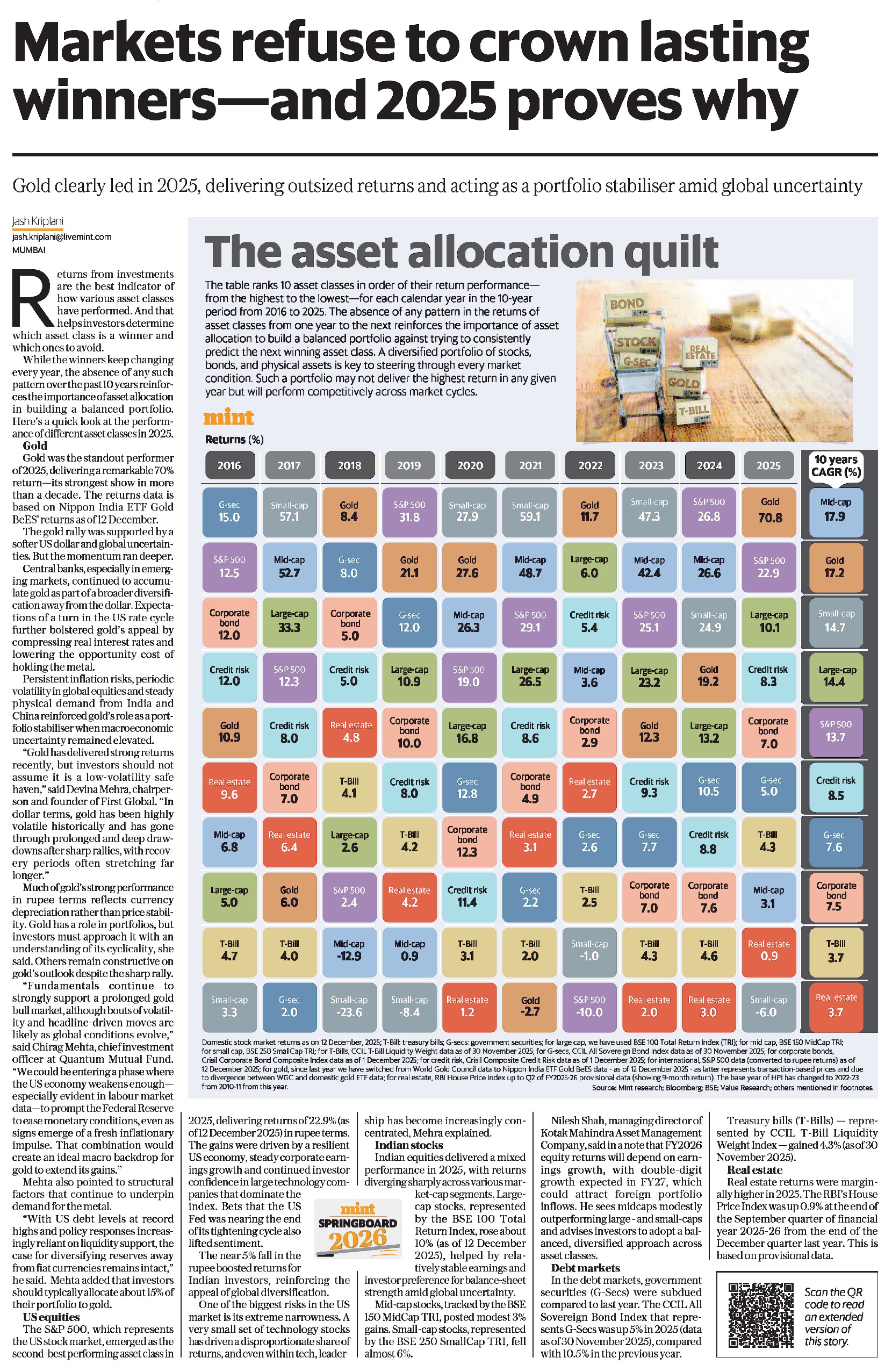
Gold clearly led in 2025, delivering outsized returns and acting as a portfolio stabiliser amid global uncertainty. Returns from investments are the best indicator of how various asset classes have performed, helping investors determine which asset class is a winner and which ones to avoid.
While the winners keep changing every year, the absence of any consistent pattern over the past 10 years reinforces the importance of asset allocation in building a balanced portfolio. Here’s a quick look at the performance of different asset classes in 2025.
Gold
Gold was the standout performer of 2025, delivering a remarkable 70% return—its strongest show in more than a decade. The returns data is based on Nippon India ETF Gold BeES returns as of 12 December.
The gold rally was supported by a softer US dollar and global uncertainties, but the momentum ran deeper.
Central banks, especially in emerging markets, continued to accumulate gold as part of a broader diversification away from the dollar. Expectations of a turn in the US rate cycle further bolstered gold’s appeal by compressing real interest rates and lowering the opportunity cost of holding the metal.
Persistent inflation risks, periodic volatility in global equities, and steady physical demand from India and China reinforced gold’s role as a portfolio stabiliser when macroeconomic uncertainty remained elevated.
“Gold has delivered strong returns recently, but investors should not assume it is a low-volatility safe haven,” said Devina Mehra, chairperson and founder of First Global. “In dollar terms, gold has been highly volatile historically and has gone through prolonged and deep drawdowns after sharp rallies.”
Much of gold’s strong performance in rupee terms reflects currency depreciation rather than price stability. Gold has a role in portfolios, but investors must approach it with an understanding of its cyclicality, she said.
Others remain constructive on gold’s outlook despite the sharp rally.
“Fundamentals continue to strongly support a prolonged gold bull market,” said Chirag Mehta, CIO at Quantum Mutual Fund. He noted that a weakening US economy, possible Fed easing, and renewed inflationary pressures could create an ideal macro backdrop for gold to extend gains.
With US debt at record highs and policy responses reliant on liquidity support, the case for diversifying away from fiat currencies remains intact, Mehta added. He suggested investors typically allocate about 15% of their portfolio to gold.
US equities
The S&P 500, representing the US stock market, emerged as the second-best performing asset class in 2025, delivering 22.9% returns (as of 12 December 2025) in rupee terms. Gains were driven by a resilient US economy, steady corporate earnings growth, and continued confidence in large technology companies.
The near 5% fall in the rupee boosted returns for Indian investors, reinforcing the appeal of global diversification.
One key risk remains the extreme narrowness of market leadership, with a small set of technology stocks driving a disproportionate share of returns, Mehra explained.
Indian stocks
Indian equities delivered mixed performance in 2025, with sharp divergence across market-cap segments. Large-cap stocks, represented by the BSE 100 TRI, rose about 10% (as of 12 December 2025), supported by stable earnings and investor preference for balance-sheet strength.
Mid-cap stocks (BSE 150 MidCap TRI) posted modest 3% gains, while small-cap stocks (BSE 250 SmallCap TRI) fell nearly 6%.
Nilesh Shah, managing director of Kotak Mahindra Asset Management, said FY2026 returns will depend on earnings growth, with double-digit growth expected in FY27, potentially attracting foreign portfolio inflows. He expects midcaps to modestly outperform and advises a balanced, diversified approach.
Debt markets
In debt markets, government securities (G-Secs) were subdued. The CCIL All Sovereign Bond Index rose 5% in 2025 (as of 30 November 2025), compared with 10.5% last year.
Treasury bills (T-Bills), represented by the CCIL T-Bill Liquidity Weight Index, gained 4.3% (as of 30 November 2025).
Real estate
Real estate returns were marginally higher in 2025. The RBI’s House Price Index rose 0.9% by the end of the September quarter of FY26, compared with the December quarter last year, based on provisional data.