
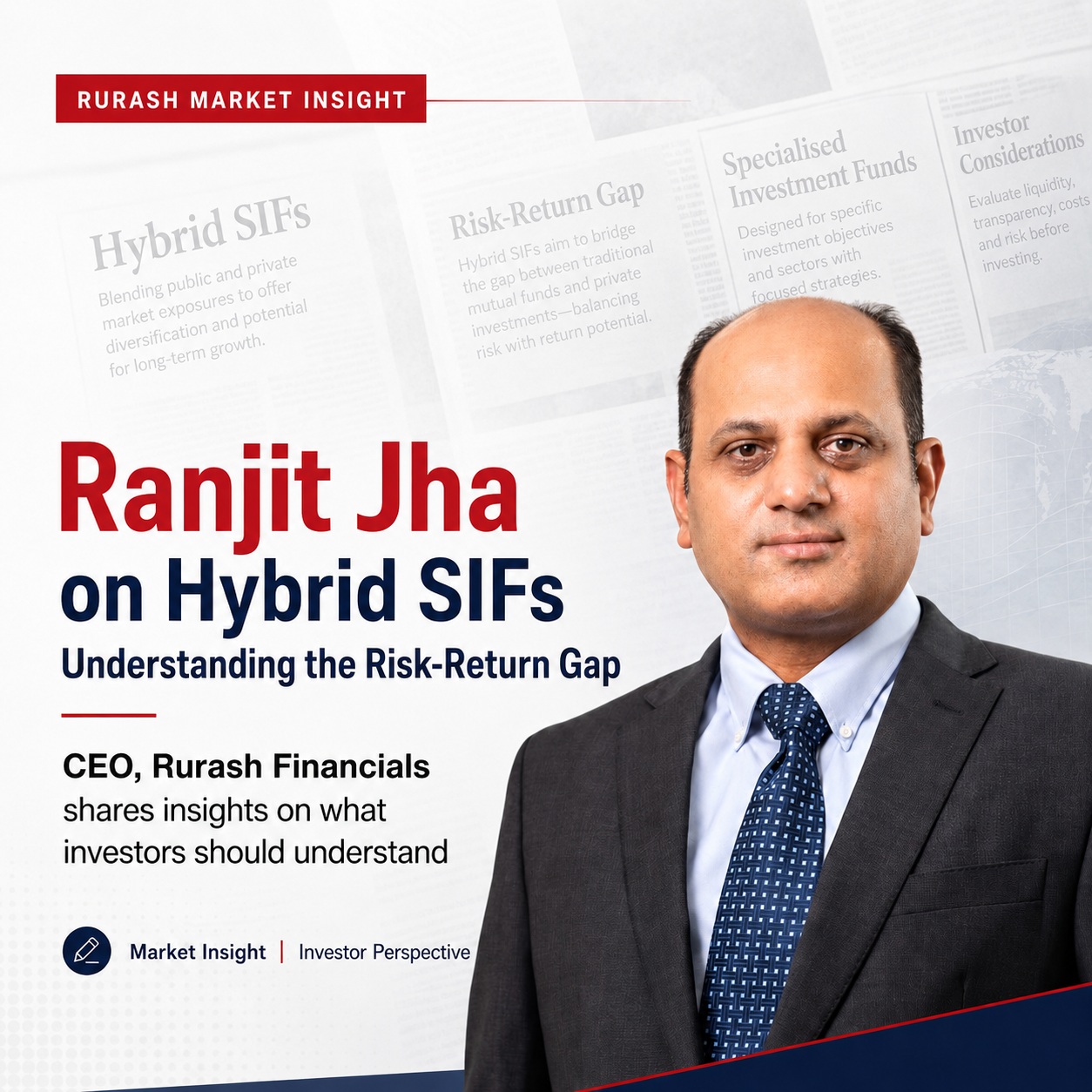
WHAT ARE HYBRID SIFS?
Hybrid Specialised Investment Funds, or Hybrid SIFs, are regulated investment strategies that can combine equity, debt and permitted derivative positions.
Their broader investment toolkit may allow fund managers to:
• Hedge portfolio risks
• Manage net market exposure
• Take limited long and short positions
• Seek returns across different market conditions
• Combine equity growth potential with fixed-income exposure
However, the term “Hybrid SIF” does not represent one uniform level of risk.
Two funds within the same category may have very different:
• Equity exposure
• Debt allocation
• Derivative usage
• Liquidity terms
• Investment objectives
• Risk-management approaches
Investors should therefore evaluate the individual strategy instead of relying only on the category name.
WHY ARE HYBRID SIFS IN THE NEWS?
A recent Economic Times Wealth report examined how Hybrid SIFs are attempting to fill the investment space between conventional hybrid mutual funds and higher-ticket, more complex investment products.
According to the report, hybrid long-short strategies managed approximately ₹11,910 crore as of June 2026. This represented nearly 67% of the total SIF assets of approximately ₹17,858 crore.
These figures indicate that early investor interest within the emerging SIF category has been concentrated more heavily in hybrid strategies.
Source: The Economic Times Wealth, 20 July 2026
HOW IS A HYBRID SIF DIFFERENT FROM A TRADITIONAL HYBRID MUTUAL FUND?
A traditional hybrid mutual fund generally manages risk by changing the allocation between equity, debt, gold or arbitrage, depending on the scheme category.
A Hybrid SIF can use a wider range of permitted investment strategies, including certain derivative and long-short positions.
1. CORE ASSET ALLOCATION
Traditional Hybrid Mutual Fund
Usually combines equity and debt according to the scheme’s stated investment mandate.
Hybrid SIF
Can combine equity and debt with a wider range of portfolio-management strategies, including permitted long-short and derivative positions.
2. USE OF DERIVATIVES
Traditional Hybrid Mutual Fund
Derivatives may be used for hedging, arbitrage or portfolio rebalancing within applicable rules.
Hybrid SIF
May use derivatives for hedging, portfolio management and limited unhedged short exposure, subject to regulatory limits.
3. STRATEGY COMPLEXITY
Traditional Hybrid Mutual Fund
The portfolio structure may be relatively easier for retail investors to understand.
Hybrid SIF
The strategy can be more complex because gross exposure, net exposure, hedging positions and short positions may differ.
4. LIQUIDITY
Traditional Hybrid Mutual Fund
Many open-ended schemes provide daily purchase and redemption facilities.
Hybrid SIF
Redemption frequency, notice periods and exit conditions may differ across strategies.
5. INVESTOR SUITABILITY
Traditional Hybrid Mutual Fund
Suitability depends on the scheme category, investor’s risk profile and investment horizon.
Hybrid SIF
Requires a deeper understanding of derivatives, liquidity conditions, portfolio exposure and the fund manager’s intended outcome.
WHAT DOES THE SEBI FRAMEWORK ALLOW?
SEBI’s Specialised Investment Fund framework recognises a Hybrid Long-Short Fund that invests across equity and debt.
Under the regulatory framework:
• A Hybrid Long-Short Fund must maintain minimum exposure to both equity and debt.
• It may use permitted derivatives for managing portfolio exposure.
• Limited unhedged short exposure may be taken through derivatives, subject to applicable limits.
• The aggregate minimum investment across SIF strategies is generally ₹10 lakh at the investor’s PAN level.
• Different conditions may apply to accredited investors.
• Subscription and redemption arrangements may vary according to the structure and liquidity requirements of the strategy.
The ability to short or hedge does not automatically make a fund safer.
The outcome depends on:
• Portfolio construction
• Position sizing
• Hedging discipline
• Market conditions
• Credit quality
• Liquidity management
• Execution by the fund manager
WHY MAY HYBRID SIFS APPEAL TO SOME INVESTORS?
The potential appeal of Hybrid SIFs lies in their flexibility.
Depending on the mandate, a fund manager may combine:
• Equity exposure
• Fixed-income securities
• Arbitrage opportunities
• Hedging strategies
• Long and short positions
• Derivative overlays
This flexibility may be used to manage volatility, reduce net equity exposure or seek returns that are less dependent on a continuously rising market.
However, every Hybrid SIF may not behave like a conservative investment product.
Some strategies may focus on downside management, while others may take more active investment calls to seek additional returns.
The same category can therefore contain strategies with significantly different risk and return outcomes.
WHAT ARE THE MAIN RISKS OF HYBRID SIFS?
1. STRATEGY RISK
The outcome depends on what the fund manager is trying to achieve.
A strategy designed primarily for risk management may behave differently from one that uses derivatives to seek additional returns.
2. DERIVATIVE AND EXECUTION RISK
Derivatives can be useful risk-management tools, but they also increase complexity.
Incorrect positioning, ineffective hedges, poor timing or execution challenges can affect portfolio performance.
3. MARKET RISK
Hybrid SIFs remain market-linked investments.
Equity prices, interest rates, credit conditions and broader market movements can affect the value of the portfolio.
4. LIQUIDITY RISK
Every SIF may not provide daily redemption.
Investors must check:
• Available redemption windows
• Notice periods
• Exit-load conditions
• Settlement timelines
• Liquidity of underlying investments
5. CREDIT AND INTEREST-RATE RISK
The debt portion of the portfolio may be affected by:
• Changes in interest rates
• Credit-rating downgrades
• Default risk
• Duration risk
• Concentration in specific issuers
6. LIMITED TRACK RECORD
The SIF category is still developing in India.
Early performance should not be treated as evidence of how a strategy will perform across an entire market cycle.
7. BENCHMARK RISK
The benchmark should reflect the fund’s actual investment objective and portfolio structure.
Comparing a defensive strategy with an aggressive equity benchmark may create an incorrect impression about performance.
RANJIT JHA’S INVESTOR CHECKLIST FOR HYBRID SIFS
Before considering a Hybrid SIF, investors should examine the following questions:
1. WHAT IS THE FUND TRYING TO DELIVER?
Is the objective:
• Income stability?
• Downside protection?
• Absolute return?
• Capital appreciation?
• Lower volatility?
• Portfolio diversification?
2. WHAT IS THE NET EQUITY EXPOSURE?
Investors should not rely only on the gross equity number.
The net equity exposure after considering derivative and short positions may provide a clearer understanding of the actual market risk.
3. WHY ARE DERIVATIVES BEING USED?
Understand whether derivatives are being used for:
• Hedging
• Arbitrage
• Portfolio rebalancing
• Additional return generation
• Directional short positions
4. WHAT IS THE QUALITY OF THE DEBT PORTFOLIO?
Review:
• Credit quality
• Average maturity
• Duration
• Issuer concentration
• Exposure to lower-rated securities
• Interest-rate sensitivity
5. WHAT CAN CREATE A LOSS?
Investors should read the risk disclosures and understand the conditions under which the strategy may underperform or lose capital.
6. HOW AND WHEN CAN THE INVESTMENT BE REDEEMED?
Check:
• Redemption frequency
• Notice period
• Exit load
• Settlement timeline
• Any restrictions on withdrawals
7. IS THE BENCHMARK APPROPRIATE?
The benchmark should match the strategy’s actual investment objective and risk profile.
8. WHAT ROLE WILL THE FUND PLAY IN THE PORTFOLIO?
The investor should determine whether the investment is intended to be:
• A core allocation
• A tactical allocation
• An income allocation
• A portfolio diversifier
• An alternative to another market-linked product
9. CAN THE INVESTOR UNDERSTAND THE STRATEGY?
Complexity should never be mistaken for suitability.
Investors should understand how the fund expects to generate returns and the risks involved before committing capital.
RANJIT JHA’S PERSPECTIVE
The relevant question is not whether Hybrid SIFs are better than traditional hybrid mutual funds.
The relevant question is whether the specific strategy, risk structure, liquidity terms and investment objective are suitable for the investor’s portfolio.
WHO MAY CONSIDER A HYBRID SIF?
A Hybrid SIF may be considered by an investor who:
• Meets the applicable minimum investment requirement
• Understands market-linked investments
• Can evaluate derivative-led strategies
• Has an appropriate investment horizon
• Can tolerate fluctuations in portfolio value
• Does not require unrestricted daily liquidity
• Understands that capital and returns are not guaranteed
WHO SHOULD APPROACH HYBRID SIFS WITH CAUTION?
Hybrid SIFs may not be suitable for investors who:
• Are seeking assured returns
• Require capital guarantees
• Need immediate or unrestricted liquidity
• Have a very short investment horizon
• Do not understand derivative strategies
• Are uncomfortable with market volatility
• Are looking for a simple replacement for a bank fixed deposit
Suitability must be evaluated in the context of the investor’s complete portfolio, financial goals, risk capacity and holding period.
WHAT SHOULD INVESTORS UNDERSTAND?
Hybrid SIFs may provide a wider investment toolkit, but wider flexibility also creates greater responsibility for investors.
Investors should not select a strategy only because it is new, specialised or attracting market attention.
The decision should be based on:
• Investment objective
• Portfolio construction
• Risk-management approach
• Derivative usage
• Debt quality
• Liquidity terms
• Fund manager capability
• Costs and taxation
• Investor suitability
Hybrid SIFs are expanding the investment choices available to Indian investors by combining equity, debt and more flexible portfolio-management tools.
Their growing share within the SIF market suggests that investors are interested in strategies that attempt to balance return potential with active risk management.
However, Hybrid SIFs should not be treated as one uniform risk category.
The most important decision is not whether to invest in Hybrid SIFs generally.
The real decision is whether a particular strategy is understandable, suitable, sufficiently liquid and aligned with the role it is expected to play in the investor’s overall portfolio.
Rurash Financials helps investors evaluate market-linked opportunities through portfolio suitability, product understanding and long-term financial planning.
The objective is to ensure that an investment is considered not only for its return potential, but also for its:
• Risk
• Liquidity
• Investment horizon
• Portfolio allocation
• Financial goals
• Overall suitability
Led by Ranjit Jha, CEO of Rurash Financials, the Rurash team supports investors across:
• Wealth Management
• Mutual Funds
• Alternative Investment Funds
• Specialised Investment Funds
• Unlisted and Pre-IPO Opportunities
• Fixed-Income Solutions
• Insurance
• Financial Planning
CONSIDERING A SPECIALISED INVESTMENT FUND?
Speak with the Rurash team to understand the investment strategy, risk structure, liquidity terms and portfolio suitability before making a decision.
WHAT IS A HYBRID SIF?
A Hybrid SIF is a Specialised Investment Fund strategy that invests across equity, debt and permitted derivatives.
The specific asset allocation and use of derivatives depend on the investment mandate of the strategy.
WHY ARE HYBRID SIFS GAINING ATTENTION?
Hybrid SIFs provide fund managers with a wider investment toolkit than conventional hybrid mutual funds.
This may include limited short exposure and derivative-based strategies that can be used to manage portfolio risk or seek differentiated returns.
WHAT IS THE MINIMUM INVESTMENT REQUIRED FOR A SIF?
Under the SEBI framework, the aggregate minimum investment across all strategies of a SIF is generally ₹10 lakh at the investor’s PAN level.
Different treatment may apply to accredited investors.
ARE HYBRID SIFS SAFER THAN EQUITY MUTUAL FUNDS?
Not automatically.
Some strategies may be designed to manage volatility, but the outcome depends on asset allocation, derivative positions, credit exposure, portfolio construction and execution.
Capital loss remains possible.
CAN INVESTORS REDEEM A HYBRID SIF EVERY DAY?
Not necessarily.
Redemption frequency and notice periods may vary across strategies.
Investors should review the Investment Strategy Information Document and other relevant documents before investing.
DO HYBRID SIFS GUARANTEE RETURNS?
No.
Hybrid SIFs are market-linked investments. Returns and capital are not guaranteed.
WHAT SHOULD INVESTORS CHECK BEFORE INVESTING?
Investors should examine:
• Investment objective
• Net equity exposure
• Derivative usage
• Debt portfolio quality
• Benchmark
• Redemption frequency
• Notice period
• Exit load
• Fund manager approach
• Risk disclosures
• Portfolio suitability
References
- Hybrid SIFs: How These Specialised Investment Funds Are Filling the Risk-Return Gap, The Economic Times Wealth
- Securities and Exchange Board of India, Regulatory Framework for Specialised Investment Funds
- Association of Mutual Funds in India, Investor education and mutual fund information
Disclaimer
This article is intended solely for investor education and general information.
It does not constitute investment advice, a recommendation, an offer or a solicitation to invest in any security, fund, product or strategy.
Specialised Investment Funds involve market risk, derivative risk, liquidity risk, credit risk and the possibility of capital loss.
Past performance does not indicate or guarantee future results.
Tax treatment may vary according to the investment strategy, investor category and prevailing laws.
Investors should read all relevant offer documents, risk disclosures and strategy information documents before making an investment decision. They should also consult qualified financial, legal and tax advisers where required.
Read the full Article:-
https://rurashfin.com/media/hybrid-sifs-and-the-risk-return-gap-ranjit-jha-explains-what-investors-should-examine/