
Greater transparency
Improved transparency is the key gain. “The core idea of this framework and
the resultant larger advantage is transparency on charges,” says Sriram B. K. R.,
senior investment strategist, Geojit Financial Services.
They can now see what they pay the fund house for portfolio management,
separate from unavoidable statutory costs. “Investors can compare returns
versus cost for each fund easily,” says Chaturvedi.
“Investors and advisers can use expense ratio as a tie-breaker between funds of
similar quality,” says Punj. He adds that this could encourage a gradual shift
towards more cost-efficient products.
The framework also helps investors track how expenses behave as assets scale
up, offering insight into whether fund houses pass on economies of scale.
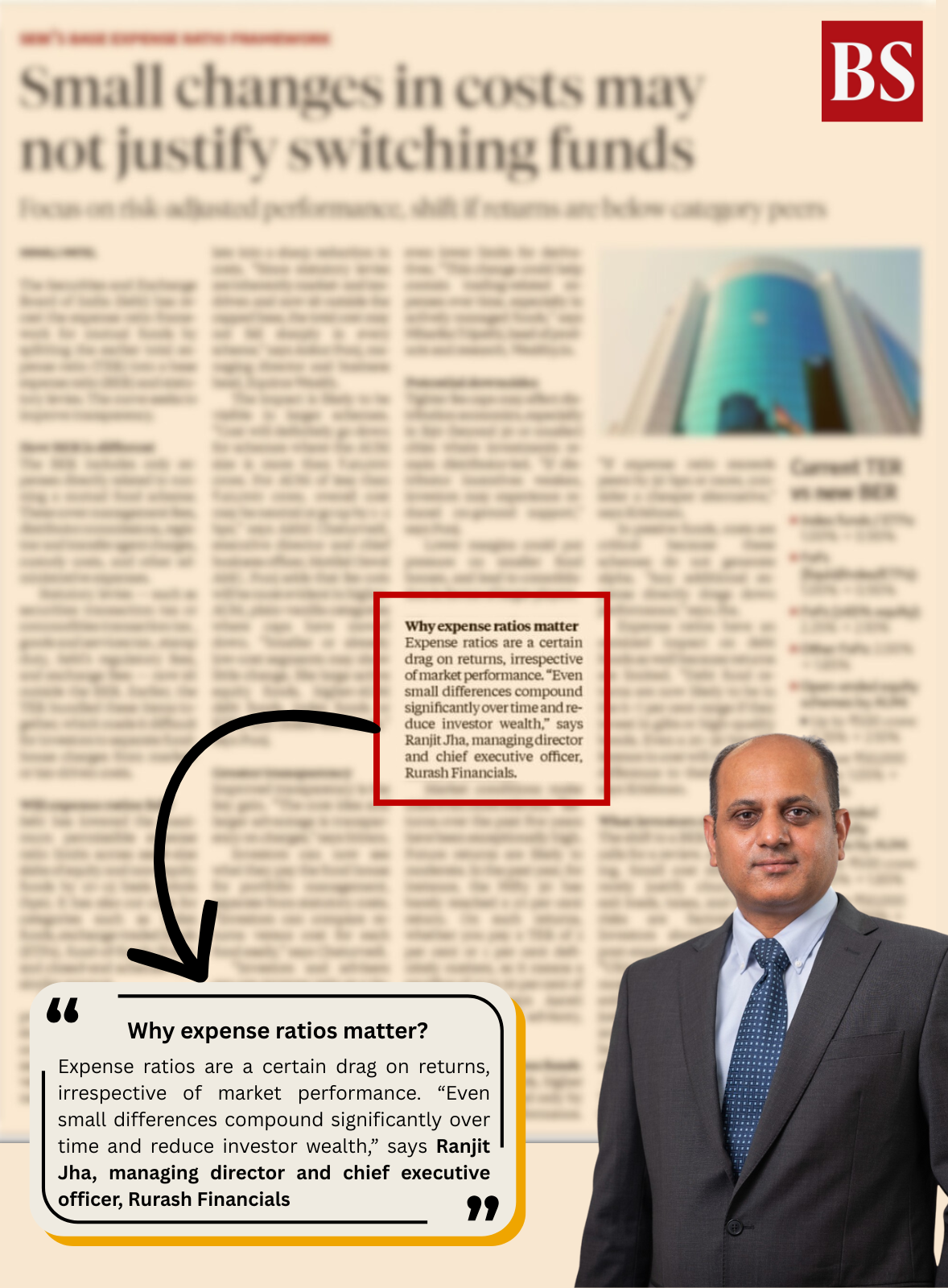
Why expense ratios matter
Expense ratios are a certain drag on returns, irrespective of market
performance. “Even small differences compound significantly over time and
directly reduce investor wealth,” says Ranjit Jha, managing director and chief
executive officer, Rurash Financials.
A monthly investment of ₹10,000 over 20 years at a 12 per cent gross return
grows to about ₹84.1 lakh with an expense ratio of 1.50 per cent, but nearly
₹85.7 lakh with an expense ratio of 1.35 per cent. A difference of 15 basis
points adds about ₹1.5 lakh over time.
Market conditions make costs even more relevant. “Returns over the past five
years have been exceptionally high and future returns are likely to moderate. In
the past year, for instance, the Nifty 50 has barely reached a 10 per cent return.
On such returns, whether you pay a TER of 2 per cent or 1 per cent definitely
matters, as it means a sacrifice of 10 to 20 per cent of the total return you
make,” says Aarati Krishnan, head of advisory, PrimeInvestor.
Expense ratios across fund types
In active equity funds, higher costs can be justified only by consistent
outperformance. If expenses remain well above the category average without
matching results, investors should look at more cost-efficient options.
In passive funds, costs are critical because these schemes do not aim to beat
the market. “Any additional expense directly drags down performance,” says
Jha. Tighter caps on index funds and ETFs by Sebi should therefore benefit
investors through lower expenses and possibly improved tracking.
Expense ratios have an outsized impact in debt funds because returns are
limited. Even modest fees can materially erode net yields. With debt fund
returns likely to stay in the mid-single-digit range, investors should prefer
funds with stable strategies, low churn, and competitive expense ratios so that
most of the interest income accrues to them.
Read the full article: https://www.business-standard.com/finance/personal-finance/lower-expense-ratio-not-enough-to-switch-funds-125122500650_1.html