
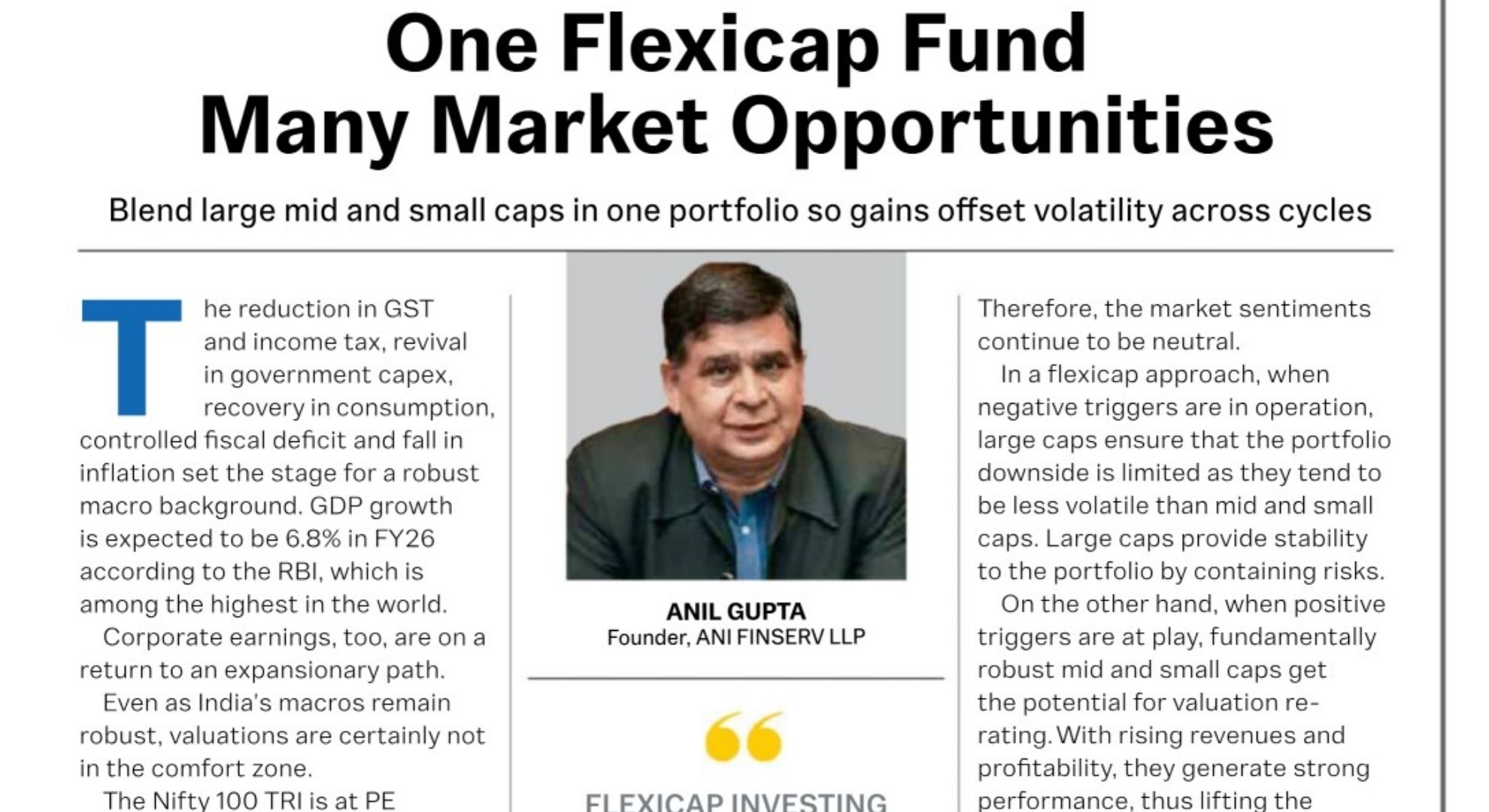
Flexicap Investing: Why Blending Large, Mid & Small Caps Works Across Market Cycles
India’s macroeconomic landscape continues to display resilience. With GST and income‑tax reductions, robust government capex, rising consumption, controlled fiscal deficit, and a cooling inflation trajectory, the foundation for FY26 looks strong.
The RBI expects GDP growth at 6.8%, one of the highest globally — a backdrop that supports long‑term equity investing.
Yet, valuations tell another story. Markets are not cheap:
Nifty 100 TRI → PE: 22.59 | PB: 3.54
Nifty Midcap 150 TRI → PE: 34.12 | PB: 4.40
Nifty Small Cap 250 TRI → PE: 30.76 | PB: 3.68
(As of Oct 31, 2025)
With stretched valuations, the question is clear:
How do investors capture growth while protecting downside risk?
The answer — a disciplined Flexicap investing approach.
Why a Flexicap Portfolio Makes Sense Now
A Flexicap strategy blends:
Large Caps → Stability & lower volatility
Mid Caps → Growth with improving earnings visibility
Small Caps → High upside during expansionary phases
This structure ensures that gains in one segment help offset the volatility of another — especially critical in rapidly shifting macroeconomic cycles.
Setting the Right Context: Key Indicators to Track
Flexicap allocations work best when guided by data-backed insights.
1. Market Valuation Multiples
Valuations today are neither cheap nor deeply overvalued — they sit in the neutral zone, requiring selective participation.
2. Business Cycle Indicators
Capacity Utilisation: 75.8% (Apr–Jun 2025) — showing mild expansion
Credit Growth: 11.4% YoY (early October) — indicative of healthy demand
Both reaffirm that India’s growth engine is functioning well.
3. Market Sentiment
FPIs continue to sell — a negative sentiment trigger
DIIs remain aggressive buyers — a stabilising force
Corporate earnings have begun to revive — a strong positive trigger
Upcoming RBI and US trade developments may bring short-term volatility, but structural fundamentals remain sound.
How Flexicap Works Across Different Cycles
When negative triggers dominate:
Large caps ensure portfolio protection with lower downside risk.
When positive triggers emerge:
Mid and small caps benefit from:
Valuation rerating
Revenue expansion
Profitability growth
Result? Strong upside for the overall portfolio.
Flexicap = Dynamic diversification + risk balance across cycles
The Discipline Behind Flexicap Investing
To make this approach effective, fund managers use a two‑layer strategy:
1. Top‑Down Approach — For Large Caps
Focus on:
Macros
Sector leadership
Business cycles
Valuations
2. Bottom‑Up Approach — For Mid & Small Caps
Focus on:
Company fundamentals
Balance sheet strength
Competitive moat
Growth runway
Market-cap allocation depends on:
Current valuations
Earnings trajectory
Macro environment indicators
Additionally, a diversified portfolio avoids sector or stock concentration risk.
Why Retail Investors Should Prefer Flexicap Mutual Funds
Flexicap investing needs:
Dynamic rebalancing
Constant valuation analysis
Sector rotation discipline
Deep macro understanding
Mutual funds bring:
Research teams
Analyst coverage
Rule-based frameworks
Proven investment models
This makes them the ideal vehicle for most investors.
Final Word
Flexicap investing isn’t about predicting markets — it’s about preparing for every outcome.
When guided by:
✔ Discipline
✔ Process
✔ Data-backed allocation
✔ Diversification
…it becomes one of the most resilient approaches across short-term volatility and long-term growth cycles.
Flexicap investing works best when discipline guides every stock and sector choice.
Explore More Insights
For deeper understanding of how wealth management, advisory excellence, and capital‑market strategies shape India’s financial ecosystem, explore guidance from Ranjit Jha (CEO) — a pioneer in research-driven wealth advisory.
To learn how Rurash Financials empowers investors through:
AIF access
Portfolio engineering
Unlisted equity opportunities
Personalised wealth strategies