
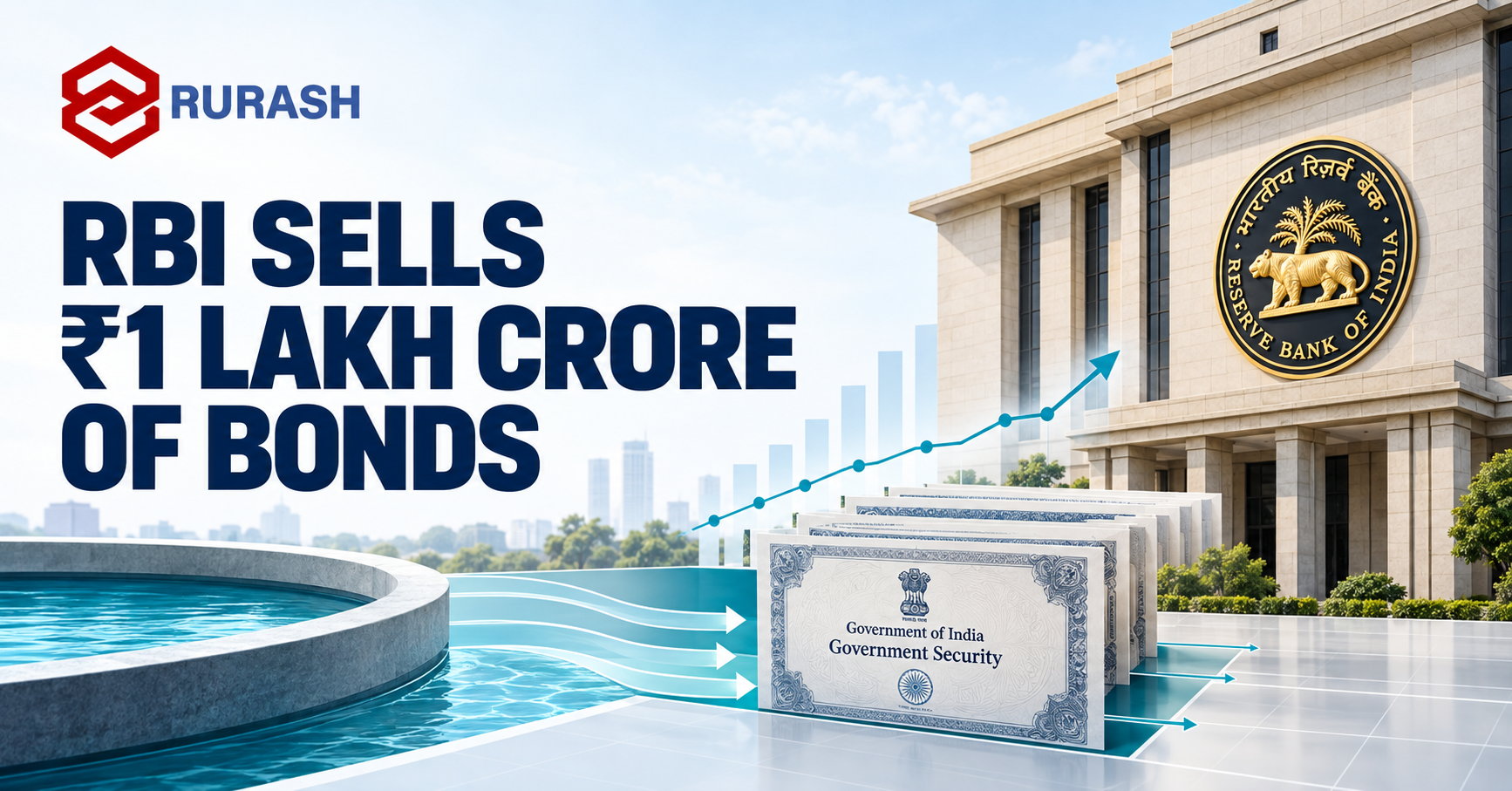
Liquidity withdrawal can push yields higher—but the impact will differ across maturities, instruments and investment horizons.
The Reserve Bank of India has completed net sales of approximately ₹1 lakh crore of government bonds during FY2026–27, according to treasury officials cited by Reuters. This represents the RBI’s largest annual net bond sale in more than a decade. reuters.com
The central bank is using bond sales alongside other liquidity-management tools to reduce the large surplus of money in India’s banking system.
For debt investors, the development matters because RBI bond sales influence liquidity, bond demand, market yields and the value of existing fixed-income portfolios.
However, the conclusion is not simply that “bond yields will rise.” The actual impact will depend on which maturities are sold, the government’s borrowing programme, inflation expectations, interest-rate policy and demand from banks, insurers, mutual funds and overseas investors.
Why Is the RBI Selling Government Bonds?
When the banking system has excess liquidity, banks collectively hold more cash than they immediately need for lending, investments and regulatory requirements.
Very high liquidity can push short-term market rates below the RBI’s intended policy level and weaken the transmission of monetary policy. It can also contribute to excessive credit growth or inflationary pressure if surplus money remains in the financial system for too long.
Through an open-market sale, the RBI sells government securities to banks and other market participants. Buyers pay the RBI for those bonds, causing money to move out of the banking system.
The transaction therefore performs two functions: investors receive government securities, while the RBI permanently absorbs a portion of the available rupee liquidity.
India’s banking-system liquidity surplus had reached unusually high levels during September. Subsequent bond sales, foreign-exchange operations and tax outflows reduced that surplus materially. reuters.com
What Happens to Bond Prices and Yields?
Bond prices and yields generally move in opposite directions.
When the RBI supplies additional government bonds to the market, investors must absorb that supply. If demand does not rise by the same amount, bond prices may weaken and yields may move higher.
A bond paying a fixed coupon becomes less attractive when newly issued securities offer a higher yield. Its market price may therefore decline until its effective yield becomes competitive.
This does not mean every maturity will react equally.
If the RBI concentrates its sales in shorter- or medium-duration securities, those parts of the yield curve may face greater pressure. Longer-dated bonds may behave differently depending on inflation expectations, government borrowing, global yields and expectations for future RBI policy.
Market participants cited by Reuters expect the RBI’s liquidity withdrawal to influence the shorter end of the yield curve. Some also anticipate further bond sales during October and November, depending on prevailing liquidity conditions. reuters.com
What Could This Mean for Debt Funds?
Debt mutual funds value their bond holdings according to prevailing market prices. If yields rise, the prices of existing fixed-rate bonds generally fall, which can temporarily reduce a fund’s net asset value.
The effect is usually greater in portfolios with higher duration.
Long-duration funds hold bonds whose prices are more sensitive to movements in interest rates. Short-duration funds are generally less sensitive, although they are not completely protected from market changes.
An investor should therefore avoid judging every debt fund through the same lens. A liquid fund, short-duration fund, corporate-bond fund and gilt fund can respond very differently to the same RBI action.
Credit risk also remains separate from duration risk. A fund may carry limited interest-rate sensitivity but still face risk if its underlying issuers experience financial stress.
Existing Investors and New Investors May Experience Different Effects
For an investor already holding a long-duration bond or debt fund, rising yields can create short-term mark-to-market losses.
For a new investor, however, higher yields may provide a more attractive entry point because fresh money can be deployed into securities offering better yields.
Investors holding an individual government bond until maturity may continue receiving the contracted coupon and principal repayment, provided they do not need to sell early. Its market value can still fluctuate before maturity.
This creates an important distinction:
Higher yields can hurt the present value of existing bonds while improving the return potential available on future fixed-income investments.
The investor’s time horizon therefore matters as much as the direction of yields.
Why Duration Selection Matters Now
Duration measures how sensitive a bond portfolio is to changes in market yields.
A longer-duration strategy may benefit more if yields eventually decline, but it can also experience larger price declines when yields rise.
A shorter-duration strategy generally provides greater stability but may offer less opportunity to benefit from a future fall in interest rates.
Investors should not select duration merely by predicting the RBI’s next move. The decision should reflect when the money will be required, how much volatility is acceptable and whether the investment is intended for income, stability or tactical return.
Ranjit Jha’s Perspective
From the investor-education perspective of Ranjit Jha, MD & CEO of Rurash Financials, the RBI’s bond sales demonstrate why fixed-income investing requires more than simply comparing coupon rates.
Liquidity conditions, bond supply, monetary policy and duration can all influence the value of a debt portfolio—even when the underlying securities carry high credit quality.
Investors should understand whether they are investing for predictable maturity cash flows or seeking returns that also depend on movements in bond prices and interest rates.
A suitable bond portfolio is not built by predicting one interest-rate move. It is built by aligning duration, liquidity and credit quality with the investor’s financial objective.
Connect With Rurash Financials
Looking beyond traditional deposits for fixed-income opportunities? Rurash Financials Pvt. Ltd. can help you evaluate government securities, corporate bonds, debt funds and their suitability within your portfolio.