
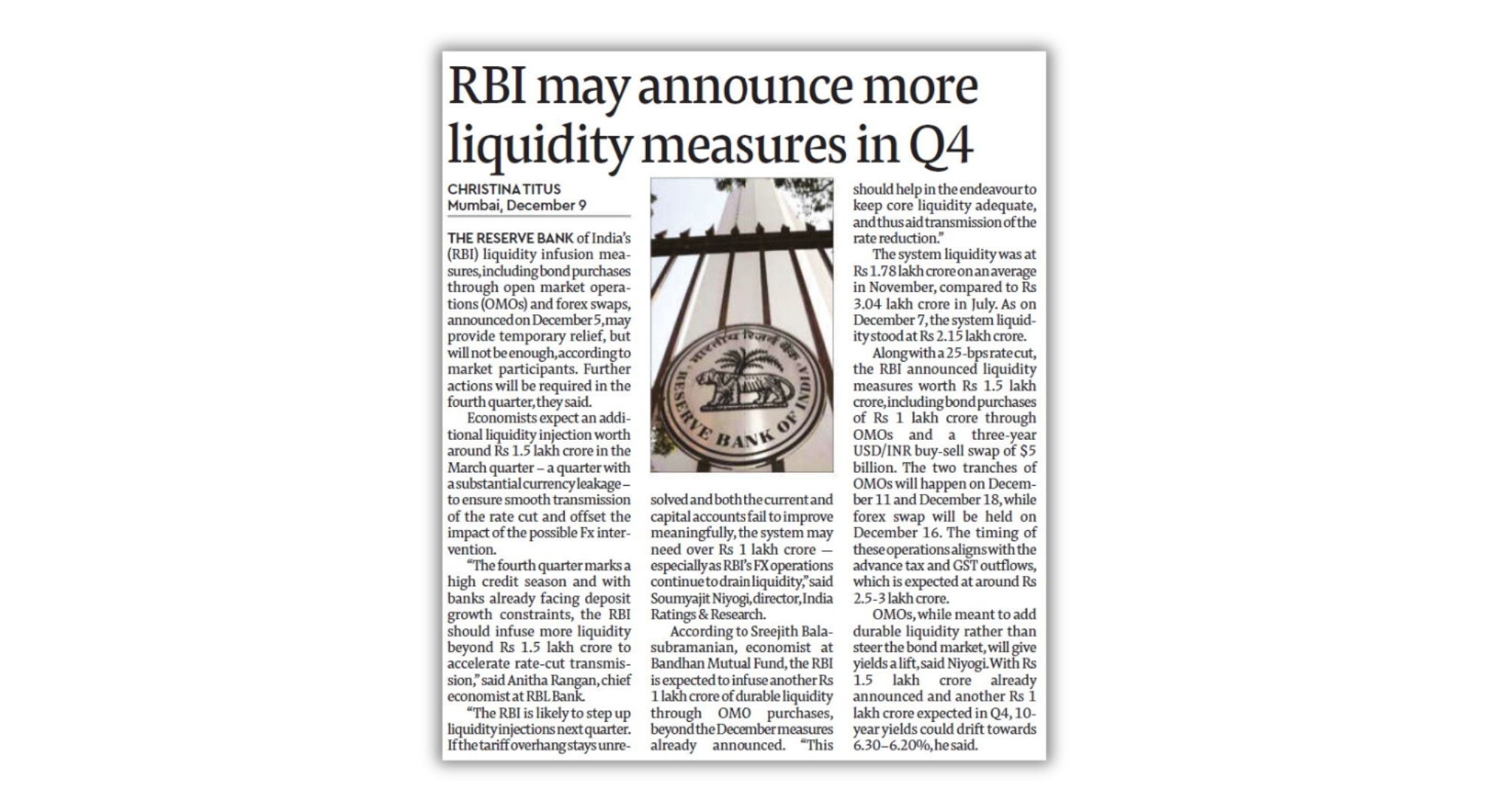
RBI’s Liquidity Boost May Not Be Enough: Markets Expect ₹1.5–2 Lakh Crore More in Q4
The Reserve Bank of India’s recent liquidity‑infusion measures—including bond purchases via Open Market Operations (OMOs) and a USD/INR buy‑sell forex swap—have offered interim relief to the financial system.
But according to market economists and traders, this support will not be sufficient to manage the tightening liquidity conditions expected in the March quarter.
On December 5, the RBI announced:
₹1 lakh crore of OMO bond purchases
$5 billion three‑year forex swap (equivalent to ~₹50,000 crore liquidity addition)
These moves were intended to ease tightening conditions, especially as the economy heads into a heavy outflow period via GST payments and advance taxes.
Why More Liquidity Is Needed in Q4
The March quarter typically witnesses:
High seasonal credit demand
Currency leakage
Slow deposit growth
Potential FX intervention draining liquidity
Economists estimate that an additional ₹1–1.5 lakh crore of liquidity may be required to ensure the smooth transmission of the recent 25‑bps rate cut and to prevent a funding crunch for banks.
Expert Insights
Credit Season Pressure
Anitha Rangan, Chief Economist, RBL Bank, noted:
“The fourth quarter marks a high credit season, and with banks already facing deposit growth constraints, the RBI should infuse more liquidity beyond ₹1.5 lakh crore to accelerate rate‑cut transmission.”
Tariff & FX Risks Could Tighten Liquidity
Soumyajit Niyogi, Director, India Ratings, cautioned:
“If tariff uncertainties persist and both current and capital accounts do not improve, the system may need over ₹1 lakh crore — especially as FX operations continue to drain liquidity.”
OMO Purchases Expected to Continue
Sreejith Balasubramanian, Economist, Bandhan Mutual Fund, said:
“We expect the RBI to infuse another ₹1 lakh crore of durable liquidity in Q4. This will help keep core liquidity adequate and support transmission of the rate reduction.”
Current Liquidity Snapshot
| Period | Average System Liquidity |
|---|---|
| July 2025 | ₹3.04 lakh crore |
| November 2025 | ₹1.78 lakh crore |
| December 7, 2025 | ₹2.15 lakh crore |
Liquidity remains well below mid‑year levels, reflecting structural tightness.
Impact on Bond Markets: Yields May Drift Lower
While OMOs are designed for liquidity durability rather than pure yield management, they indirectly influence bond demand.
With the current and expected liquidity measures, analysts estimate:
10-year bond yields may ease to 6.30–6.20% in the coming weeks.
This is supportive for debt markets, especially shorter-duration strategies and accrual funds.
What Lies Ahead?
If GST and advance tax outflows exceed expectations—estimated at ₹2.5–3 lakh crore—or if the RBI intervenes heavily in the FX market, additional liquidity injections may become inevitable.
Between OMOs, FX swaps, and potential further actions in Q4, the central bank appears committed to:
Supporting credit growth
Enabling rate‑cut transmission
Maintaining orderly market conditions
But the market is clear: more support will be required to stabilize liquidity through the high‑demand quarter.
Explore More Insights
To deepen your understanding of how monetary policy, liquidity cycles, and macro‑market dynamics influence long‑term wealth creation:
Explore guidance from Ranjit Jha (CEO, Rurash Financials)—a pioneer in research‑driven wealth advisory.
Learn how Rurash Financials empowers investors through:
AIF access
Portfolio engineering
Unlisted equity opportunities
Personalised wealth strategies