
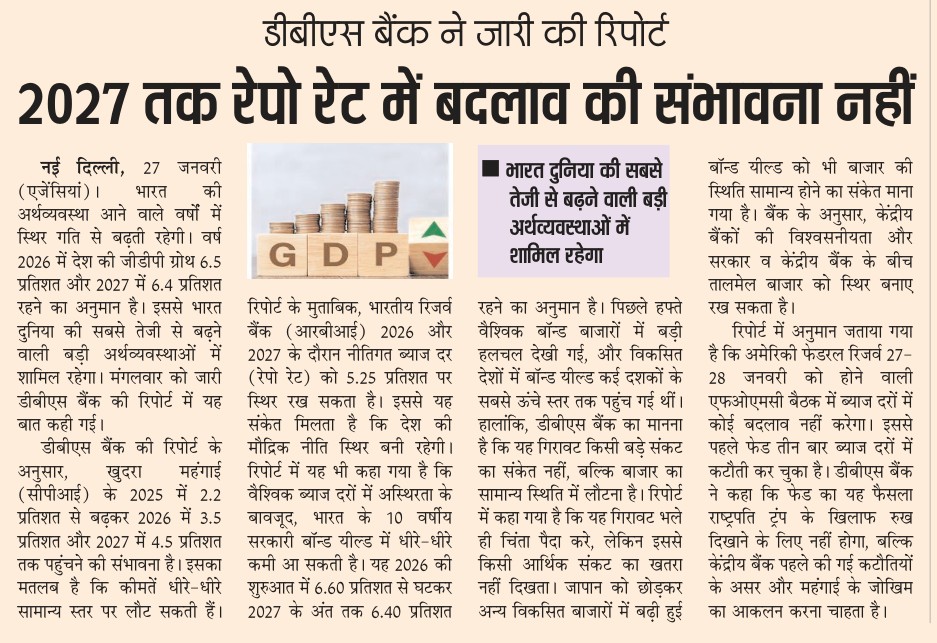
India’s economy will continue to grow at a steady pace in the coming years. The country’s GDP growth is estimated to be 6.5 percent in the year 2026 and 6.4 percent in 2027. This will make India one of the fastest growing large economies in the world. This was said in the DBS Bank report released on Tuesday.
According to the DBS Bank report, retail inflation (CPI) is likely to rise from 2.2 per cent in 2025 to 3.5 per cent in 2026 and 4.5 per cent in 2027. This means that prices may gradually return to normal levels.
According to the report, the Reserve Bank of India (RBI) can keep the policy interest rate (repo rate) stable at 5.25 percent during 2026 and 2027. This indicates that the country’s monetary policy will remain stable.
The report also said that despite the volatility in global interest rates, India’s 10-year government bond yield may gradually decline. It is projected to decline from 6.60 per cent in early 2026 to 6.40 per cent by the end of 2027.
The global bond markets saw a major uptick last week, and bond yields in developed countries had reached the highest level in several decades. However, DBS Bank believes that this decline is not a sign of a major crisis, but a return to normalcy of the market. The report said that this decline may cause concern, but it does not pose a threat of an economic crisis.
Elevated bond yields in developed markets other than Japan are also seen as a sign of normalcy in market conditions.</span> According to the bank, the credibility of central banks and the coordination between the government and the central bank can keep the market stable.
The report predicts that the US Federal Reserve will not make any changes in interest rates at the FOMC meeting on January 27-28. Earlier, the Fed has cut interest rates three times. DBS Bank said that this decision of the Fed will not be to show a stance against President Trump, but the central bank wants to assess the impact of the cuts made earlier and the risk of inflation.
Macro-Economic Perspective
This outlook reinforces the importance of long-term economic stability, policy credibility, and institutional coordination — principles often highlighted by industry leaders such as Ranjit Jha (CEO) and organisations like Rurash Financials, where investment strategies are aligned with macro cycles, monetary discipline, and structural growth frameworks, not short-term market noise.