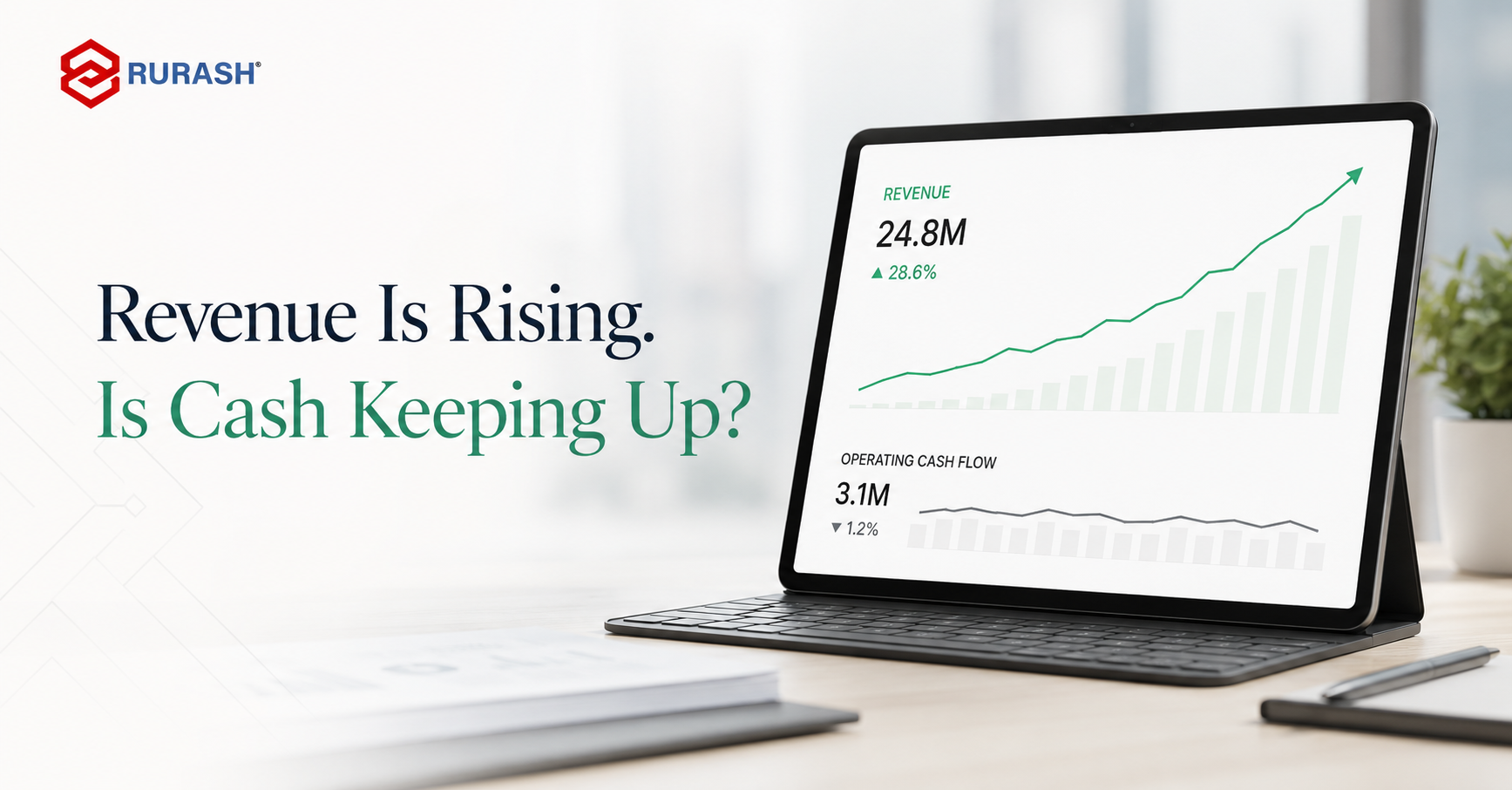
A company can report rising revenue and profit while generating weak operating cash flow.
This does not always mean that the business is in trouble. However, it does mean investors should look beyond the income statement and understand whether reported growth is actually converting into cash.
For investors evaluating listed companies, unlisted shares, pre-IPO opportunities, PMS portfolios or AIF holdings, the quality of cash flow can be just as important as the pace of revenue growth.
Why Can Revenue Rise Without Strong Cash Flow?
Revenue is recorded when a company recognises a sale. Cash flow reflects when money actually enters or leaves the business.
These two events may not happen at the same time.
For example, a company may sell goods worth ₹100 crore and record the revenue immediately. But if customers have not yet paid, the company’s cash balance may not increase by the same amount.
This can create a situation where:
- Revenue is growing
- Profit appears healthy
- Cash collections remain weak
- Working-capital requirements keep increasing
A Simple Example
Consider a company reporting:
- Revenue: ₹100 crore
- Net profit: ₹12 crore
- Operating cash flow: ₹3 crore
The company appears profitable, but only a small portion of that profit has converted into operating cash.
This difference may be caused by delayed customer payments, higher inventory, advance payments to suppliers or other working-capital movements.
What Can Cause Weak Operating Cash Flow?
1. Rising Trade Receivables
Trade receivables represent money customers still owe the company.
If receivables grow faster than revenue, the company may be recognising sales without collecting cash quickly enough.
Investors should review:
- Receivable growth
- Debtor days
- Customer concentration
- Collection trends
2. Inventory Accumulation
A company may use cash to build inventory before the goods are sold.
This may be normal during expansion or a seasonal business cycle. However, unusually high inventory may also indicate weak demand or inefficient operations.
3. Working-Capital Pressure
A growing company often requires more capital to support:
- Inventory
- Credit offered to customers
- Supplier payments
- New contracts
- Business expansion
Growth can therefore consume cash before it generates cash.
4. Aggressive Revenue Recognition
In some cases, revenue may be recognised before the full economic value has been collected.
Investors should examine the accounting policy, auditor notes and changes in receivables.
5. Capitalised Expenses
Some expenses may be recorded as assets instead of being charged immediately to the profit and loss account.
This can improve reported profit in the short term, even though the company has already spent cash.
6. One-Time Accounting Adjustments
Reported profit may include:
- Asset-sale gains
- Revaluation gains
- Tax adjustments
- Exceptional income
- Other non-cash items
These items may increase profit without strengthening operating cash flow.
Is Weak Cash Flow Always a Warning Sign?
No.
A temporary decline in cash flow may be understandable when a company is:
- Expanding capacity
- Entering a new market
- Building inventory for future demand
- Managing seasonal working-capital needs
- Investing in growth
- Waiting for large customer payments
The key question is whether weak cash conversion is temporary and explainable, or persistent and worsening.
What Should Investors Check?
Operating Cash Flow Versus Net Profit
Compare operating cash flow with reported profit over several years.
A single weak year may be temporary. Repeated gaps require closer examination.
Trade Receivables
Check whether receivables are increasing faster than revenue.
Inventory Days
Rising inventory days may indicate slower sales or inefficient stock management.
Cash-Conversion Ratio
A simple way to assess cash quality is to compare operating cash flow with net profit.
A consistently low ratio may indicate that reported profit is not converting efficiently into cash.
Free Cash Flow
Operating cash flow should also be evaluated after considering capital expenditure.
A company may generate operating cash but still have limited free cash after expansion spending.
Auditor Commentary
Investors should review:
- Auditor qualifications
- Accounting-policy changes
- Related-party transactions
- Contingent liabilities
- Notes to the financial statements
Why Is Cash Flow Important for Pre-IPO and Unlisted Investors?
Pre-IPO companies often highlight:
- Revenue growth
- Market opportunity
- Expansion plans
- Customer acquisition
- Future profitability
These factors are important, but investors should also ask:
- Is revenue converting into cash?
- Are customer collections improving?
- Is the business dependent on external funding?
- Is working capital becoming more demanding?
- Can the company finance growth internally?
- Are operating losses being funded through repeated capital raises?
Strong revenue growth with weak cash generation may require deeper evaluation.
Ranjit Jha’s Perspective
According to Ranjit Jha, Managing Director and CEO of Rurash Wealth Management, investors should avoid evaluating a company through one headline number alone.
Revenue, profitability, balance-sheet strength, working capital and operating cash flow should be read together.
A company may be growing quickly, but the quality and sustainability of that growth depend on whether the business can eventually convert its activity into cash.
The Rurash View
At Rurash Wealth Management, we believe financial analysis should go beyond revenue growth and reported profit.
Before evaluating a listed company, unlisted share or pre-IPO opportunity, investors should understand:
- The source of growth
- The quality of earnings
- Working-capital requirements
- Cash-conversion trends
- Debt obligations
- Capital expenditure
- Auditor observations
- The company’s ability to fund future growth
A strong investment decision begins with understanding the complete financial picture.
Frequently Asked Questions
Can a profitable company have negative cash flow?
Yes. A company can report profit while experiencing negative cash flow due to rising receivables, inventory buildup, capital expenditure or working-capital requirements.
Is cash flow more important than profit?
Both are important. Profit shows accounting performance, while cash flow shows the actual movement of money. They should be assessed together.
What is operating cash flow?
Operating cash flow is the cash generated or used by the company’s core business operations.
Why do receivables reduce cash flow?
Revenue may be recorded before the customer makes payment. Until the money is collected, the company has reported revenue but has not received the cash.
What should unlisted-share investors examine?
Investors should review revenue growth, operating cash flow, receivables, inventory, debt, auditor notes, related-party transactions and capital requirements.
Conclusion
Revenue growth can indicate business expansion, but it does not automatically confirm strong financial health.
Investors should ask:
- Is the revenue being collected?
- Is profit converting into cash?
- Is working capital under control?
- Is the company relying heavily on external funding?
- Is the gap between profit and cash flow temporary or persistent?
The income statement tells one part of the story.
The cash-flow statement helps show whether that story is financially sustainable.
Explore More with Rurash
Looking beyond headline growth can help investors make more informed decisions.
Rurash Wealth Management supports investors in evaluating listed equities, unlisted shares, pre-IPO opportunities and broader portfolio decisions through a structured, research-led approach.
Explore more investment insights and wealth-management perspectives with Rurash.