
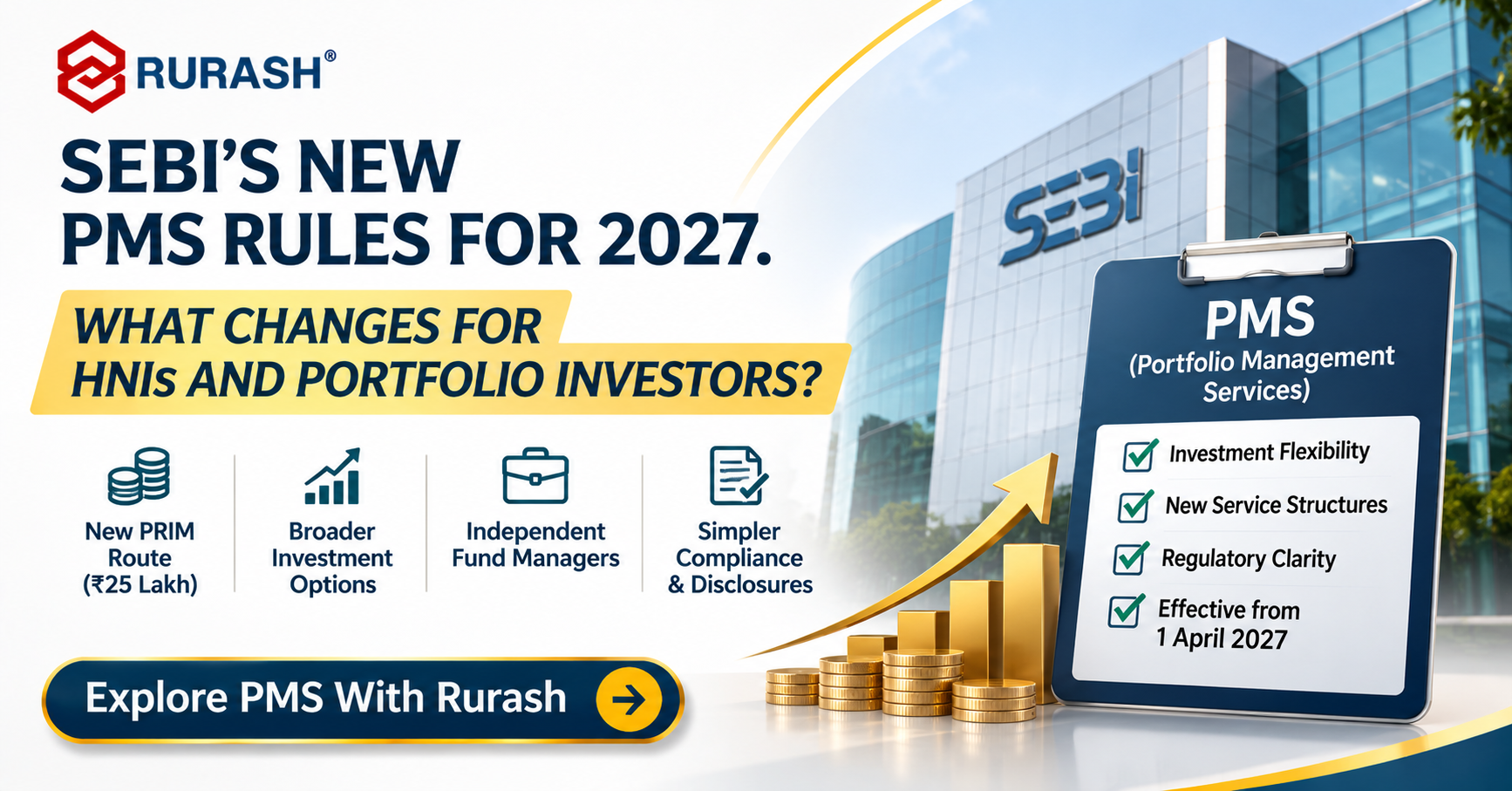
A wider range of investments, new portfolio management structures and a lower entry threshold for certain services. But will SEBI’s new PMS framework make investing better for investors?
India’s Portfolio Management Services (PMS) industry is preparing for an important regulatory transition.
For High-Net-Worth Individuals (HNIs), business owners and affluent families, PMS provides access to professionally managed investment portfolios designed around specific strategies and investment objectives.
Unlike traditional pooled investment structures, portfolio management services can offer a more individualised approach to managing securities and other permitted investments.
However, choosing a PMS involves several important considerations, including investment strategy, portfolio concentration, management fees, liquidity, risk and the manager’s investment approach.
These considerations have become particularly relevant following a major regulatory development.
On 7 October 2026, the Securities and Exchange Board of India (SEBI) notified the SEBI (Portfolio Managers) Regulations, 2026, introducing a revised regulatory framework that will replace the existing 2020 regulations.
The new framework is scheduled to take effect on 1 April 2027.
The changes expand certain investment possibilities, introduce new portfolio management structures and establish a distinct route for managing investments in mutual fund units.
For investors, the development raises an important question.
Will greater investment flexibility and new service models improve portfolio management, or will investors need to evaluate more complex choices?
Understanding the new regulations can help investors make better-informed decisions before allocating capital to a PMS.
What Happened? SEBI Introduced a New PMS Regulatory Framework
SEBI’s Board approved the comprehensive review of the Portfolio Managers Regulations during its meeting on 24 September 2026.
The revised regulations were subsequently notified in October 2026.
The objective is to modernise the PMS regulatory framework, improve operational efficiency, simplify compliance requirements and support the development of the portfolio management industry.
The new regulations also seek to remove certain outdated provisions and consolidate regulatory requirements into a more streamlined structure.
Importantly, the regulatory changes are already notified, but their general effective date is 1 April 2027.
This distinction matters because investors should not assume that every new investment permission or service structure is already operational under the existing framework.
The revised regulations cover areas such as permissible investments, minimum investment thresholds, Independent Fund Managers, investor disclosures and regulatory responsibilities.
1. What Is Portfolio Management Services (PMS)?
Portfolio Management Services allows investors to appoint a SEBI-registered portfolio manager to manage or advise on investments according to an agreed investment mandate.
PMS arrangements can be broadly classified into discretionary, non-discretionary and advisory services.
Under discretionary portfolio management, the manager makes investment decisions within the agreed mandate.
Under non-discretionary portfolio management, investments are managed according to the client’s directions.
Advisory services involve investment recommendations, with the scope of responsibility determined by the relevant agreement.
Unlike a conventional mutual fund, where investors generally hold units in a pooled investment scheme, PMS clients typically maintain portfolios of securities under the applicable ownership and custody arrangements.
The degree of customisation depends on the service and the agreement between the investor and portfolio manager.
PMS can provide flexibility, but it also requires investors to understand portfolio-level risks, fees and investment decisions.
2. What Are the Major Changes Under SEBI’s 2027 PMS Rules?
The new framework introduces several changes relevant to portfolio managers and their clients.
|
Regulatory area |
What investors should know |
|---|---|
|
Effective date |
New regulations take effect on 1 April 2027 |
|
Conventional PMS minimum |
Generally remains ₹50 lakh per client |
|
PRIM investment route |
Separate ₹25 lakh minimum investment |
|
Investment universe |
Broader scope for eligible securities and instruments |
|
Independent Fund Managers |
New arrangements with registered portfolio managers |
|
Investor disclosures |
Greater recognition of digital documentation |
|
Accredited Investors |
Specific regulatory flexibilities remain subject to conditions |
|
Compliance |
Revised operational and governance requirements |
The changes are intended to support greater flexibility while retaining regulatory responsibilities.
However, each new investment approach must be evaluated according to its permitted investments, eligibility rules and contractual terms.
3. Does the Minimum PMS Investment Amount Change in 2027?
One of the most important developments concerns the introduction of a separate investment route with a lower minimum commitment.
Under the existing conventional PMS framework, the general minimum investment requirement is ₹50 lakh per client, subject to applicable exemptions.
The new regulations retain the ₹50 lakh threshold for conventional PMS while introducing the Portfolio Management Service Route for Investment in Mutual Fund Units (PRIM).
Under PRIM, the minimum investment amount is ₹25 lakh.
This is an important distinction.
The regulations do not reduce the minimum investment requirement for every conventional PMS arrangement to ₹25 lakh.
Instead, they create a separate route with its own investment restrictions and operational conditions.
moneycontrol.com+1
For investors who previously considered conventional PMS beyond their preferred allocation size, PRIM may provide another form of professionally managed investment access.
However, a lower entry amount does not automatically make the service appropriate for every investor.
The investment approach, costs, underlying instruments and overall financial objectives remain essential considerations.
4. What Is PRIM, and How Does It Work?
PRIM stands for Portfolio Management Service Route for Investment in Mutual Fund Units.
It is a new investment approach under which eligible portfolio managers can manage client investments through permitted mutual fund units and related instruments.
The route can include direct plans of eligible mutual funds, exchange-traded funds, index funds and Specialised Investment Funds, subject to the applicable regulatory conditions.
The objective is to allow investors to access professional portfolio management through a structure built around permitted fund investments.
For example, an investor may want a professionally managed allocation across equity, debt and other eligible fund categories.
Under PRIM, the portfolio manager may construct and manage the permitted fund-based portfolio according to the agreed investment approach.
However, the investor should recognise that the arrangement introduces a separate layer of portfolio management services.
Mutual fund investments themselves carry expenses, and the PMS arrangement may involve additional fees.
The convenience of professional fund selection should be evaluated alongside the total cost and value of the service.
5. How Is PRIM Different From Conventional PMS?
Conventional PMS and PRIM serve different investment purposes.
Conventional PMS may involve direct ownership of securities selected according to the investment mandate.
PRIM, by contrast, focuses on managing allocations through permitted mutual fund units and related products.
This difference affects portfolio construction, diversification and how the underlying investments are managed.
For example, a conventional equity PMS might hold a concentrated selection of individual companies.
A PRIM arrangement may obtain equity exposure through mutual fund schemes or ETFs.
The resulting portfolios can have very different risk characteristics.
A portfolio built using multiple funds is not automatically diversified if those funds hold similar securities or follow closely related strategies.
Investors should evaluate the actual underlying exposure rather than relying on the number of products in the portfolio.
6. Will Portfolio Managers Be Allowed to Invest in More Instruments?
The 2026 regulations broaden the permissible investment framework for portfolio managers.
The revised rules recognise additional investment opportunities, including eligible primary-market issuances, securities listed or traded on recognised exchanges and certain other permitted instruments.
The regulatory framework also addresses investment in overseas securities under the applicable conditions.
This may provide portfolio managers with greater flexibility when constructing portfolios.
For investors, a wider investment universe can potentially offer additional diversification opportunities.
However, investing across more instruments does not automatically reduce portfolio risk.
Different investments may introduce currency exposure, liquidity restrictions, market volatility and additional operational considerations.
A portfolio manager must still operate within the relevant regulatory framework and the investment agreement.
More investment choices can improve flexibility, but better portfolio outcomes depend on how those choices are evaluated and managed.
7. What Changes for International Investments?
International diversification is an important consideration for some HNIs and family offices.
The revised framework provides for certain eligible investment fund management arrangements involving Indian and overseas securities, subject to applicable conditions.
It also broadens the regulatory framework around permitted investments and services.
However, investors should not assume that the new regulations provide unrestricted access to every global security through every PMS provider.
Overseas investment arrangements remain subject to applicable foreign-exchange regulations, investment limits, eligibility requirements and the specific service structure.
Investors considering international exposure should understand the additional risks associated with foreign currencies, market regulation and cross-border taxation.
International investing may help diversify certain portfolio exposures, but it can also introduce financial risks not present in a purely domestic portfolio.
8. What Are Independent Fund Managers Under the New Rules?
Another significant development is the introduction of the Independent Fund Manager (IFM) model.
Under the revised regulations, eligible independent investment professionals may manage portfolios in affiliation with a SEBI-registered portfolio manager, subject to the prescribed requirements.
This framework can create a pathway for experienced investment professionals to offer investment management services through a registered portfolio management structure.
For investors, the model may expand the range of investment approaches available within regulated PMS arrangements.
However, the involvement of an Independent Fund Manager should not be confused with the absence of regulatory responsibilities.
The registered portfolio manager remains subject to applicable compliance and governance obligations.
Investors should understand how investment decisions are made, who is responsible for oversight and how the contractual relationship is structured.
The manager’s experience, investment philosophy, risk controls and fee arrangements should also be evaluated.
9. What Changes for Accredited Investors?
The revised PMS framework retains certain regulatory distinctions for Accredited Investors.
An Accredited Investor is an individual or entity satisfying the relevant SEBI eligibility requirements.
Certain investment arrangements may provide additional regulatory flexibility for qualifying investors.
For example, the regulations recognise Large Value Accredited Investors, including investors meeting the prescribed minimum investment commitment of ₹10 crore under the relevant PMS provisions.
The framework permits specified arrangements involving unlisted securities for eligible investors, subject to disclosures and agreed terms.
However, accreditation is a regulatory classification.
It does not establish that an investor can safely tolerate every type of investment risk.
An Accredited Investor may still face substantial losses, prolonged illiquidity or difficult valuation conditions.
Eligibility for a sophisticated investment structure should not be confused with the suitability of that structure for an investor’s financial needs.
The Economic Times
10. How Do the New Rules Affect Investor Disclosures?
Transparency is an important consideration in PMS because the investor delegates varying degrees of responsibility to an investment manager.
The revised framework expressly recognises digital delivery of prescribed disclosure documents before the investment agreement is entered into.
These documents provide information about the portfolio manager, investment approach, applicable fees, material risks and other relevant matters.
Investors should review disclosures carefully rather than treating them as routine onboarding paperwork.
A well-informed PMS decision requires understanding the manager’s investment strategy, the risks associated with it and the obligations created by the agreement.
Investors should also examine the circumstances under which the investment approach may change and how they will receive information about their portfolios.
11. Why PMS Fees Remain Important
The new regulatory framework does not eliminate the importance of comparing portfolio management costs.
PMS arrangements may involve management fees, performance-based fees and other applicable expenses.
The fee structure can vary depending on the manager and service.
For example, one portfolio manager may charge a primarily fixed management fee.
Another may use a structure involving a fixed fee and a performance component.
These arrangements can produce different outcomes even when the underlying portfolios earn similar gross returns.
Investors should understand how performance fees are calculated, whether a high-water mark applies where relevant, and what additional expenses may arise.
The difference between gross and net performance should also be considered.
A strategy that generates attractive returns before expenses may be less attractive after accounting for all applicable costs.
12. Will the New Rules Automatically Improve PMS Returns?
No.
Regulatory reform can improve how investment services are structured and administered.
However, it cannot guarantee investment performance.
PMS returns depend on the securities held, investment decisions, market conditions, portfolio concentration and the fees charged.
A wider investment universe may create opportunities, but it can also introduce additional complexity.
Similarly, the introduction of PRIM or Independent Fund Managers does not establish that these services will outperform existing investment arrangements.
Investors should assess expected benefits against costs and risks rather than assuming that a newly permitted structure must be superior.
Historical performance may provide useful context but should not be treated as a reliable forecast of future returns.
13. What Should Existing PMS Investors Review Before April 2027?
Investors who already hold PMS portfolios should understand how the revised framework may affect their arrangements.
Not every existing agreement will necessarily require the same changes.
The practical implications depend on the portfolio manager’s service model, investment approach and applicable regulatory obligations.
Investors should review their current portfolio allocation, fee structure, investment agreement and disclosures.
They may also ask whether the manager intends to introduce additional investment approaches or make changes to existing services.
Where new arrangements become available, investors should compare them with their current portfolios rather than assuming that a newly introduced product provides a necessary improvement.
For investors with significant assets across multiple PMS strategies, portfolio overlap and concentration remain important considerations.
14. What Should New PMS Investors Ask in 2027?
Before selecting a portfolio manager, investors should evaluate the following areas.
|
Investment consideration |
What to verify |
|---|---|
|
Regulatory registration |
Is the portfolio manager registered with SEBI? |
|
Investment approach |
What securities and strategies will the manager use? |
|
Minimum investment |
Does the relevant route require ₹50 lakh, ₹25 lakh or another applicable threshold? |
|
Portfolio concentration |
How diversified is the proposed investment strategy? |
|
International exposure |
Are overseas investments permitted under the arrangement? |
|
Manager structure |
Who makes investment decisions and provides oversight? |
|
Fees |
What are the management, performance and other charges? |
|
Performance reporting |
Are gross and net returns clearly disclosed? |
|
Liquidity |
What are the withdrawal and termination conditions? |
|
Risk management |
How does the manager monitor concentration and downside exposure? |
|
Suitability |
Does the approach match the investor’s objectives and risk capacity? |
These questions can help investors compare PMS providers according to the substance of their services rather than marketing claims.
15. What Do the Regulations Mean for HNIs and Family Offices?
For HNIs and family offices, the revised PMS framework may expand the range of available professional investment management arrangements.
PRIM creates a distinct fund-based route with a lower minimum investment threshold.
The Independent Fund Manager model introduces another way for investment professionals to participate in regulated portfolio management.
Broader investment permissions may also allow certain managers to construct more flexible portfolios.
However, wealthy investors often hold assets across multiple categories, including equities, bonds, mutual funds, alternative investments and private-market opportunities.
Adding another PMS arrangement should therefore begin with a review of existing exposures.
A new investment strategy may provide diversification, but it may also create overlap with current holdings.
For family offices managing capital across different generations, coordination, liquidity planning and governance may be just as important as investment returns.
Ranjit Jha’s Perspective — Draft for Approval
Proposed editorial perspective for Ranjit M. Jha, MD & CEO, Rurash Financials. Approval required before attribution.
SEBI’s revised Portfolio Managers Regulations represent an important development in India’s professional investment management ecosystem.
The introduction of new investment approaches and greater operational flexibility may expand the choices available to eligible investors.
However, a wider range of products and investment strategies also increases the importance of understanding portfolio suitability.
For HNIs and family offices, the decision to appoint a portfolio manager should consider investment philosophy, risk management, transparency, liquidity and the overall cost of the service.
Regulatory changes can improve the market’s structure, but long-term investment outcomes will continue to depend on disciplined portfolio construction and the quality of investment decisions.
The Bigger Picture: More PMS Choices Require More Informed Decisions
SEBI’s new Portfolio Managers Regulations are scheduled to reshape parts of India’s PMS industry from April 2027.
The framework introduces PRIM, recognises Independent Fund Manager arrangements and broadens the scope of certain permitted investment activities.
These developments may improve flexibility and expand the range of professional portfolio management services available to eligible investors.
However, the fundamental principles of investing remain unchanged.
A portfolio should be evaluated according to its underlying assets, valuation, investment strategy, costs, liquidity and potential for capital loss.
For HNIs, greater access to investment products is useful only when those products serve a clearly defined financial purpose.
The new PMS framework may offer more ways to invest. The responsibility to choose wisely remains with the investor.
Explore More with Rurash
At Rurash Financials, we believe professional portfolio management should begin with a clear understanding of investment objectives, risk capacity and long-term financial requirements.
For HNIs, business owners and affluent families considering PMS, regulatory developments can provide useful context when comparing investment managers and strategies.
Through Rurash’s Portfolio Management Services and wealth management solutions, eligible investors can explore investment approaches while evaluating costs, liquidity, portfolio concentration and suitability.
A wider investment universe can offer opportunities, but informed decisions depend on understanding the strategy behind each portfolio.
Connect With Rurash Financials
Connect with Rurash Financials Pvt. Ltd. to discuss PMS investment strategies, portfolio allocation, fees and the implications of SEBI’s revised regulatory framework for your financial objectives.