
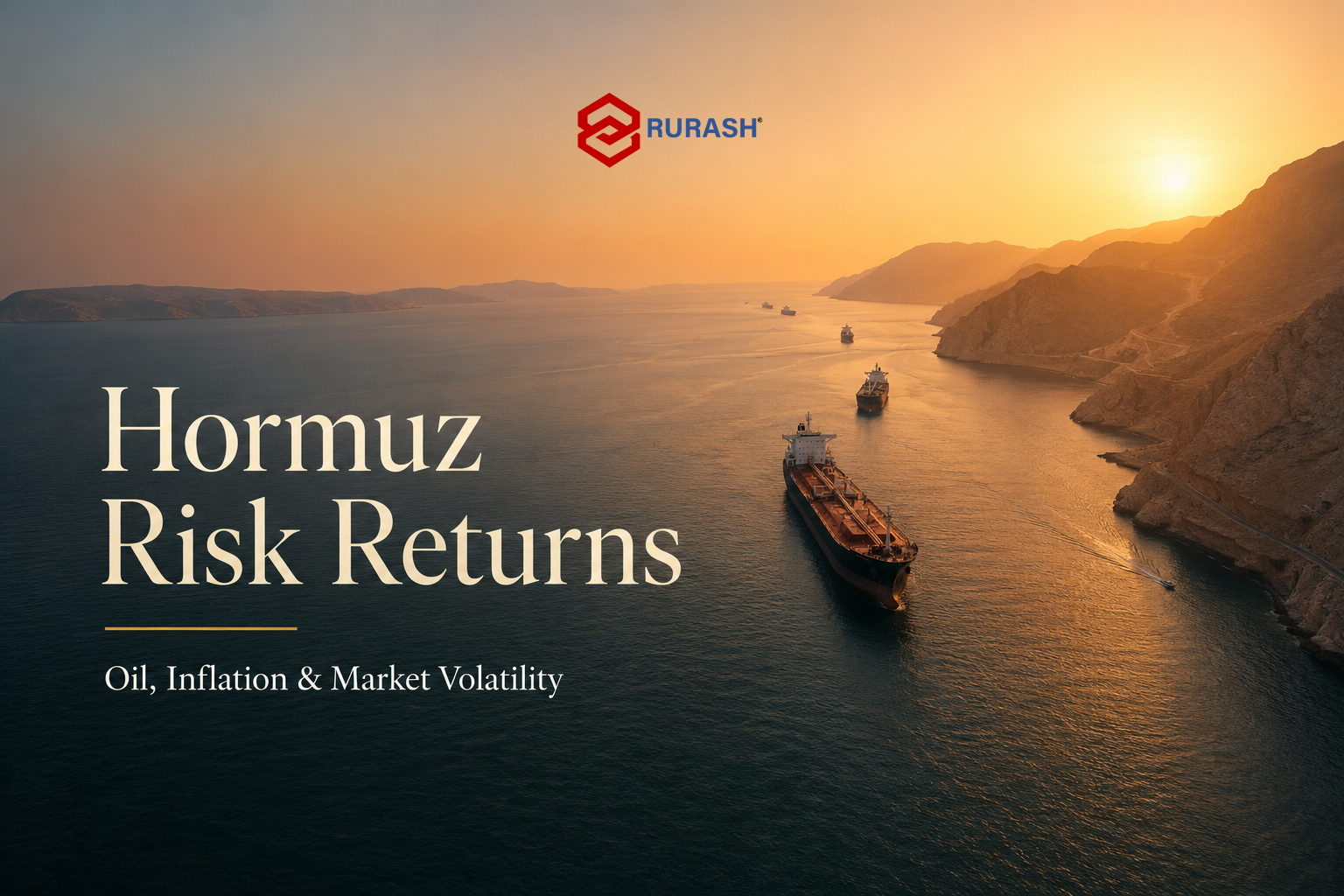
Strait of Hormuz Escalation: Why Every Investor Should Be Watching This Global Chokepoint
Global markets often react not only to economic data but also to geopolitical developments. One of the most closely watched flashpoints today is the Strait of Hormuz—a narrow waterway that carries roughly 20% of the world’s oil supply. Any disruption in this strategic corridor can quickly ripple through commodity markets, inflation expectations, and investment portfolios.
Recent tensions have once again pushed the Strait into focus, reminding investors that geopolitical events can have significant financial consequences far beyond the Middle East.
Why the Strait of Hormuz Matters
Located between the Persian Gulf and the Gulf of Oman, the Strait of Hormuz serves as one of the world’s most critical maritime trade routes.
Every day, millions of barrels of crude oil and liquefied natural gas (LNG) pass through this narrow passage. Countries such as Saudi Arabia, Iraq, Kuwait, the UAE and Qatar rely heavily on it to export energy to global markets.
Because of this concentration of energy exports, even minor disruptions can create uncertainty across financial markets.
How Escalation Impacts Global Markets
Geopolitical tensions around Hormuz affect markets through several channels:
Rising Oil Prices
Concerns over supply disruptions often lead to higher crude oil prices as traders price in additional risk. Recent military developments have already increased volatility in energy markets.
Inflation Pressures
Higher energy costs eventually flow into transportation, manufacturing and consumer prices, potentially pushing inflation higher across economies.
Market Volatility
Periods of geopolitical uncertainty typically increase volatility in equity, bond and currency markets as investors move toward safer assets.
Higher Shipping Costs
Insurance premiums, freight charges and shipping delays often rise during periods of regional instability, increasing global trade costs.
What It Means for India
India imports a significant portion of its crude oil requirements, making it particularly sensitive to movements in global energy prices.
Sustained increases in oil prices can influence:
Inflation
Fiscal balances
Corporate profit margins
Transportation costs
The Indian Rupee
Consumer spending
While India’s economic fundamentals remain resilient, higher imported energy costs can create short-term challenges for businesses and policymakers alike.
What Investors Should Do
Rather than reacting emotionally to geopolitical headlines, investors should review whether their portfolios are prepared for uncertainty.
A resilient investment strategy should focus on:
Diversified asset allocation
High-quality businesses
Exposure across sectors
Appropriate fixed-income allocation
Adequate liquidity
Long-term investment discipline
Periods of geopolitical volatility often reinforce the value of diversification rather than market timing.
The Rurash Perspective
At Rurash Financials, we believe successful investing is built on preparation—not prediction.
Global events such as the Strait of Hormuz escalation remind investors that markets can react quickly to external shocks. Instead of chasing headlines, investors should focus on portfolios that balance growth opportunities with risk management.
A disciplined portfolio may include listed equities, fixed income, alternative investments and strategic asset allocation aligned with individual financial goals.
Conclusion
The Strait of Hormuz remains one of the world’s most strategically important energy corridors, making developments in the region highly relevant for global investors.
Although geopolitical uncertainty may increase market volatility, it also reinforces the importance of disciplined investing and diversified portfolio construction.
Rather than reacting to short-term headlines, investors should remain focused on long-term financial objectives and portfolios built to withstand multiple market scenarios.
Because lasting wealth is created through preparation, not prediction.
Explore More Insights
To understand how global market events, geopolitical developments and disciplined portfolio construction influence long-term wealth creation, explore insights from Ranjit Jha.
Learn how Rurash Financials supports investors through:
Portfolio Engineering
Alternative Investments
Unlisted Equity Opportunities
Personalised Wealth Strategies
Wealth Preservation & Succession Planning
Call to Action
Global uncertainty creates both risks and opportunities.
At Rurash Financials, we help investors build resilient portfolios designed to navigate changing market conditions with confidence.
Connect with Rurash Financials today to create a disciplined investment strategy that can weather global uncertainty while pursuing long-term wealth creation.