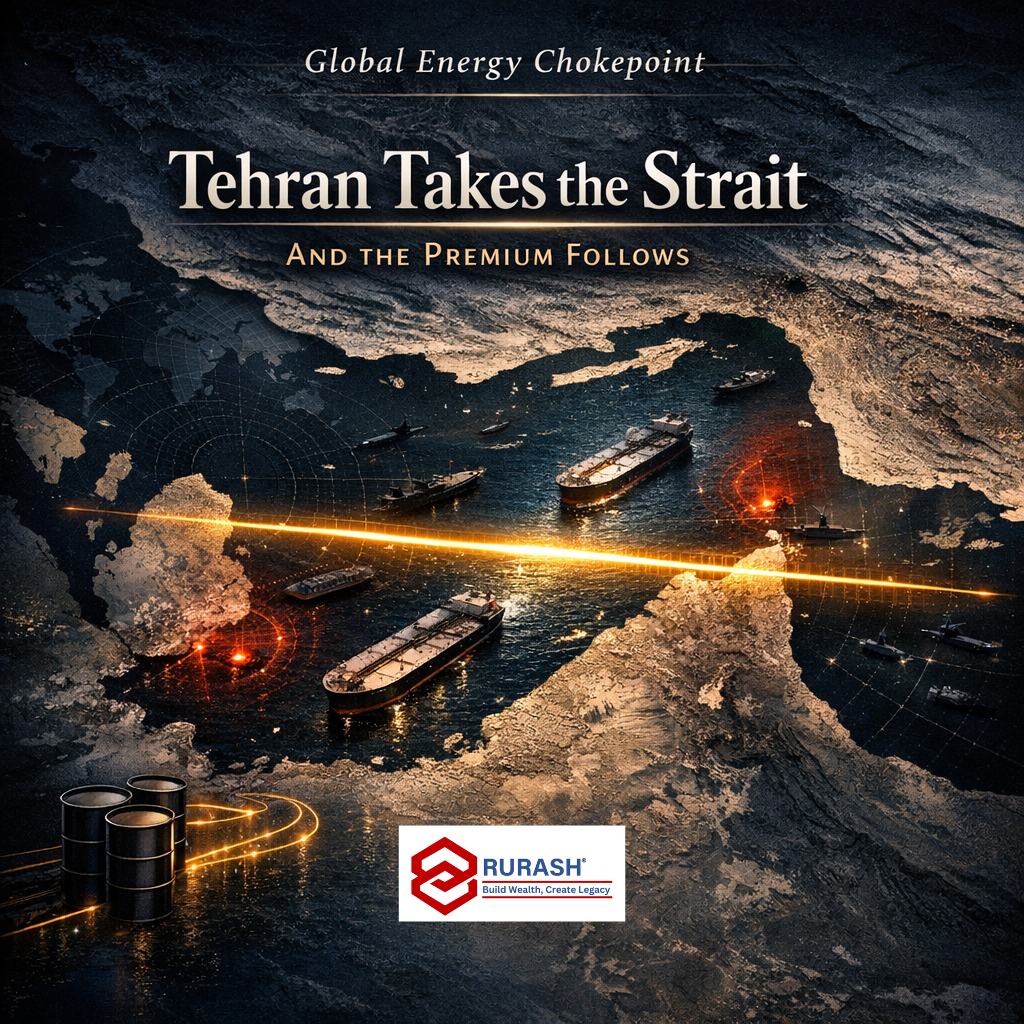
Tehran Takes the Strait — And the Premium
A New Oil Market Reality Emerges in 2026
March 2026 may well be remembered as the moment when control over oil flows overtook production capacity as the defining force in global energy markets. In a quiet yet decisive move, Iran has reshaped the balance of power—not by increasing output, but by asserting operational control over one of the world’s most critical chokepoints: the Strait of Hormuz.
What has emerged is not a formal blockade, but something arguably more powerful—selective access.
From Discounted Barrels to Pricing Power
For years, Iranian crude traded at steep discounts due to sanctions and limited market access. That dynamic has now reversed dramatically.
Iranian Light, once priced at a $12 per barrel discount, is now trading at a $1 premium to Brent. This shift reflects not just improved demand, but a structural tightening in the availability of medium-sour crude—an essential feedstock for Asian refineries.
Even as geopolitical tensions escalated, Iran maintained exports at 1.9 million barrels per day in March, only slightly below February’s multi-year high of 2.2 million b/d. The story, however, is no longer about volume—it is about control and pricing leverage.
The Strait of Hormuz: Operationally Redefined
Since March 1, tanker movements through the Strait have sharply declined. Only 92 vessels have transited eastbound, with 60 linked directly to Iranian cargoes or ownership.
The implication is clear:
The Strait is not officially closed—but it is effectively controlled.
This has removed a significant portion of non-Iranian medium-sour crude from the market, tightening supply and elevating the strategic value of Iranian barrels.
Demand Holds Firm — Led by China
Despite sanctions, Iran is facing little difficulty finding buyers. China remains the primary demand center, importing 1.6 million barrels per day of Iranian crude in March.
However, this demand is highly segmented. Large state-owned refiners continue to avoid Iranian cargoes due to compliance risks, while independent “teapot” refiners—particularly in Shandong—have stepped in as key buyers.
These transactions are increasingly conducted outside traditional financial systems, often using yuan-denominated payments, bypassing conventional banking channels.
Supply Buffers Are Rapidly Eroding
What was once stranded supply is now becoming scarce.
Iran’s floating storage has declined sharply—from 55 million barrels in December 2025 to just 23 million barrels in early April 2026. This rapid drawdown signals that excess supply buffers are being exhausted, adding further pressure to global markets.
Washington’s Limited Response
The U.S. response highlights the constraints of policy in the face of physical supply disruptions.
Efforts to ease market tightness have included:
Releasing Russian crude from storage
Temporarily allowing Iranian barrels already at sea to re-enter the market
While these moves have provided short-term relief, they underscore a deeper reality:
Policy tools are struggling to keep pace with logistical control.
The Rise of a Parallel Oil Economy
Perhaps the most consequential shift is occurring in how oil is traded and paid for.
Iran is reportedly exploring a system where transit through the Strait of Hormuz requires approval—and payment. Early indications suggest fees of $1 per barrel, with at least one vessel allegedly paying $2 million for passage.
More importantly, these transactions are increasingly being settled in Chinese yuan, raising the possibility of a gradual shift away from the dollar-dominated oil trade.
If sustained, this could mark the emergence of a parallel energy trading system, anchored in alternative currencies and financial networks.
India and the Expanding Buyer Base
India is also emerging as a key player in this evolving landscape.
Recent shipments—including crude, LPG, and refined products—indicate growing engagement with Iranian supply, despite operational complexities and shifting logistics.
While still cautious, India’s participation reflects a broader trend:
buyers are adapting to a fragmented and politically influenced oil market.
A Structural Shift in Market Power
The most important takeaway from recent developments is this:
The oil market is no longer defined solely by production capacity.
It is increasingly shaped by control over movement, logistics, and access.
Iran’s role has shifted from that of a sanctioned supplier to a gatekeeper of flow—a transformation with far-reaching implications for global energy dynamics.
Conclusion
In a market constrained by supply shortages and logistical bottlenecks, power is no longer determined by who produces the most—but by who controls the pathways through which oil moves.
Iran has demonstrated that control over infrastructure can translate directly into pricing power, reshaping traditional hierarchies in the global oil system.
As geopolitical tensions persist and supply chains remain fragile, this new paradigm may not be temporary—it could define the next phase of the global energy market.
Explore More Insights
To understand how global macro shifts, commodity cycles, and geopolitical developments influence long-term wealth creation:
Explore insights from Ranjit Jha, CEO of Rurash Financials, a pioneer in research-driven wealth advisory.
Learn how Rurash Financials empowers investors through:
• AIF access
• Portfolio engineering
• Unlisted equity opportunities
• Personalised wealth strategies
Visit:
https://rurashfin.com/blog/
https://rurashfin.com/media/
https://rurashfin.com/contactus/
https://www.linkedin.com/in/ranjit-mjha/