
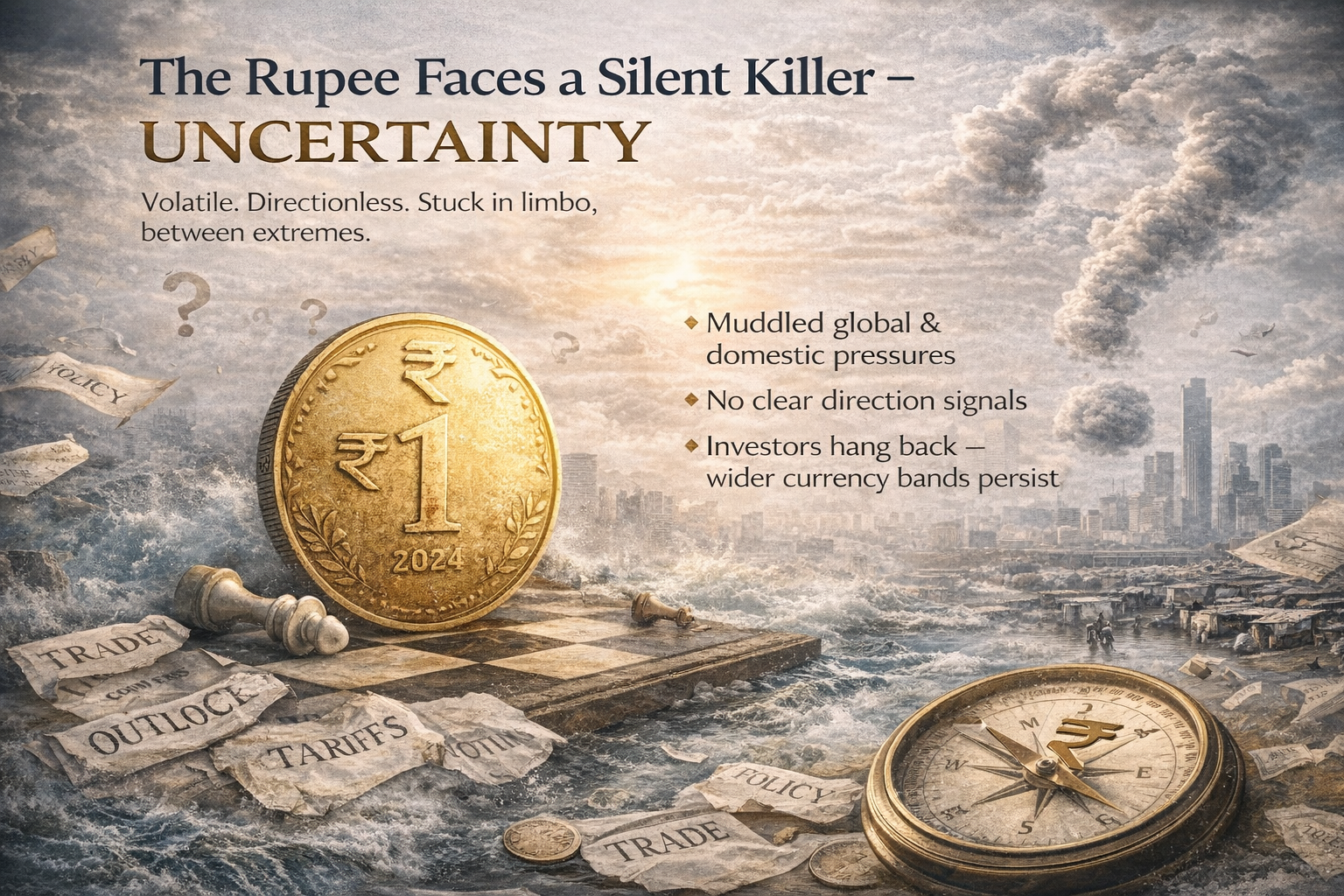
In markets where clarity is scarce, the Indian rupee is grappling not with a dramatic slide to new lows, but with a more insidious drag uncertainty. The currency may not revisit record-weak levels, yet it also lacks the momentum to strengthen meaningfully amid ongoing macro and geopolitical ambiguity.
Uncertainty as opposed to outright weakness can be a more persistent driver of currency stagnation. Markets often move only when expectations become more precise, not merely when risks spike higher.
Why Uncertainty Is Especially Harmful Now
The article highlights that recent regulatory and trade developments (including global tariff shifts and policy limbo) are not offering a clear directional signal for the rupee. With investors indecisive, capital flows remain cautious, keeping downward pressure on the currency’s appreciation potential.
In such an environment:
Businesses delay hedge and investment decisions
Foreign capital becomes more selective
Importers and exporters face wider volatility bands
All of these factors combine to muddle forex directionality without necessarily exacerbating outright depreciation.
Rupee Action Is Now About Volatility, Not Extremes
Unlike episodes where currencies plummet sharply, the rupee’s risk profile today centers on range-bound trade moving within narrow bands without clear conviction. This translates into trading patterns where short-term swings dominate but long-term trends lack definition.
Markets hate ambiguity but often stabilize only when crossroads become crossroads no more.
Implications for Investors & Businesses
This silent drag has implications beyond FX desks:
Imported inflation risk remains alive if volatility persists
Corporate planning horizons shorten as hedging becomes costlier
Portfolio flows tilt toward assets with clearer risk–reward narratives
For corporates with forex exposure, managing uncertainty often means emphasis on risk-adjusted frameworks rather than directionally betting on currency moves.
Suggested Closing (For Your Company’s Social Post)
In markets driven by ambiguity rather than extremes, strategic positioning and risk discipline matter more than ever.
For investors, this reinforces the value of diversified portfolios and hedged exposures — especially in currencies and assets sensitive to global policy shifts.
For more market perspectives and strategic insights, follow Ranjit Jha (CEO) and explore thought leadership from Rurash Financials