
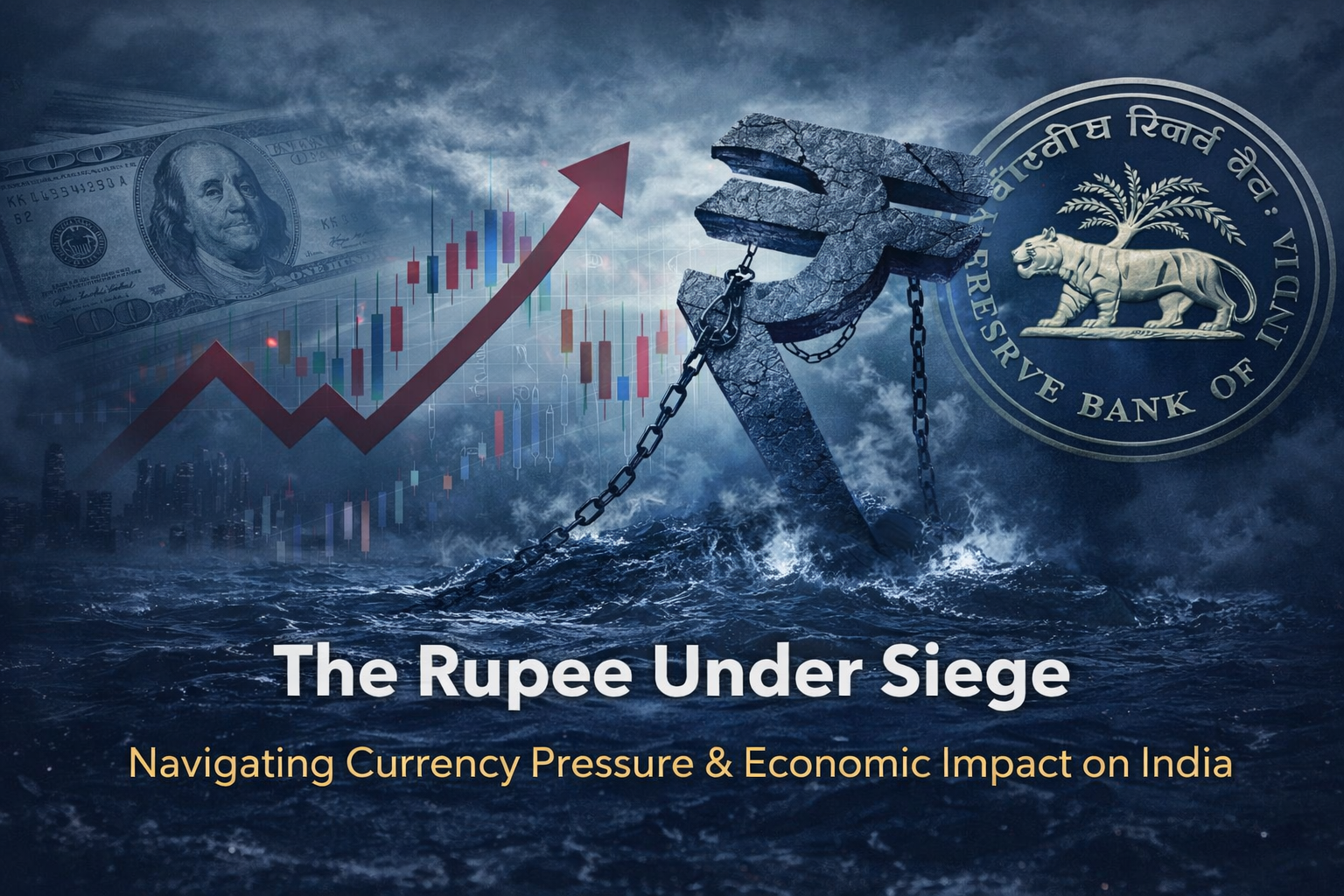
What Currency Pressure Means for India & Investors
The Indian Rupee has been under sustained pressure, hovering near record lows against the US Dollar. While currency movement often appears as just another headline, it reflects deeper global and domestic economic forces. This is not merely a forex story it is closely tied to inflation, capital flows, interest rates, and overall economic stability. Understanding this shift is essential for investors navigating today’s macro environment.
Why Is the Rupee Weakening?
The depreciation of the rupee is not driven by a single factor but by a combination of global and domestic forces. A strengthening US Dollar, supported by higher interest rates and global safe-haven demand, has put pressure on emerging market currencies. At the same time, rising crude oil prices have increased India’s import bill, leading to higher demand for dollars and widening the trade deficit. Additionally, foreign portfolio investor (FPI) outflows and global risk-off sentiment have further weakened the rupee, as capital shifts towards safer assets like US Treasuries.
Why This Matters for India
A weakening rupee has direct implications for the Indian economy. One of the most immediate effects is imported inflation, as the cost of essential imports such as crude oil, electronics, and raw materials rises. This can lead to broader price increases across sectors. Corporate profitability may also come under pressure, particularly for industries that rely heavily on imports, such as aviation, chemicals, and manufacturing. Furthermore, a rising import bill can widen the current account deficit, creating additional macroeconomic challenges and increasing the burden on policymakers.
Policy & Interest Rate Implications
Currency movements often influence central bank decisions. A weaker rupee, coupled with rising inflation, may limit the RBI’s flexibility in easing interest rates. The central bank may need to intervene in the forex market, manage liquidity, or maintain a cautious policy stance. These actions can have a cascading impact on borrowing costs, investment activity, and overall economic momentum.
Is There Any Positive Side?
Despite the challenges, a weaker rupee can also create opportunities. Export-oriented sectors such as IT, pharmaceuticals, and textiles may benefit, as their earnings in foreign currencies translate into higher revenues in rupee terms. This creates a divergence in sectoral performance, highlighting the importance of selective and informed investment decisions rather than broad market assumptions.
What Should Investors Be Thinking?
In such an environment, investors should focus on portfolio resilience rather than short-term currency movements. Diversification across asset classes, including equities, fixed income, and global exposure, becomes increasingly important. Sectoral allocation also plays a key role, as different industries respond differently to currency shifts. Most importantly, investors should avoid reactive decision-making and instead adopt a structured, long-term approach aligned with broader economic cycles.
The Bigger Picture
The movement of the rupee is not just about exchange rates it reflects India’s position within the global economic framework. Currency trends are influenced by capital flows, global confidence, and macroeconomic stability. As global interconnections deepen, such movements become more frequent and more impactful.
A weakening currency often brings uncertainty, but it also reshapes opportunities. For investors, the focus should not be on predicting exact currency levels, but on building portfolios that can adapt across changing economic conditions.