
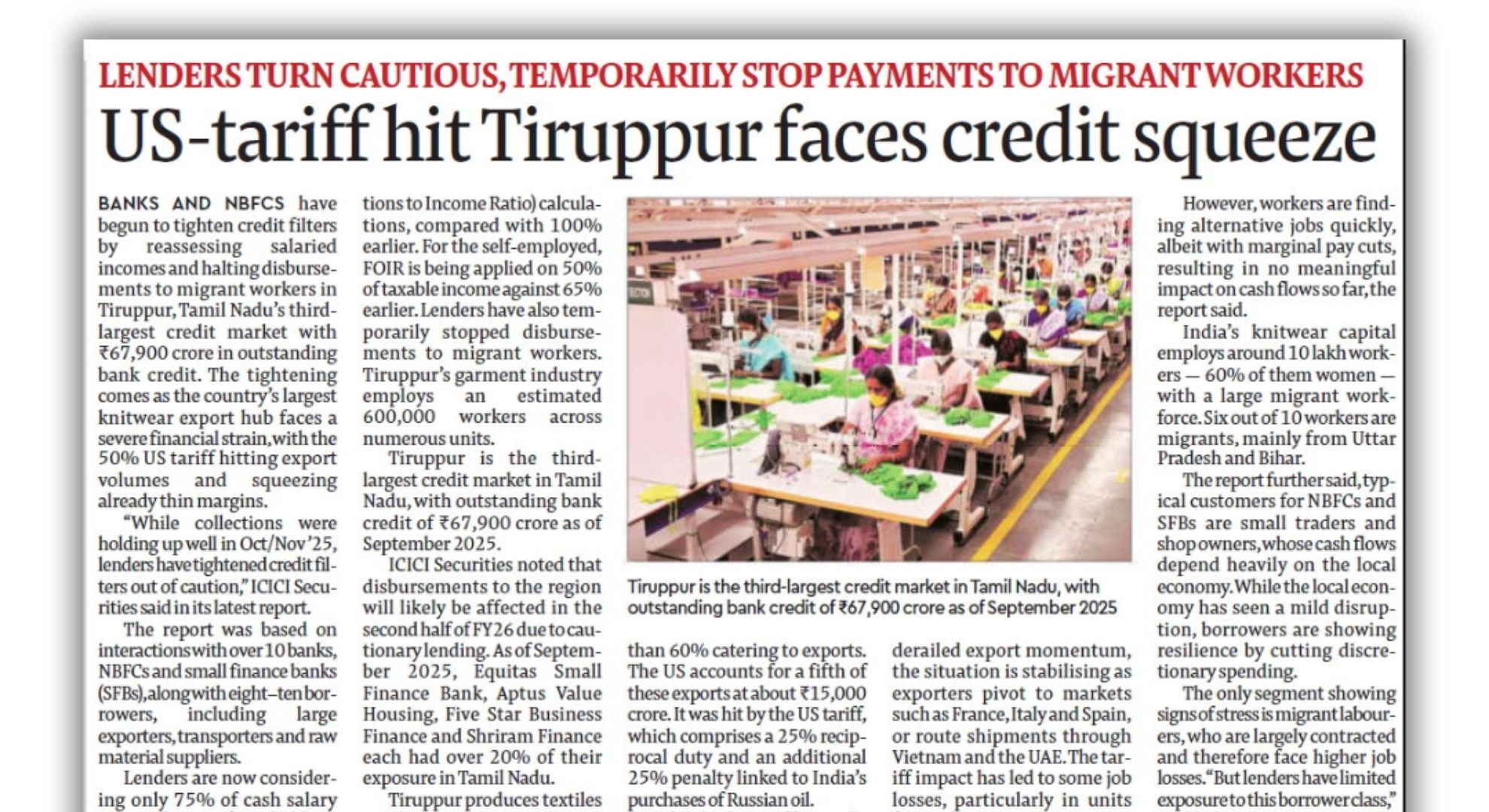
Banks Tighten Credit Filters in Tiruppur as US Tariffs Pressure India’s Knitwear Hub
India’s third‑largest credit market, Tiruppur, is witnessing a visible tightening of lending norms as banks and NBFCs reassess credit risk amid severe financial strain caused by a steep 50% US tariff on garment exports. The textile hub, known for contributing over ₹72,000 crore in textile production and employing nearly 10 lakh workers, now faces disrupted cash flows, shrinking margins, and rising caution across lenders.
According to a recent ICICI Securities report, lenders have shifted to a more conservative stance despite collections holding up through October and November 2025.
Why Lenders Are Tightening Credit Filters
Based on interactions with over 10 banks, NBFCs, SFBs, and multiple borrowers—including exporters, transporters, and raw‑material suppliers—the report highlights a clear trend: caution-driven credit tightening.
Key credit policy changes include:
Only 75% of cash salary is now considered for FOIR (Fixed Obligations to Income Ratio); earlier it was 100%.
For self-employed individuals, FOIR is calculated on 50% of taxable income, down from 65%.
Temporary halt in loan disbursements to migrant workers, who form a significant share of the city’s labor force.
This recalibration comes at a time when Tiruppur holds ₹67,900 crore in outstanding bank credit (as of Sept 2025), making any regional lending shift economically significant.
Impact of US Tariffs on Tiruppur’s Export Engine
Tiruppur exports over 60% of its textile output, with the US alone accounting for nearly ₹15,000 crore worth of shipments. The tariff impact comprises
25% reciprocal duty
25% penalty linked to India’s Russian oil purchases
This sudden hit to cost competitiveness has:
Initially derailed export volumes
Led to early-phase job losses in US-oriented units
Compressed already thin profit margins
Yet, the industry is showing adaptability. Exporters are shifting to European markets (France, Italy, and Spain) and rerouting shipments through Vietnam and the UAE to mitigate tariff shock.
Labour Market Resilience Despite Disruptions
Tiruppur is a massive employment hub:
10 lakh workers, of which
60% are women, and
6 in 10 are migrant workers from UP and Bihar
While job losses have occurred, particularly in export-heavy units, the report notes:
Workers are quickly finding alternative jobs
Pay cuts are occurring but cash flows are largely intact
Only migrant contract workers show signs of deeper stress
Even so, lenders have limited exposure to this borrower segment, which contains systemic risk.
NBFCs & SFBs: Exposure and Emerging Risks
Institutions with over 20% exposure in Tamil Nadu—including Equitas SFB, Aptus Value Housing, Five Star Business Finance, and Shriram Finance—are expected to witness slower disbursement growth in H2 FY26.
Typical borrowers in this region are:
Small traders
Shop owners
Micro‑enterprise operators
Their incomes are highly linked to local economic activity, making even mild disruptions relevant for lender risk models.
Borrowers, however, are showing resilience through:
Reduced discretionary spending
Business model adjustments
Maintaining repayment discipline
What Lies Ahead?
The economic recalibration in Tiruppur marks the start of a more data‑driven credit cycle.
While US tariffs triggered the disruption, lenders’ cautious stance reflects deeper concerns about:
Credit quality visibility
Employment stability
Export market volatility
Urban-migrant cash flow risks
Disbursements in FY26 are likely to slow significantly, even as the region continues demonstrating strong structural resilience.
Explore More Insights
To deepen your understanding of how monetary policy, liquidity cycles, and macro‑market dynamics influence long‑term wealth creation:
Explore guidance from Ranjit Jha (CEO, Rurash Financials)—a pioneer in research‑driven wealth advisory.
Learn how Rurash Financials empowers investors through:
AIF access
Portfolio engineering
Unlisted equity opportunities
Personalised wealth strategies
Visit the official Rurash Financials website to know more.