
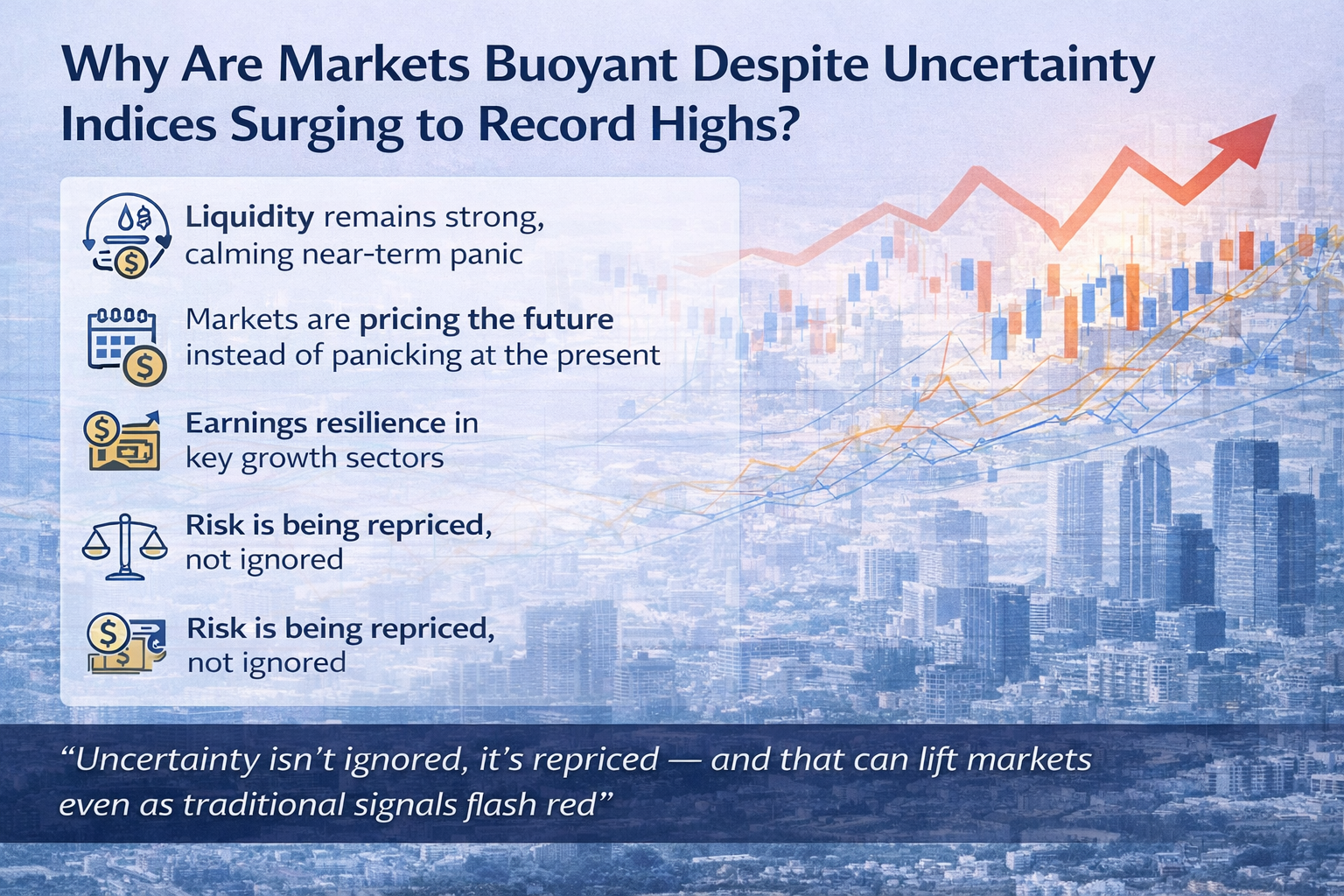
At a time when global uncertainty indices are touching record levels, equity markets continue to scale new highs. On the surface, this appears contradictory. Traditionally, rising geopolitical tensions, policy ambiguity, and macroeconomic risks tend to suppress investor sentiment. Yet, markets are displaying remarkable resilience.
So what explains this divergence?
Liquidity Is Still the Dominant Force
One of the strongest pillars supporting markets today is abundant liquidity. Central banks across major economies, despite cautionary commentary, are still operating within a relatively accommodative framework compared to historical tightening cycles.
Even when uncertainty rises, liquidity often overrides fear in the short term. Investors anticipate that monetary authorities will intervene if growth weakens significantly. This implicit backstop reduces downside panic and supports risk assets.
Liquidity-driven markets can remain elevated even when economic data sends mixed signals.
Markets Price the Future — Not the Present
Financial markets are forward-looking mechanisms. While uncertainty indicators reflect current sentiment and headline risks, markets are constantly discounting expected future outcomes.
If investors believe:
Inflation is moderating
Rate hikes are nearing a pause
Corporate earnings will stabilize
Then valuations adjust accordingly.
In other words, markets are reacting to anticipated normalization, not present discomfort.
Earnings Resilience & Structural Growth Themes
Despite macro volatility, several sectors continue to demonstrate strong earnings visibility — particularly technology, manufacturing upgrades, defense, and domestic consumption themes.
Investors are differentiating between:
Cyclical volatility
Structural long-term growth
This selective optimism explains why indices remain buoyant even amid caution.
Uncertainty may rise broadly, but capital flows selectively toward durable earnings models.
Risk Is Being Repriced — Not Ignored
It is important to understand that markets are not dismissing uncertainty; they are repricing it.
Higher risk premiums, sector rotation, and volatility spikes often occur beneath the surface. However, index levels may still trend upward because capital allocation becomes more strategic rather than retreating entirely.
This environment demands:
Asset allocation discipline
Portfolio diversification
Risk-adjusted positioning
What Should Investors Take Away?
Periods like this highlight the importance of structured investing rather than emotional reaction.
Uncertainty does not automatically mean market collapse.
It often means volatility, sector rotation, and selective opportunity.
Investors who:
Focus on long-term allocation
Maintain liquidity buffers
Align investments with risk tolerance
are better positioned to navigate such phases.
Strategic asset allocation, alternative strategies, and structured portfolio frameworks can help manage volatility more effectively. Thoughtful positioning rather than prediction becomes the key differentiator.
For deeper insights on structured investing approaches, follow Ranjit Jha (CEO) and explore advisory perspectives from Rurash Financials