
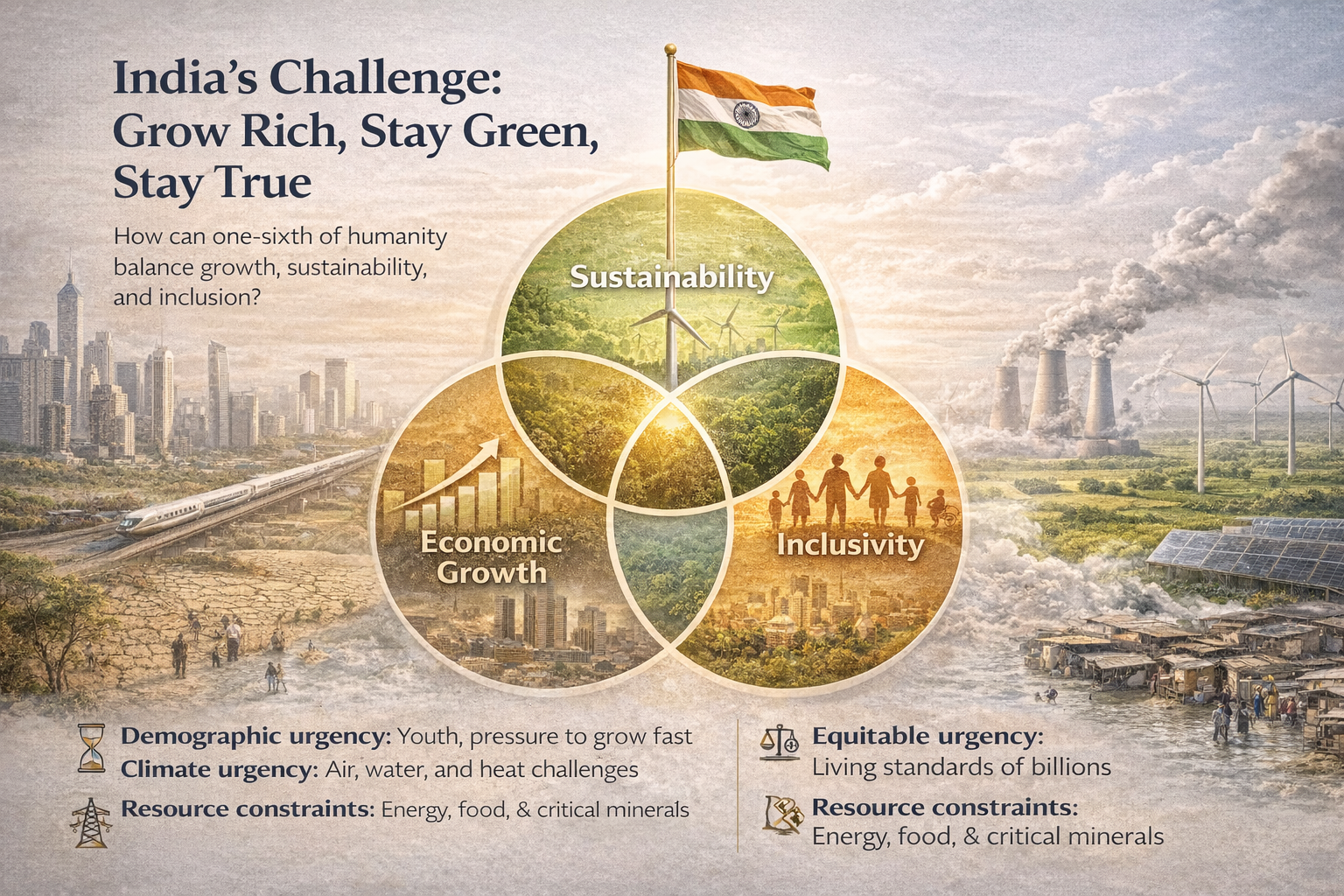
India faces a unique “three-way conundrum”: grow fast, stay green, and stay true to our values of equity and inclusion — all at the scale of one-sixth of humanity. That’s the core argument in this Moneycontrol opinion piece.
What makes India’s challenge different
India is trying to dramatically raise per capita income within a generation while also lowering carbon footprint—with two-thirds of the population under 35, making the demographic window both a huge opportunity and a time-bound pressure.
This is not just a climate story or a growth story — it’s a “systems redesign” story.
Why “growth first, cleanup later” won’t work
The article points to real, present risks—declining groundwater, arsenic-tainted water, chronic air pollution, and noise pollution—arguing these are already eroding health and productivity across states.
It also stresses that science suggests we may have a ~20-year window to shift decisively toward cleaner energy and sustainable systems, after which damage compounds faster than adaptation can keep up.
Three visions of India’s future (and why the choice matters)
The authors outline three broad “end goals”:
Restoring a historical share of global GDP (requiring sustained high growth for decades)
Reaching high-income status by global benchmarks (per-capita jump to developed thresholds)
Ensuring bottom-decile living standards (health, education, dignity) comparable to advanced economies — even if headline income lags
Each path demands trade-offs, and the article argues that growth, sustainability, and inclusion cannot be sequenced — they must move together.
Demographic dividend” isn’t automatic — it becomes real only if we create enough well-paid, low-carbon jobs before the window narrows.
Constraints India must plan around
The piece highlights:
Energy transition vs. coal-region livelihoods (jobs + communities)
AI/digital productivity vs. inequality risks (skilling + oversight)
Urbanisation without resilience (else floods, heatwaves, pollution worsen)
Resource constraints like limited domestic reserves of certain critical minerals needed for batteries/renewables, raising geopolitical dependence.
The governance message
A strong theme is collaborative federalism: solutions must be hyper-local because air, water, heat, and flood risks differ by city/state. The article argues local data + local institutions are essential for durable results.
Success metrics may need to expand beyond GDP to include clean air, safe water, health, education, and climate resilience.
Suggested closing (for your company post)
India’s next growth phase will be defined by how well we align capital with sustainability and inclusion — not by growth alone.
For investors and families, this reinforces a simple principle: long-term wealth outcomes improve when portfolios and planning account for structural transitions (energy, resources, urban resilience, and policy shifts).
For more market and strategy insights, follow Ranjit Jha (CEO) and explore perspectives from Rurash Financials.