
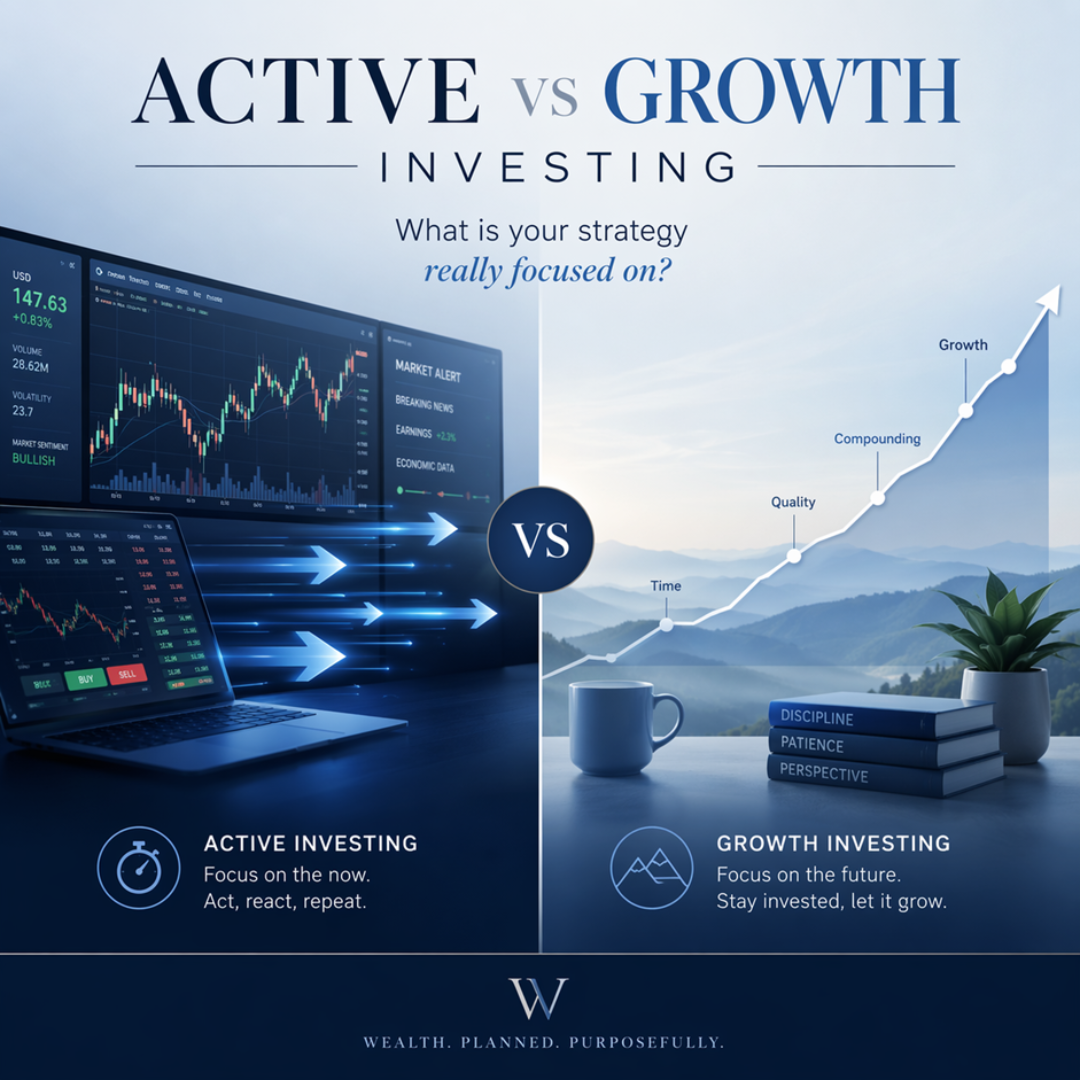
Active vs Growth Investing — What Is Your Strategy Really Focused On?
In today’s evolving financial landscape, having an investment strategy is no longer optional—it is essential. Yet, many investors operate with portfolios that lack clarity, often blending approaches without intention.
The result?
A mismatch between strategy and outcomes.
The real question is not whether you are investing.
It is whether your portfolio reflects a clearly defined strategy.
The Real Question
Most investors believe they follow a structured approach.
In reality, portfolios often drift—shaped by market noise, short-term trends, and reactive decisions.
Without clarity, even good investments fail to deliver meaningful long-term results.
Understanding the Two Approaches
Active Investing
Active investing focuses on capturing short- to medium-term opportunities through frequent decisions.
It involves:
- Tactical entry and exit
- Continuous portfolio monitoring
- Adapting to market movements
This approach demands expertise, time, and disciplined execution frameworks.
Growth Investing
Growth investing is built on long-term wealth creation.
It emphasizes:
- Strong business fundamentals
- Long-term compounding
- Patience and conviction
This strategy requires a clear time horizon and the discipline to stay invested through cycles.
Where Most Investors Go Wrong
The problem is not choosing between active and growth investing.
It is the lack of clarity.
Many investors:
- Mix strategies unintentionally
- React to short-term volatility
- Shift approach during uncertainty
The outcome is a portfolio without direction—leading to inconsistent performance and missed opportunities.
What Structured Investors Do Differently
Disciplined investors approach investing with intent and structure.
They:
- Define their strategy before investing
- Align portfolios with financial goals
- Maintain consistency across market cycles
This approach reduces emotional decision-making and strengthens long-term outcomes.
The Better Approach
It is not about choosing one strategy over the other.
It is about:
- Understanding your core investment philosophy
- Structuring your portfolio accordingly
- Staying consistent through market cycles
A clear strategy brings discipline, reduces noise, and improves decision-making.
Final Insight
A strategy is not what you say.
It is what your portfolio reflects.
Explore More Insights
To understand how disciplined investing and structured portfolios shape long-term wealth creation in an increasingly complex financial environment, explore insights from Ranjit Jha, CEO of Rurash Financials, a pioneer in research-driven wealth advisory.
Learn how Rurash Financials empowers investors through:
• AIF access
• Portfolio engineering
• Unlisted equity opportunities
• Personalised wealth strategies
Visit:
https://rurashfin.com/blog/
https://rurashfin.com/media/
https://rurashfin.com/contactus/
https://www.linkedin.com/in/ranjit-mjha/
CTA
Connect with us to align your investment strategy with your long-term goals.