
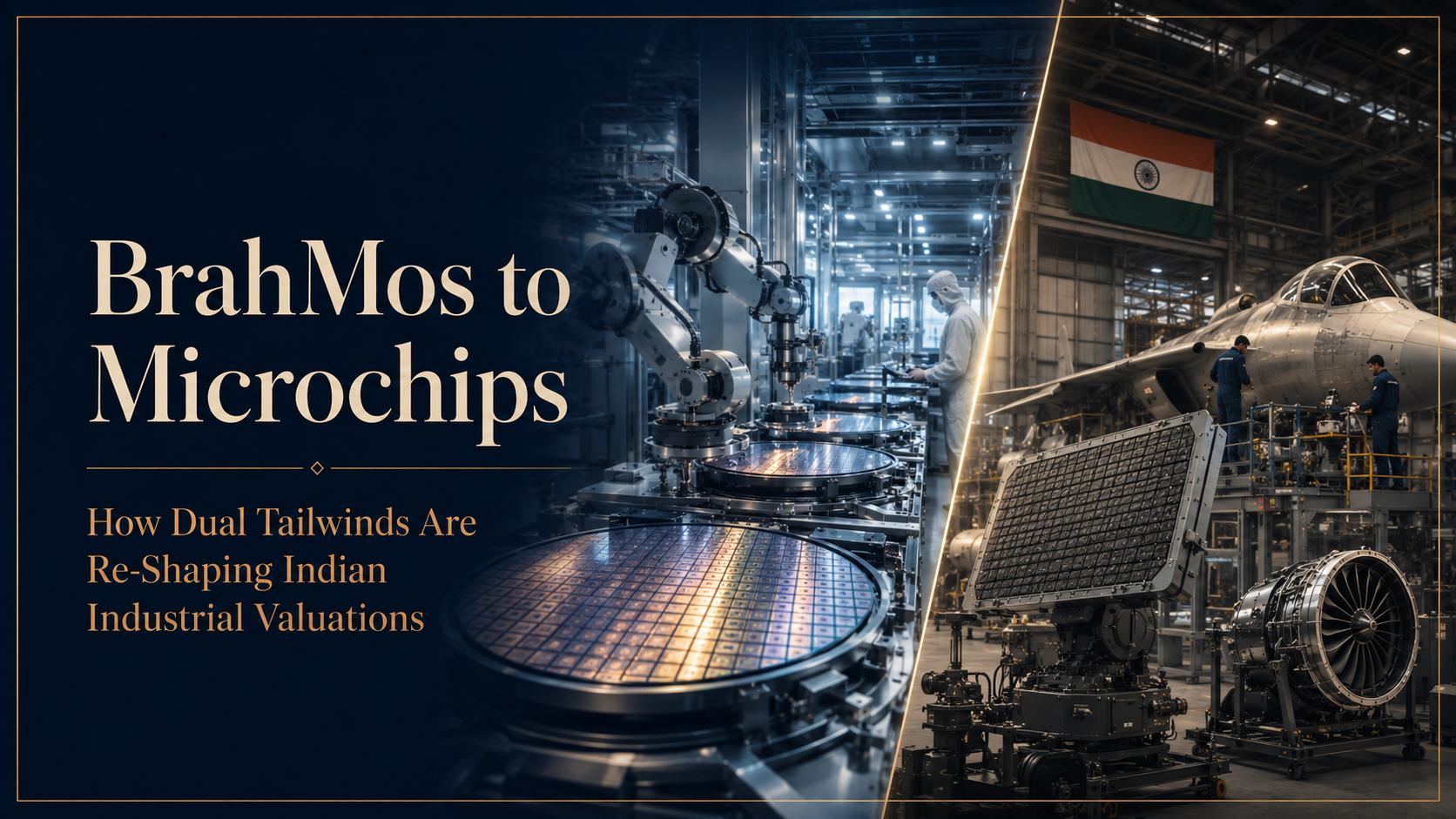
BrahMos to Microchips: How Dual Tailwinds Are Re-Shaping Indian Industrial Valuations
India’s industrial landscape is entering a new phase of transformation.
For years, manufacturing growth was largely associated with infrastructure, automobiles and traditional engineering businesses. Today, a new generation of strategic industries is emerging as key drivers of economic expansion.
From BrahMos missile exports to the government’s Semicon India initiative, India is investing heavily in sectors that combine national security, advanced technology and high-value manufacturing.
For investors, these are not isolated developments—they represent long-term structural themes that could reshape industrial valuations for years to come.
A New Manufacturing Cycle Is Emerging
India’s industrial growth story is increasingly being supported by policy initiatives focused on self-reliance, technological capability and global competitiveness.
Government programmes such as:
Make in India
Atmanirbhar Bharat
Production Linked Incentive (PLI) schemes
Defence indigenisation
Semiconductor manufacturing incentives
are encouraging companies to expand capacity, invest in technology and build globally competitive businesses.
This shift is creating opportunities across engineering, electronics, aerospace and precision manufacturing.
Defence Exports Are Gaining Global Recognition
India’s defence sector has evolved from being largely import-dependent to becoming an emerging exporter of sophisticated defence systems.
Products such as the BrahMos supersonic cruise missile, defence electronics, naval platforms, radars and aerospace components are strengthening India’s position in the global defence ecosystem.
The sector benefits from several long-term drivers:
Rising global defence spending
Indigenous manufacturing
Strategic export partnerships
Advanced aerospace engineering
Defence technology innovation
As export opportunities expand, companies across the defence value chain may benefit from improving order visibility and long-term revenue growth.
Semiconductors: Building India’s Technology Backbone
Alongside defence manufacturing, semiconductors have become another strategic priority.
Modern industries—from automobiles and consumer electronics to artificial intelligence and defence systems—depend on advanced semiconductor technologies.
India’s semiconductor ecosystem is gradually expanding through investments in:
Chip fabrication
Assembly and testing
Electronic components
Design and research
Advanced manufacturing infrastructure
A stronger domestic semiconductor industry can reduce import dependence while supporting multiple high-growth sectors.
Why These Themes Are Connected
Defence and semiconductors are increasingly interconnected.
Modern defence platforms rely on:
High-performance processors
Advanced sensors
Communication chips
Artificial intelligence
Precision electronics
Embedded software
As semiconductor capabilities improve, India’s defence manufacturing ecosystem also becomes more competitive.
Together, these industries create a multiplier effect across the broader manufacturing economy.
Why Industrial Valuations Are Changing
Markets often assign higher valuations to companies operating within structural growth industries.
Several factors are contributing to this shift:
Long-Term Policy Support
Government initiatives provide visibility for investment and capacity expansion.
Technology Leadership
Companies with specialised manufacturing capabilities often command stronger competitive positions.
Export Potential
Access to international markets expands long-term growth opportunities.
Higher Entry Barriers
Advanced manufacturing requires significant capital, expertise and research, creating barriers for new competitors.
Diversified Demand
Many industrial businesses now serve multiple sectors, including defence, aerospace, automotive and electronics.
However, investors should remember that strong industry prospects do not automatically justify every valuation.
What Investors Should Evaluate
Before investing in industrial and manufacturing themes, investors should assess:
Order Book Quality
Large order books should be supported by execution capability and cash-flow visibility.
Technology Advantage
Businesses with proprietary technology or specialised manufacturing expertise may have stronger long-term potential.
Capital Allocation
Industrial expansion often requires significant investment, making efficient capital management essential.
Earnings Visibility
Sustainable profitability matters more than short-term revenue growth.
Valuation Discipline
Even high-quality businesses should be evaluated against realistic growth expectations.
The Rurash Perspective
At Rurash Financials, we believe India’s industrial transformation is creating opportunities beyond traditional sectors.
Defence manufacturing and semiconductor development are long-term structural themes supported by government policy, technological advancement and global demand.
Rather than chasing momentum, investors should focus on businesses with durable competitive advantages, strong execution capabilities and disciplined financial management.
A diversified portfolio that includes exposure to emerging industrial themes can help investors participate in India’s next phase of economic growth while managing risk effectively.
Conclusion
India’s journey from BrahMos to microchips reflects more than industrial progress—it represents a strategic shift toward innovation-led manufacturing and global competitiveness.
As defence exports expand and semiconductor capabilities strengthen, these sectors have the potential to reshape industrial valuations and create new investment opportunities.
For long-term investors, success will depend not on following headlines but on identifying fundamentally strong businesses positioned to benefit from these enduring structural trends.
Because the future of Indian manufacturing will be driven by innovation, execution and disciplined investing—not momentum alone.
Explore More Insights
To understand how defence manufacturing, emerging technologies and structured portfolios shape long-term wealth creation, explore insights from Ranjit Jha.
Learn how Rurash Financials supports investors through:
Portfolio Engineering
Alternative Investments
Unlisted Equity Opportunities
Personalised Wealth Strategies
Wealth Preservation & Succession Planning
Call to Action
India’s industrial transformation is opening new opportunities across defence, technology and advanced manufacturing.
At Rurash Financials, we help investors identify long-term structural themes through research-driven portfolio construction and disciplined wealth management.
Connect with Rurash Financials today to build a diversified portfolio positioned for India’s next generation of industrial growth.