
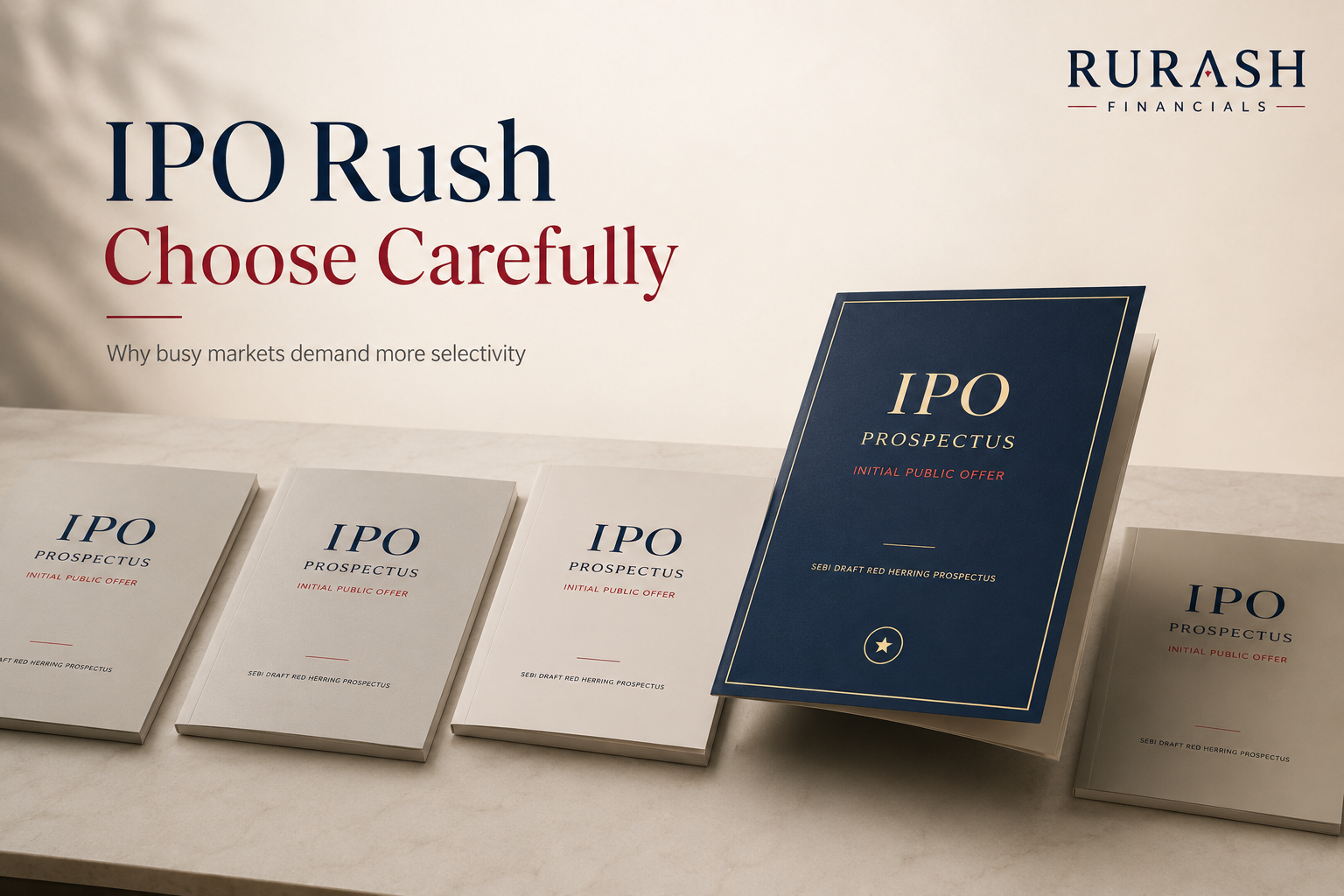
IPO Rush Is Not a Buying Signal: Why Busy Markets Demand More Selectivity
When several IPOs arrive within the same week, something interesting happens.
The investor’s problem changes.
It is no longer:
“Is there an IPO worth looking at?”
It becomes:
“Which of these opportunities actually deserves my capital?”
That distinction matters this week.
At the start of the week beginning 17 August 2026, reports indicated that India’s primary market was preparing for another heavy round of fund-raising, with nine IPOs expected to seek around ₹7,100 crore collectively.
For investors, a crowded calendar can create excitement.
It can also create pressure.
One issue is closing. Another is opening. Grey-market premiums begin circulating. Subscription figures appear every few hours. Anchor-investor names enter conversations. Social-media timelines fill with predictions about listing gains.
Suddenly, doing nothing can feel like missing out.
But IPO investing should work in exactly the opposite direction.
The more opportunities that arrive at once, the more selective an investor should become.
A Busy IPO Market Creates a Different Kind of Risk
An abundance of choices feels like an advantage.
Behaviourally, however, it can make decision-making more difficult.
When investors evaluate one company in isolation, they may spend time understanding its business, financial performance and valuation.
When five, seven or nine issues arrive close together, attention gets divided.
The decision can slowly shift from:
“Is this company worth owning?”
to:
“Which IPO should I apply for?”
That subtle change is important.
The first question allows the answer to be none.
The second almost assumes that money must be invested somewhere.
A disciplined investor should always preserve the right to walk away.
The Prospectus Matters More Than the Noise Around It
Every IPO comes with a story.
Growth.
Expansion.
Market leadership.
A large addressable opportunity.
A recognisable brand.
But an investor is not buying the story alone.
They are buying a share in the economics behind it.
SEBI’s investor guidance encourages investors to examine the company’s business, competitive position, financial health and valuation before committing capital.
The offer document provides much of the information needed to begin that assessment.
It contains details around the company’s business, financial statements, risk factors, use of proceeds, capital structure, litigation and other material disclosures.
The difficult part is not finding the information.
The difficult part is deciding which information deserves the most attention.
Start With the Business, Not the IPO
Before looking at subscription numbers or potential listing gains, understand how the company actually makes money.
A useful IPO should first make sense as a business.
Look at where revenue comes from.
Look at the company’s major customers.
Understand whether the business depends heavily on one region, one product category or a small number of clients.
Study the competitive landscape.
Consider whether growth is coming from genuine expansion or simply from a temporary industry cycle.
The question is not whether the company’s sector sounds attractive.
The question is whether this particular company has a durable position inside that sector.
A fashionable industry cannot rescue a weak business model.
Growth Looks Different When You Look at Cash
Revenue growth is easy to highlight.
Cash generation is harder to disguise.
Two companies can report similar top-line growth while having very different financial quality.
One may be generating healthy operating cash flows and reinvesting from a position of strength.
Another may require continuous working capital, borrowing or external funding simply to maintain growth.
Margins matter.
Debt matters.
Receivables matter.
Cash conversion matters.
And the direction of these numbers matters just as much as the latest year’s headline figure.
IPO analysis becomes far more useful when investors stop asking:
“How fast is the company growing?”
and start asking:
“What kind of growth is the company producing?”
Valuation Can Turn a Good Company Into a Difficult Investment
One of the most important distinctions in investing is also one of the easiest to forget during an IPO rush:
A good company and a good investment are not always the same thing.
A strong brand may still be offered at an aggressive valuation.
A profitable company may already have much of its future growth priced into the issue.
A less familiar company may sometimes offer a more reasonable risk-return equation.
That is why valuation must sit beside business quality, not underneath it.
Investors should compare the proposed valuation with relevant listed peers where possible.
Look at earnings multiples.
Look at revenue multiples when appropriate.
Consider profitability and return ratios.
Most importantly, ask how much future success the issue price already assumes.
The higher the expectation built into the valuation, the smaller the room for disappointment.
Follow the Money Raised
Another section deserves more attention than it usually receives:
Where is the IPO money actually going?
A public issue can contain fresh shares, an offer for sale, or a combination of both.
Fresh capital enters the company.
It may be used for expansion, debt reduction, working capital, acquisitions or other stated purposes.
In an offer for sale, existing shareholders sell part of their holdings and the proceeds generally go to those selling shareholders rather than becoming fresh capital for the company.
Neither structure is automatically positive or negative.
The investor simply needs to understand what is happening.
If a large issue is primarily an exit for existing shareholders, ask why.
If significant fresh capital is being raised, understand how management intends to deploy it.
Capital allocation after listing can influence shareholder outcomes for years.
Subscription Numbers Are Popularity Indicators, Not Quality Certificates
Heavy subscription can make an IPO appear validated.
But demand during a short subscription window should not replace fundamental analysis.
Oversubscription can arise from several factors:
market sentiment, liquidity, institutional interest, listing expectations and the structure of the issue itself.
An IPO being subscribed many times does not suddenly improve the company’s balance sheet.
It does not change the valuation.
It does not remove business risks.
And it does not guarantee what the shares will do after listing.
Subscription data tells investors something useful:
there is demand.
It does not tell them:
the investment is suitable for you.
Those are two very different conclusions.
Anchor Investors Deserve Context, Not Blind Confidence
The presence of respected institutional investors can naturally attract attention.
It may indicate that professional investors have evaluated the opportunity.
But it should still remain one input among many.
Rurash highlighted this distinction recently while discussing SEBI’s study of anchor-investor behaviour.
An anchor entering an IPO is a signal.
It is not a substitute for understanding:
Business quality
Valuation
Liquidity
Risk
Exit visibility
Institutional participation should encourage investors to investigate further.
It should not end the investigation.
Grey Market Premium Is Not the Investment Thesis
Few numbers travel through IPO conversations faster than the GMP.
It is easy to understand why.
Investors naturally want some indication of how an issue might behave when it lists.
But grey-market activity exists outside the formal exchange mechanism and can change rapidly.
More importantly, a potential listing gain and a long-term investment case are not the same decision.
Someone applying only for a listing trade is evaluating a different proposition from someone intending to own the company for several years.
Confusing those objectives can lead to poor decisions.
Before applying, decide which investor you are.
A Better Filter for a Crowded IPO Week
When many IPOs compete for attention, investors do not necessarily need more information.
They need a stronger filter.
A practical sequence is:
Business first.
Understand what the company does and why customers choose it.
Financial quality second.
Examine growth, profitability, cash flows, debt and working-capital behaviour.
Valuation third.
Determine what price you are being asked to pay for that business.
Use of funds next.
Understand whether the issue finances growth, strengthens the balance sheet or primarily enables shareholder exits.
Risk after that.
Read the material risk disclosures instead of assuming every risk is boilerplate.
Market excitement last.
Only after the investment case stands on its own should subscription trends, institutional participation and sentiment enter the picture.
That order matters.
Reverse it, and hype can begin influencing the analysis before the analysis even starts.
Sometimes the Best IPO Decision Is No Application
Investors often judge themselves by the opportunities they captured.
They should also learn to value the opportunities they rejected.
Capital not committed to an unsuitable IPO is still capital available for another opportunity.
There will be another company.
Another sector.
Another market cycle.
Another IPO.
The primary market does not reward investors simply for being active.
Over time, selectivity can be much more valuable than participation.
The Rurash Perspective
At Rurash Financials, we believe an IPO should be approached the same way as any other serious investment decision.
Not through urgency.
Not through popularity.
And not through one headline number.
The starting point should remain the underlying business.
From there, investors can evaluate financial quality, valuation, promoters, use of proceeds, competitive positioning and the risks disclosed in the offer document.
This is especially relevant for investors who also participate in unlisted and pre-IPO opportunities.
The transition from private company to public listing may change liquidity and disclosure.
It does not remove the need for due diligence.
Whether an investor encounters a company before its IPO, during the public issue or after listing, the fundamental question remains the same:
What am I buying, and at what price?
A week with nine IPOs may create nine invitations.
It does not create nine obligations.
More IPOs do not automatically mean more good investments.
Sometimes the strongest investment decision is simply choosing carefully.
Explore More With Rurash
Rurash Financials helps investors navigate opportunities across Unlisted Shares, Mutual Funds, PMS, AIFs, Bonds & Fixed Income and broader wealth solutions with a focus on suitability and informed decision-making.
Before following the IPO rush, understand the investment behind the issue.
Connect with Rurash Financials for investor-focused insights and portfolio conversations.