
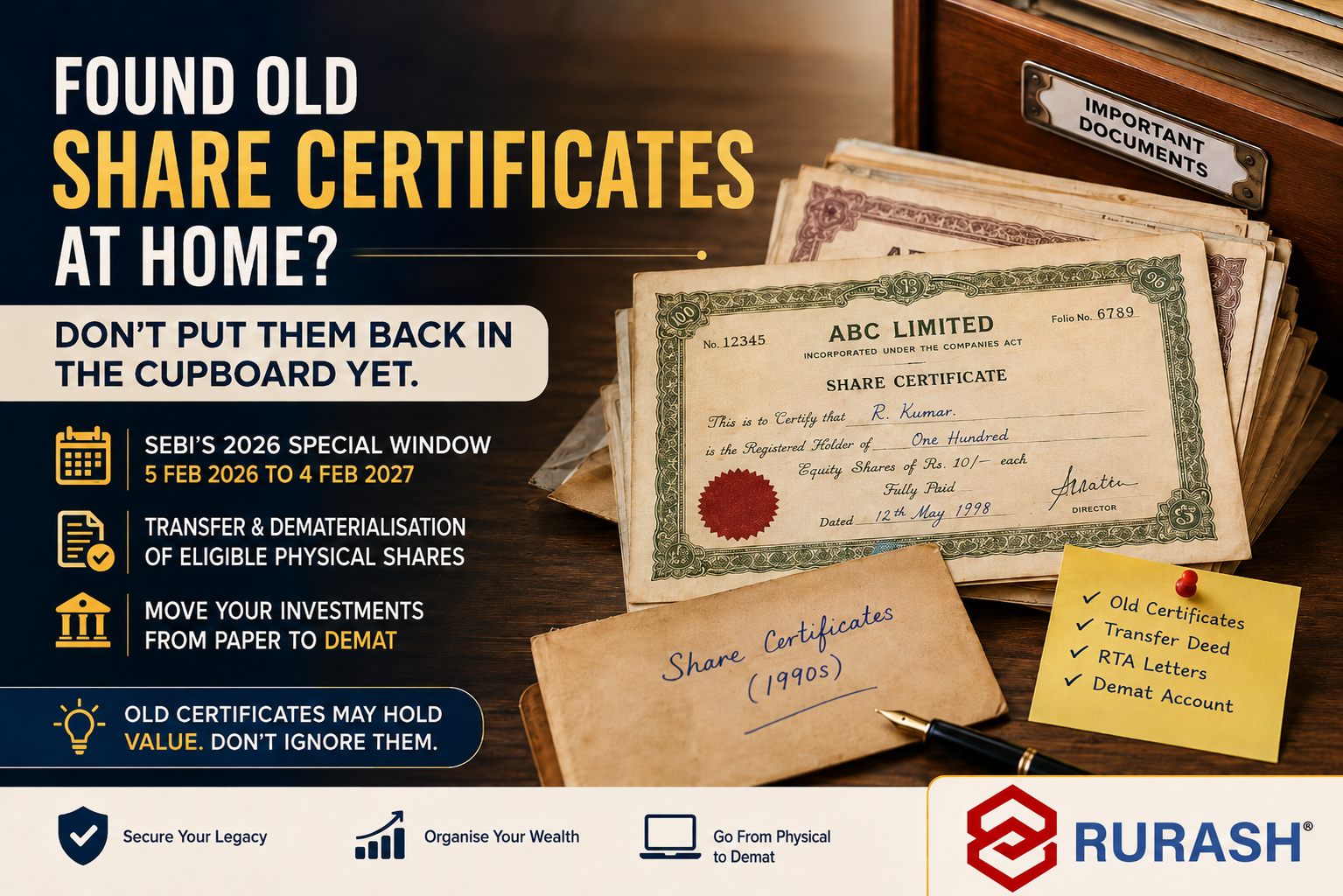
Found Old Share Certificates at Home? Don’t Put Them Back in the Cupboard Yet
That old envelope of share certificates sitting in a cupboard, locker or family file may deserve another look. SEBI has opened a special one-year window that could help certain investors resolve long-pending physical share transfer cases and move eligible securities into demat form.
Imagine you are cleaning an old cupboard at home.
Between property papers, LIC documents, bank passbooks and old family records, you find a bundle of physical share certificates.
Some may be in your father’s name. Some may belong to your grandparents. Others may relate to shares that were purchased years ago but never properly transferred.
The natural reaction is often:
“These are so old. Are they even useful anymore?”
Before putting them back in the cupboard, there is something worth checking.
SEBI has opened a special window from 5 February 2026 to 4 February 2027 for the transfer and dematerialisation of certain physical securities that were sold or purchased before 1 April 2019. The facility also covers certain transfer requests that had previously been rejected, returned or left unattended because of deficiencies in documents or processes.
For families still holding old physical share certificates, this could be an important opportunity.
What Exactly Is SEBI’s 2026 Special Window?
Transfer of listed securities in physical form was discontinued from 1 April 2019.
However, several older transactions remained incomplete. In some cases, investors purchased shares years ago but never lodged the transfer. In others, documents had been submitted but were rejected or returned due to discrepancies.
To address qualifying legacy cases, SEBI introduced this special window.
It remains open for one year, from 5 February 2026 until 4 February 2027.
But there is an important distinction:
Not every old share certificate automatically qualifies.
The eligibility of a case depends on the history of the transaction and the documents available.
Who May Be Eligible?
According to SEBI’s eligibility framework, the special window can cover a fresh lodgement where the transfer deed was executed before 1 April 2019 and the original security certificate is available.
It can also cover qualifying cases that had been lodged previously but were rejected or returned, provided the original certificate is available.
So, if you have found old certificates, begin by asking:
Is the original share certificate available?
Is there a transfer deed executed before 1 April 2019?
Was the transfer ever submitted earlier?
If it was submitted, was it rejected or returned?
Do you still have old company or RTA correspondence?
These seemingly small details can determine whether the special window applies to your case.
One important point
If the original security certificate is not available, SEBI’s eligibility matrix does not treat that case as eligible under this specific special window.
That does not necessarily mean nothing can ever be done with the holding. It means the process may be different and should not automatically be treated as a special-window case.
Why Do Old Physical Share Cases Become Complicated?
Finding the certificate is sometimes the easiest part.
The challenge is what happened during the 10, 20 or even 30 years since it was issued.
1. Signature Mismatch
Think about your signature today.
Now imagine comparing it with the way you signed your name 25 years ago.
It may look completely different.
Signature differences are common in old securities records. SEBI specifically provides for a verification procedure where the transferor’s signature differs from the available records or is not available.
So a signature mismatch does not automatically mean the investment should be forgotten, but it may require the correct verification process.
2. Name Mismatch
The name printed on a decades-old document may also be different from the investor’s current PAN or other KYC records.
For example:
R. Kumar on one document
Rajesh Kumar on another
Or a person’s surname may have changed after marriage.
SEBI’s circular specifically addresses name differences between the PAN card and transfer deed. Additional documents explaining the difference, such as an officially valid document or gazette notification in appropriate cases, may be required.
This is why apparently minor spelling differences should not simply be ignored.
3. Missing Documents
Old investments rarely come neatly packed with every document required today.
You may have:
The share certificate but no old correspondence
The transfer deed but incomplete KYC records
An old rejection letter from the company
Proof of purchase but no idea what happened after submission
Documents carrying an outdated address
Papers relating to a company whose name has since changed
In certain circumstances involving non-availability of required documents, non-traceability or non-cooperation of the transferor, SEBI’s process can involve publication of notices in an English national daily and a regional-language newspaper, followed by a period for objections.
The important lesson is simple:
Do not assume a case is impossible just because the paperwork is complicated. First understand what is missing and which process applies.
What Documents Should You Start Looking For?
If you have discovered old physical securities, search the same cupboards, lockers and family files for related papers.
For qualifying cases under the special window, SEBI specifies documents including:
Original security certificate
Transfer deed executed before 1 April 2019
Proof of purchase, where available
Applicable KYC documents
A recent Client Master List of the transferee’s demat account, not older than two months and duly attested by the Depository Participant
Undertaking-cum-Indemnity in the prescribed format
Old correspondence from the company or Registrar and Transfer Agent can also be useful when trying to understand what happened historically.
Do not discard an old rejection letter just because it looks irrelevant today.
It may help explain the case.
Why Is Demat Required?
The purpose of the special window is not to replace one paper certificate with another.
SEBI requires securities transferred through this mechanism to be credited to the transferee in demat mode.
That means an appropriate demat account is required.
Moving securities into demat form also means the ownership becomes part of the electronic securities ecosystem rather than continuing to depend on a physical certificate kept in a cupboard or locker.
What Happens After the Transfer?
Suppose your case qualifies, the documents are accepted and the transfer is successfully registered.
The securities are then credited to the transferee’s demat account.
But there is another rule investors should know.
There is a one-year lock-in.
SEBI states that securities transferred through this special window will remain under lock-in for one year from the date of registration of transfer.
During this period, the securities cannot be transferred, lien-marked or pledged.
SEBI has also directed listed companies and RTAs to process transfer requests within 70 days of receiving a request with complete documentation.
So investors should not interpret demat credit as an immediate opportunity to sell the securities.
What If the Shares Are Already With IEPF?
This is another area where investors often get confused.
The SEBI special window and IEPF recovery are not the same process.
SEBI has specifically stated that securities already transferred to the Investor Education and Protection Fund (IEPF) will not be processed under this special window.
Those securities need to follow the applicable IEPF claim process.
Similarly, cases involving disputes between the transferor and transferee are excluded from this special window and may require resolution through the appropriate court or NCLT process.
This is why the first question should not simply be:
“How do I demat these shares?”
It should be:
“What type of case do I actually have?”
Found Old Shares? Start With These 5 Checks
Before filling forms or sending documents anywhere:
Keep the original certificate safe. Do not write on it, laminate it or discard it.
Check the shareholder and company details. Look at the shareholder name, folio number, certificate number and company name.
Search for the old transfer deed. The date can be critical in determining whether the special window applies.
Collect previous correspondence. Rejection letters, RTA communication and old company letters may help establish the history of the case.
Get the documents reviewed before starting the process. A name mismatch, signature difference, transmission issue, missing certificate or IEPF case can each require a different route.
A Simple Example
Suppose your father purchased shares in 1998.
The original certificates and transfer deed remained in a family file. Perhaps the transfer was never lodged, or perhaps it was submitted years ago and returned because a document was missing.
You discover the file in 2026.
There are two possible reactions.
The first is:
“These are just old papers.”
The second is:
“Before we ignore them, let’s find out exactly what they represent.”
The second question is the one worth asking.
An old certificate may or may not eventually result in a successful claim or transfer. But without reviewing it, there is no way to know.
How Can Rurash Assist?
Physical share cases can become document-heavy very quickly.
One investor may simply need assistance understanding a physical-to-demat process. Another may be dealing with a signature mismatch, name change, transmission matter, missing certificate, old transfer documentation or an IEPF-related case.
Rurash lists Physical Shares to Demat and related legacy-share services among the solutions available to investors.
Depending on the facts of the case, the process may involve understanding the available documents, identifying the appropriate route and coordinating the requirements connected with the relevant company, RTA, demat account or other process.
The aim should be to understand the investment’s history before deciding what action is required.
A Perspective From Ranjit Jha
Rurash’s approach to legacy investments is also relevant to a larger conversation about wealth.
Under the leadership of Ranjit Jha, MD & CEO of Rurash Financials, the firm has worked across areas including physical shares and investor wealth solutions.
For families, wealth organisation is not always about finding the next investment.
Sometimes it begins with understanding investments that already exist but have been forgotten, misplaced or left unresolved for years.
An investment may have economic value, but accessing that value can depend on establishing ownership and completing the appropriate documentation.
The Certificate May Be Old. The Deadline Isn’t.
SEBI’s special window is scheduled to remain open until 4 February 2027.
That does not mean every old physical certificate qualifies.
But if you have old certificates, a pre-2019 transfer deed or a physical share transfer request that was previously rejected or returned, this may be the right time to examine the documents instead of leaving them untouched for another year.
So the next time you find an old share certificate in a cupboard, don’t immediately put it back.
Find out what you are holding first.
Frequently Asked Questions
What is SEBI’s special window for physical shares in 2026?
SEBI has opened a special window from 5 February 2026 to 4 February 2027 for qualifying physical securities sold or purchased before 1 April 2019 and certain earlier rejected, returned or unattended transfer requests.
Can every old physical share certificate be transferred?
No. Eligibility depends on the facts of the case. Under SEBI’s eligibility matrix, the transfer deed must have been executed before 1 April 2019 and the original security certificate must be available for cases under this window.
What if the signature has changed?
SEBI provides a verification process for differences or non-availability of the transferor’s signature.
What if there is a name mismatch?
Additional supporting documentation may be required to explain the difference between the name on the transfer deed and current PAN records.
Do I need a demat account?
Yes. Securities transferred through this special window must ultimately be credited in demat mode.
Can the shares be sold immediately after transfer?
No. Securities transferred under the special window are subject to a one-year lock-in from registration of transfer.
Are IEPF shares covered?
No. Securities already transferred to IEPF are excluded from this particular special-window process.
Found Physical Share Certificates?
Don’t let uncertainty send them back into the cupboard.
If you have old physical shares, transfer documents or a previously rejected case, start by understanding what documents you have and which process may apply.
CTA: Explore Physical-to-Demat Assistance With Rurash
CTA Button: Get My Physical Shares Reviewed
Explore More With Rurash
If you are reviewing old or unresolved investments, you may also want to explore:
Physical Shares to Demat
Understand the process involved in bringing eligible physical share holdings into demat form.
Explore → Physical to Demat Shares
IEPF Share & Dividend Recovery
If your shares or unpaid dividends have already moved to IEPF, understand the separate recovery process that may apply.
Explore → IEPF Recovery
Transmission of Shares
Dealing with investments belonging to a deceased family member? Learn about the documentation and process involved in transmission.
Explore → Transmission of Shares
Name or Signature Mismatch
Old records often contain names or signatures that differ from current KYC documents. Understand how such discrepancies may need to be addressed.
Explore → Legacy Share Resolution