
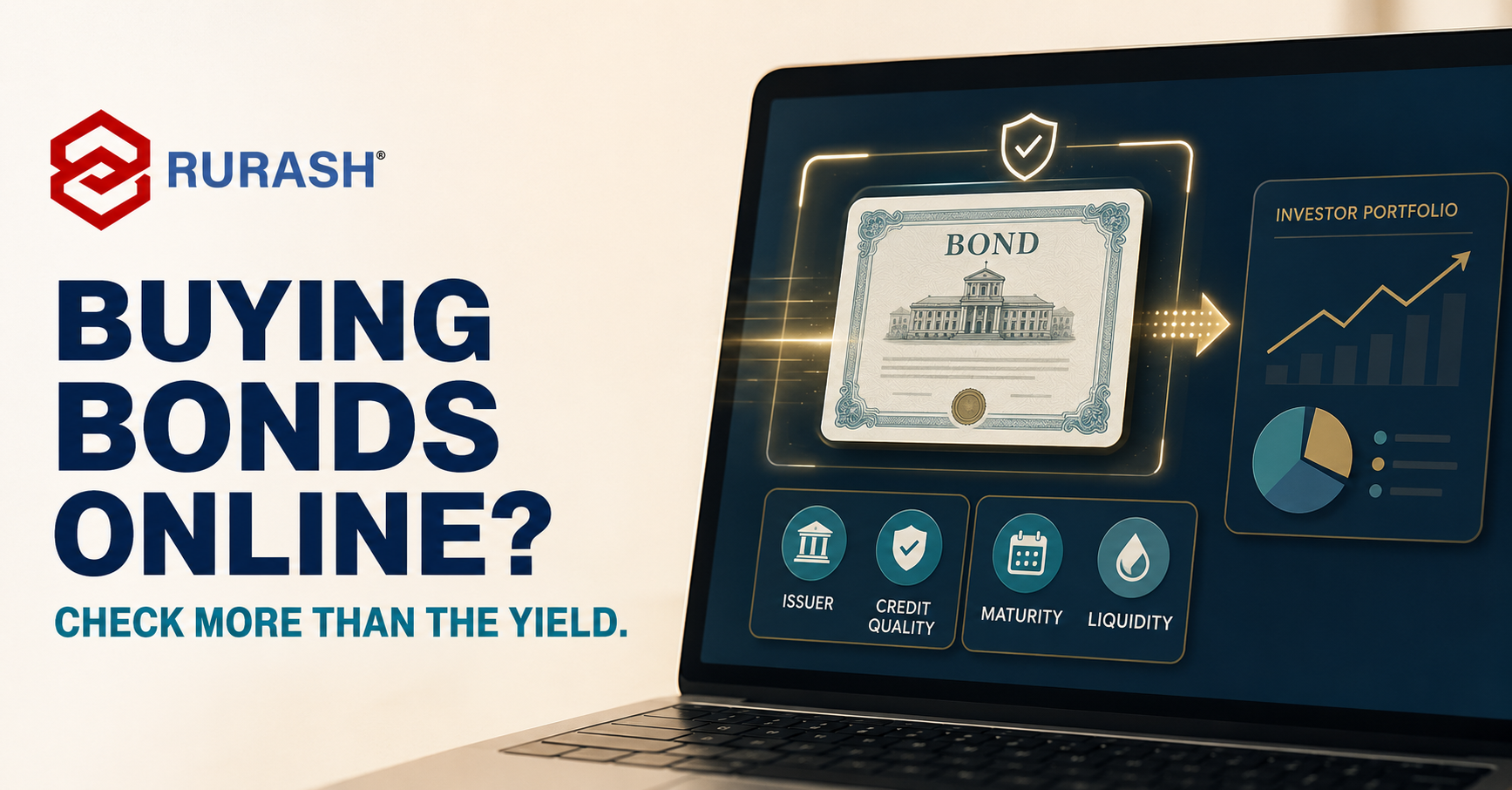
Buying bonds is becoming increasingly digital. Investors can now compare yields, maturities and issuers through online platforms without following the traditionally lengthy offline process.
On 14 August 2026, SEBI issued a circular modifying the regulatory framework for Online Bond Platform Providers, or OBPPs. The changes expand the products and services that registered platforms may offer while introducing specific disclosure and operational requirements.
The development may improve accessibility, but an easier buying process does not make the investment itself risk-free.
Before selecting a bond online, investors must look beyond the displayed yield and understand the issuer, credit quality, maturity, liquidity and platform registration.
Quick Answer: What Should Investors Check Before Buying Bonds Online?
Before purchasing a bond through an online platform, investors should verify:
- Whether the platform is operated by a SEBI-registered OBPP
- Whether the bond is listed or unlisted
- Issuer identity and financial strength
- Credit rating and latest rating rationale
- Coupon rate, yield and maturity date
- Whether the bond is secured or unsecured
- Liquidity and early-exit possibilities
- Default, delay and credit-downgrade risks
- Tax treatment and applicable charges
- Grievance-redressal mechanism
A high yield should be treated as a starting point for investigation—not as proof of a good investment.
What Happened?
SEBI’s 14 August 2026 circular modified certain provisions governing OBPPs.
Under the updated framework, OBPPs may offer:
- Listed debt securities
- Listed municipal debt securities
- Listed securitised debt instruments
- Debt securities proposed to be listed through public offerings
- Listed Government Securities
- State Development Loans
- Treasury Bills
- Listed Sovereign Gold Bonds
- Products and services regulated by SEBI, RBI, IRDAI, IFSCA or PFRDA
- Eligible tax-saving bonds issued under Section 54EC or the corresponding provision of the Income-tax Act, 2025
The circular also permits IFSCA-regulated products to be offered subject to applicable rules. International or overseas instruments must be clearly labelled to avoid confusion with domestic debt securities.
SEBI has also prescribed disclosures for tax-specific bonds, including information about eligibility, lock-in, investment limits, transferability and taxation.
The revised framework came into effect immediately.
Why Does This Matter?
Online platforms can make bonds easier to discover and compare. This may support wider participation in India’s corporate bond and fixed-income markets.
However, accessibility can also create a misleading sense of simplicity.
A bond displayed on a clean digital interface can still carry:
- Credit risk
- Interest-rate risk
- Liquidity risk
- Reinvestment risk
- Concentration risk
- Call or redemption risk
- Tax-related considerations
The platform simplifies the transaction. It does not remove the investment risk.
Five Things Investors Should Understand
1. Platform Registration Must Be Verified
Investors should first check whether the online platform is operated by a registered OBPP.
SEBI previously cautioned investors about dealing with unregistered online bond platforms and advised the public to verify registration status before transacting. A registered framework provides defined operational and grievance-related responsibilities, but it does not guarantee the performance of securities offered on the platform.
The platform’s name, registration details and official website should be independently verified.
2. A Higher Yield Usually Reflects Higher Risk
Online bond platforms often make it convenient to sort opportunities by yield. While useful, this can cause investors to focus on the largest percentage appearing on the screen.
A higher yield may reflect:
- Lower issuer credit quality
- Greater probability of delayed payment or default
- Lower market liquidity
- Longer maturity
- Subordination within the capital structure
- Unfavourable security or covenant terms
Investors should ask why one bond offers a significantly higher yield than comparable instruments.
Yield is not a standalone return promise. It must be viewed together with the possibility of loss.
3. The Credit Rating Is Only One Input
Credit ratings can help investors understand an independent agency’s assessment of the issuer’s creditworthiness. However, ratings can change and cannot eliminate default risk.
Investors should examine:
- Latest rating and rating rationale
- Previous upgrades or downgrades
- Issuer’s debt levels
- Cash-flow position
- Interest coverage
- Repayment record
- Industry-related risks
- Any material litigation or regulatory concerns
A rating should support due diligence—not replace it.
4. Liquidity May Be Limited
A bond may be listed on an exchange but still have limited trading activity.
If investors need to exit before maturity, they may:
- Struggle to find a buyer
- Receive a price below the purchase value
- Face a wider bid-ask spread
- Experience price changes due to interest-rate movements
Therefore, “listed” should not automatically be interpreted as “easily sellable.”
Investors should ideally commit funds that can remain invested until maturity unless adequate secondary-market liquidity is visible.
5. Different Products Follow Different Rules
The updated framework allows OBPPs to display a broader range of regulated products and services.
But different products can fall under different regulators, grievance mechanisms and tax rules.
For example:
- An international product regulated by IFSCA must be clearly identified as an overseas instrument.
- Applicable FEMA, overseas investment and Liberalised Remittance Scheme rules may apply.
- Tax-saving bonds have specific eligibility, investment and lock-in conditions.
- Grievances concerning certain tax-specific instruments may lie with the issuer rather than SEBI.
Investors should not assume that every product appearing on the same platform carries the same regulatory structure.
What Should Investors Learn?
Look Beyond the Coupon Rate
The coupon represents the interest paid on the bond’s face value. It is not always the same as the investor’s effective yield.
The actual outcome can depend on:
- Purchase price
- Remaining maturity
- Interest-payment frequency
- Taxes
- Transaction charges
- Reinvestment rate
- Final repayment by the issuer
Investors should understand both the coupon and yield-to-maturity before deciding.
Check Whether the Bond Is Secured
A secured bond may be backed by specific assets or collateral. An unsecured bond depends primarily on the issuer’s repayment capacity.
However, the word “secured” does not mean that recovery will be immediate or complete after a default. Investors should examine the nature, value and enforceability of the security.
Match Maturity With the Financial Goal
A long-maturity bond may offer a higher yield, but it can also expose investors to greater interest-rate and liquidity risk.
Bond maturity should correspond with the investor’s requirement for the money. Funds needed in two years should not automatically be placed in a security maturing much later simply because its displayed yield appears attractive.
Avoid Excessive Issuer Concentration
Investing a large portion of a fixed-income portfolio in one company can create unnecessary concentration risk.
Diversification may be considered across:
- Issuers
- Industries
- Credit ratings
- Maturities
- Bond structures
The purpose of fixed income is generally to provide stability and predictable cash-flow characteristics. Excessive concentration can weaken that purpose.
Ranjit Jha’s Perspective
Under the leadership of Ranjit Jha, MD & CEO of Rurash, the relevant investor-education perspective is that digital access should be supported by financial understanding.
Online platforms may make bond discovery and execution more convenient, but the investor still needs to evaluate what stands behind the displayed yield.
The central questions remain:
- Who is borrowing the money?
- Why is the issuer offering this return?
- How strong is its repayment capacity?
- Can the investor hold the bond until maturity?
- What role will the bond perform in the overall portfolio?
Technology can simplify access. It cannot substitute for credit assessment and portfolio suitability.
The Bigger Picture
SEBI’s updated OBPP framework forms part of a wider effort to develop India’s corporate bond market and improve ease of doing business.
A broader, well-regulated digital distribution ecosystem can help investors access fixed-income opportunities that were previously difficult to discover. It can also encourage issuers to reach a wider investor base.
At the same time, the success of online bond investing will depend on:
- Clear product disclosures
- Responsible advertising
- Platform accountability
- Investor awareness
- Effective grievance mechanisms
- Proper risk communication
The market may become more accessible, but informed selection will remain essential.
Explore More with Rurash
Rurash Financials helps investors evaluate fixed-income opportunities based on their income requirements, risk capacity, liquidity needs, maturity preferences and overall portfolio.
Before selecting a bond, investors can explore:
- Issuer and credit-quality assessment
- Yield and maturity comparison
- Secured versus unsecured structures
- Liquidity and exit considerations
- Fixed-income portfolio diversification
- Alignment with financial goals
Explore bonds and fixed-income opportunities with Rurash—because the right bond decision begins with more than the highest displayed yield.