Indofil Industries FY26 Results: Strong Earnings, Valuable Assets—and a Deep-Value Opportunity?
Indofil Industries has entered the unlisted-market spotlight after reporting a sharp improvement in its FY26 financial performance.
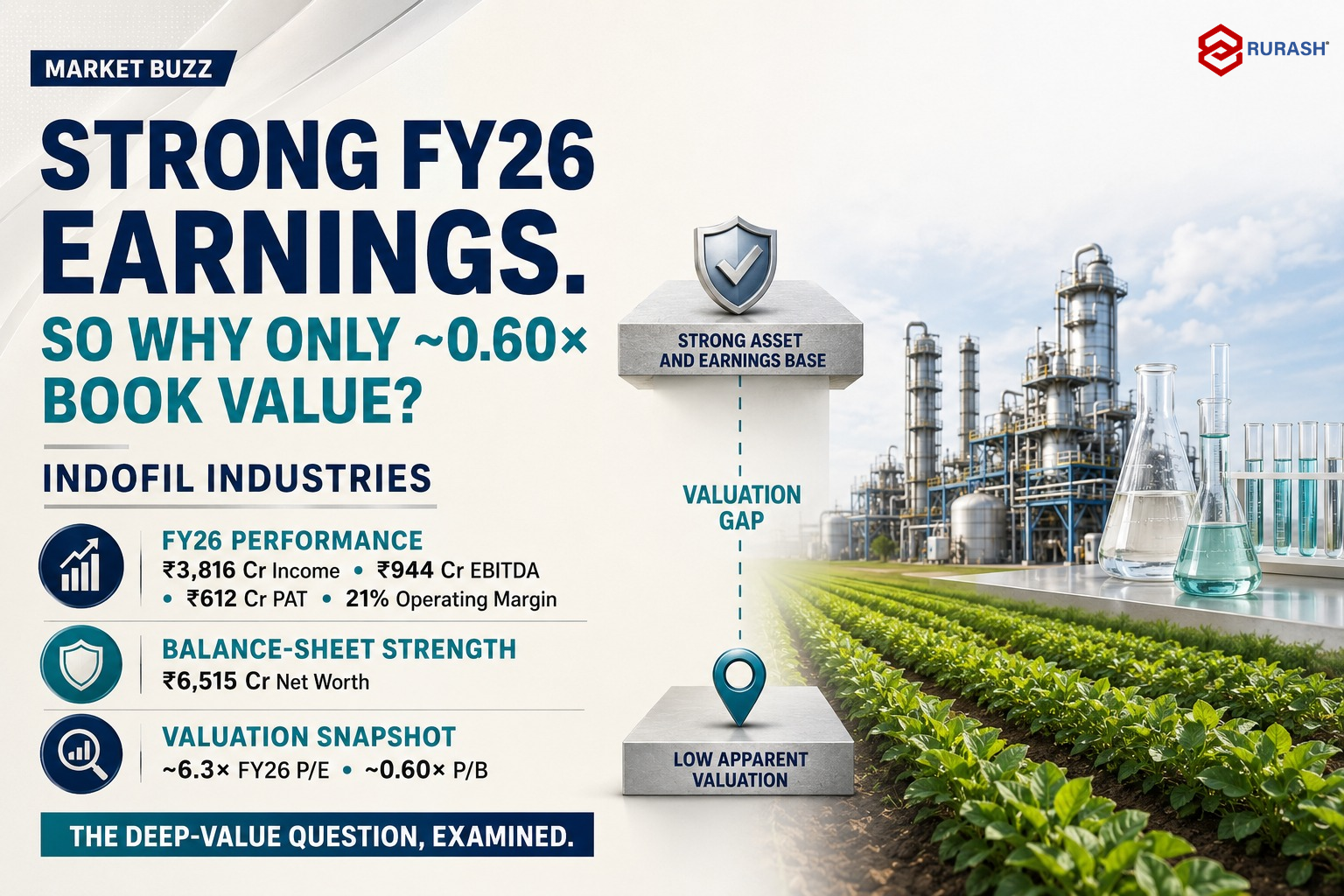
According to the recently published Market Buzz analysis, consolidated total income reached ₹3,816 crore, EBITDA rose to ₹944 crore and profit after tax stood at ₹612 crore. The company also ended the financial year with a reported net worth of approximately ₹6,515 crore and minimal balance-sheet leverage.
The operating performance is noteworthy. However, what has attracted greater investor interest is the apparent difference between Indofil Industries’ implied unlisted-market valuation and the reported value of its underlying assets.
At an indicative unlisted price of ₹1,700 per share, the company was estimated to trade at approximately 6.3 times FY26 earnings and 0.60 times book value. These numbers could make Indofil appear inexpensive—but an attractive valuation ratio alone does not automatically make an unlisted share a suitable investment.
The real question is whether the market has overlooked sustainable value or is applying a justified discount for liquidity, governance and execution risks.
What Happened in FY26?
Indofil Industries reportedly delivered one of its strongest recent financial performances during FY26.
FY26 financial highlights
Total income: ₹3,816 crore
EBITDA: ₹944 crore
Profit after tax: ₹612 crore
Net worth: ₹6,515 crore
Debt-to-equity ratio: approximately 0.02 times
Indicative unlisted price: approximately ₹1,700 per share
Implied valuation: approximately 6.3 times earnings and 0.60 times book value
Total income increased from ₹3,419 crore in FY25 to ₹3,816 crore in FY26—growth of approximately 12%.
More importantly, EBITDA reportedly increased from ₹636 crore to ₹944 crore. This means earnings grew considerably faster than total income, indicating stronger operating leverage and improved profitability.
Based on the reported EBITDA and total-income numbers, Indofil’s EBITDA margin was approximately 24.7% in FY26. The operating-margin measure mentioned in the source analysis improved from approximately 15% to 21%. Investors should distinguish between EBITDA margin and other operating-margin definitions when comparing the company across periods.
What Drove the Earnings Improvement?
Indofil Industries operates across agrochemicals, crop-protection products and specialty chemicals. Its portfolio includes fungicides, herbicides, insecticides, plant-growth regulators and solutions used in industries such as plastics, coatings, textiles and construction.
Several developments appear to have supported its FY26 performance.
Growing international operations
The company reportedly entered four new international markets, secured 60 international product registrations and added more than 20 international business customers during the year.
Agrochemical export revenue increased from approximately ₹1,482 crore to ₹1,769 crore. A broader international presence can reduce dependence on any one geography, although it also introduces currency, regulatory and agricultural-cycle risks.
Expansion beyond traditional products
Indofil has historically been associated with Mancozeb, a widely used fungicide. The company is gradually building a broader portfolio across differentiated crop-protection products, biologicals, biostimulants and plant nutrition.
During FY26, it reportedly commercialised 21 products and filed 17 patents.
Diversification can strengthen future revenue quality, but investors should examine how quickly new products scale and whether they produce attractive returns on research and development expenditure.
Low financial leverage
The company’s reported debt-to-equity ratio declined to approximately 0.02 times.
Low leverage offers financial flexibility and reduces vulnerability to higher borrowing costs. It can also help a cyclical chemical or agricultural-input business manage periods of weaker demand.
Why Is Indofil Being Viewed as a Deep-Value Opportunity?
At an indicative price of ₹1,700 per share and approximately 2.29 crore outstanding shares, Indofil’s implied market capitalisation would be close to ₹3,893 crore.
Against a reported FY26 net worth of ₹6,515 crore, this translates into a price-to-book ratio of approximately 0.60 times.
On the surface, investors are paying roughly ₹0.60 for every ₹1 of reported book value.
The implied price-to-earnings ratio of approximately 6.3 times also appears modest when compared with many listed specialty-chemical and agrochemical businesses.
However, this comparison needs context. Listed businesses generally benefit from better price discovery, easier liquidity, regular analyst coverage and greater public disclosure. An unlisted company may deserve a meaningful discount because investors cannot enter or exit with the same ease.
The Godfrey Phillips Holding: A Powerful—but Complex—Valuation Signal
One of the most discussed components of Indofil’s valuation is its reported holding in Godfrey Phillips India.
The source analysis estimates that Indofil owns approximately 1.96 crore shares of Godfrey Phillips. At an assumed price of ₹2,150 per share, the holding would be worth approximately ₹4,214 crore.
That estimated value would be higher than Indofil’s entire implied market capitalisation of approximately ₹3,893 crore at an unlisted price of ₹1,700 per share.
On a look-through basis, the estimated Godfrey Phillips holding would represent approximately ₹1,840 for every Indofil share—before assigning any value to:
Indofil’s agrochemical operations
Its specialty-chemical business
Its interest in Indo Baijin Chemicals
Other investments and financial assets
Cash flows from future operations
This creates an apparent sum-of-the-parts valuation gap.
But investors should not interpret the entire market value of the holding as immediately realisable cash. The value changes with the listed company’s share price, while taxes, transaction costs, control considerations, ownership arrangements and restrictions on monetisation may reduce the amount ultimately attributable to shareholders.
A holding-company discount may therefore remain even when the underlying asset appears valuable.
The Modi Family Developments
Indofil belongs to the broader K.K. Modi business group. Disputes connected with the Modi family and family trust have historically created uncertainty around different group assets.
A recent withdrawal of certain legal proceedings by Samir Modi against Bina Modi has been presented as a move towards reconciliation. However, this should not be treated as a complete resolution of the wider family-trust and inheritance matters.
Investors must distinguish between the withdrawal of individual cases and a legally final settlement affecting ownership or control.
Lalit Modi’s separate relief in the 2009 IPL-related FEMA matter is also unrelated to the central family-trust dispute and should not be interpreted as resolving Indofil’s ownership overhang.
What Could the Market Be Discounting?
A low valuation can represent an opportunity, but it can also be the market’s way of pricing unresolved risks.
Limited liquidity
Unlisted shares do not trade through a regular stock-exchange order book. Finding a buyer may take time, and the eventual selling price may differ materially from the quoted indicative price.
No assured IPO timeline
An investment thesis should not depend entirely on an assumed listing. An IPO can be delayed, restructured or abandoned depending on market conditions and company decisions.
Governance and ownership uncertainty
Family disputes or changes in control can affect decision-making, dividend policy, asset monetisation and investor perception.
Cyclical business exposure
Agrochemical demand can be affected by weather, crop prices, channel inventory, commodity costs and regulatory decisions across different markets.
Sustainability of margins
FY26 margin expansion was significant. Investors must determine whether it reflects structural business improvement or favourable conditions that may normalise.
Valuation-source risk
Indicative unlisted-share prices are not equivalent to exchange-discovered prices. P/E, P/B and implied market capitalisation can change depending on the actual transaction price available to an investor.
What Should Investors Examine Before Investing?
Before considering Indofil Industries or another unlisted company, investors should review:
The latest audited consolidated financial statements
Cash flow from operations—not only accounting profit
Related-party transactions and ownership structure
The exact number and nature of shares held in other companies
Restrictions affecting the monetisation of major investments
Historical dividend distribution
Available buyer and seller quotations
Transfer documentation and demat eligibility
Possible tax implications
The absence or uncertainty of an exit timeline
Unlisted investing requires a different mindset from buying a liquid listed stock. The investor must be prepared for incomplete price discovery, longer holding periods and fewer exit options.
Ranjit Jha’s Perspective
From a wealth-management perspective, a low valuation multiple is the beginning of research—not the end of it.
Indofil’s earnings improvement, low leverage and valuable underlying holdings create a case worth examining. Yet the investment decision must also account for liquidity, governance, ownership clarity, cash-flow quality and the practical ability to realise the value of major assets.
For suitable investors, unlisted shares may add differentiated exposure to a broader portfolio. However, allocation should remain proportionate to the investor’s risk capacity, liquidity requirements and investment horizon.
The Bigger Investor Lesson
Indofil Industries illustrates why unlisted-market valuation requires more than looking at the latest quoted price.
The company appears to combine:
Strong FY26 earnings
Meaningful margin expansion
Low balance-sheet leverage
A valuable listed investment
A significant discount to reported book value
At the same time, the valuation gap may persist because of limited liquidity, governance uncertainty and the absence of a guaranteed value-unlocking event.
The opportunity is therefore not simply that Indofil looks inexpensive. The opportunity—if supported by complete due diligence—is that earnings, assets and the implied market valuation may not currently be aligned.
Explore More with Rurash
Rurash Financials helps eligible investors evaluate opportunities in unlisted shares and pre-IPO companies through structured research, financial analysis and transaction support.
Before allocating capital, investors should understand the company, valuation, ownership structure, liquidity conditions and potential exit scenarios.
To explore unlisted-share opportunities with a research-led approach, connect with Rurash Financials.