
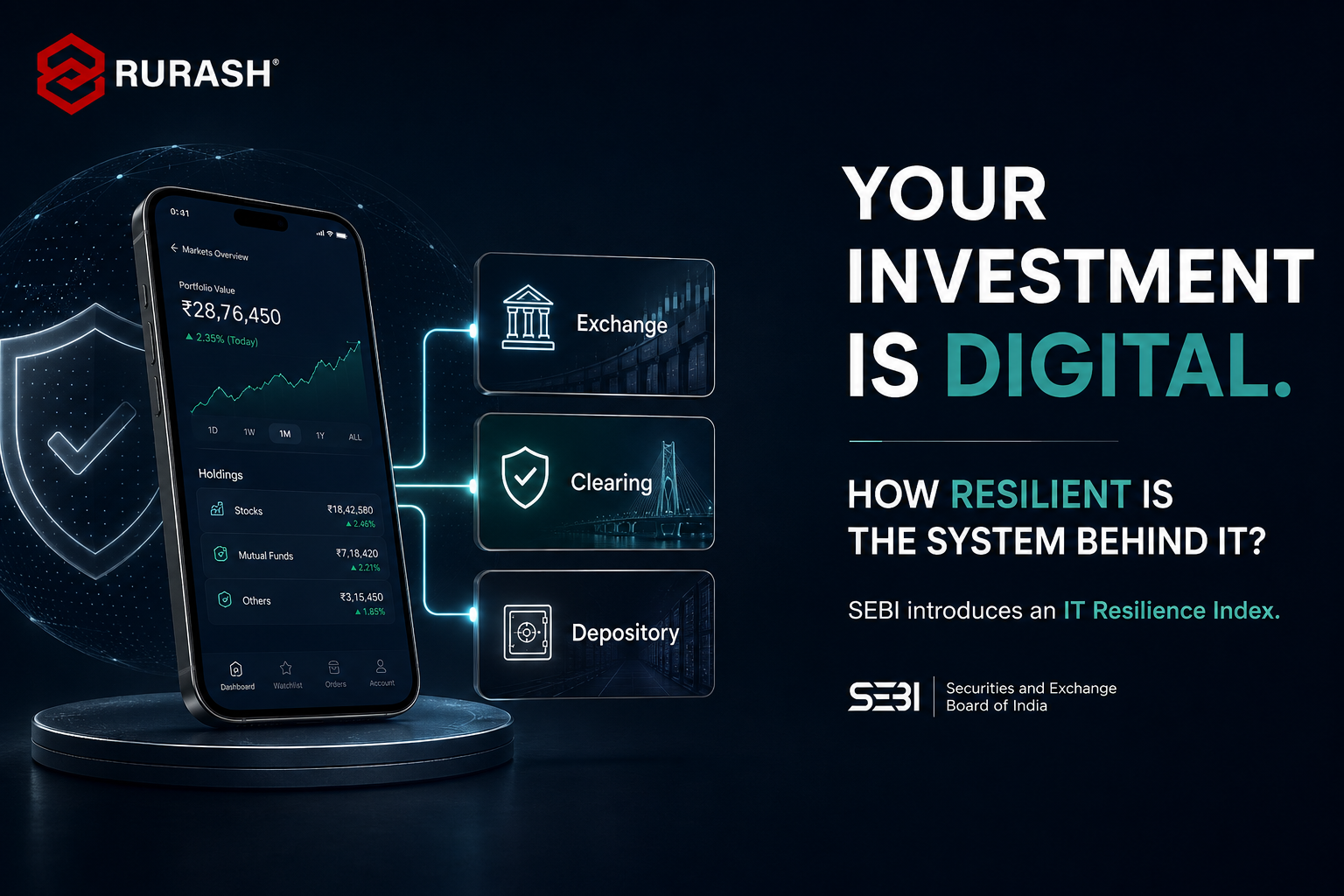
SEBI Introduces an IT Resilience Index: Why the Technology Behind Your Investments Matters Too
Investors usually evaluate markets through familiar questions:
What is the return?
What is the risk?
Where is the market heading?
But there is another layer that investors rarely see:
Is the infrastructure processing their trades resilient enough to keep functioning when technology fails?
On 24 August 2026, SEBI issued a circular introducing an IT Resilience Index for Market Infrastructure Institutions, covering key entities such as stock exchanges, clearing corporations and depositories.
It is an important reminder that modern investing depends not only on financial markets—but also on the technology running underneath them.
What Happened?
SEBI has introduced a framework intended to measure the resilience of critical technology systems used by Market Infrastructure Institutions, or MIIs.
The regulator’s earlier consultation explained that the index is designed to provide management and oversight committees with a clearer view of the health of critical IT systems and areas that may require improvement. It covers critical systems as well as systems connected to or feeding into them.
Reported details of the final framework indicate a 100-point IT Resilience Index covering nine parameters, with assessments conducted twice a year and additional monitoring and early-warning mechanisms forming part of the framework.
Why Should an Investor Care?
Because almost every modern investment now depends on digital infrastructure.
When an investor:
- buys a share
- receives securities
- settles a trade
- accesses a demat account
- transfers securities
multiple systems may be working behind the scenes.
Most investors notice this infrastructure only when something goes wrong.
That is why operational resilience is increasingly becoming part of market integrity.
Market Risk Is Not the Only Risk
Investors are familiar with:
market risk — prices can fall.
credit risk — borrowers can default.
liquidity risk — assets may be difficult to sell.
But markets also contain:
Operational and technology risk
A technical disruption can affect access, order processing, settlement or other market functions even when the underlying investment itself has not changed.
SEBI’s latest initiative reflects the growing importance of measuring these systems systematically.
Why an Index Can Matter
A structured resilience index potentially creates three useful disciplines.
1. Measurement
Resilience becomes something institutions can monitor rather than discuss only after a failure.
2. Early Identification
Weaknesses in technology infrastructure can potentially be identified before they become major disruptions.
3. Accountability
Management and oversight teams receive a clearer framework for evaluating the technology supporting market operations.
The intention is not to guarantee that systems will never fail.
It is to build stronger processes for preparedness, monitoring and recovery.
The Bigger Investor Lesson
The most interesting takeaway goes beyond cybersecurity.
Modern financial markets increasingly combine:
finance + data + technology + infrastructure.
We have already seen this evolution through:
- digital investing
- dematerialised securities
- algorithmic trading
- electronic settlement
- digital KYC
- tokenisation
As investing becomes more digital, technology resilience becomes part of the wider trust architecture supporting financial markets.
What Should Investors Understand?
Investors do not need to become technology engineers.
But they should recognise that financial-market safety involves more than analysing the underlying asset.
The systems through which assets are:
held • traded • cleared • settled
matter too.
SEBI’s IT Resilience Index is therefore less about predicting investment returns and more about strengthening the infrastructure that supports market participation.
Ranjit Jha’s Perspective
A healthy investment ecosystem requires both good financial products and reliable financial infrastructure.
From the investor-education lens associated with Ranjit Jha, MD & CEO of Rurash Financials, technological resilience should be viewed as part of the broader evolution of India’s capital markets.
As investors become increasingly digital, understanding the systems supporting investment access, custody and settlement will become progressively more relevant.
Explore More With Rurash
At Rurash, investor education goes beyond selecting a product.
Understanding how an investment works, what risks surround it and how it fits into the broader financial system can support better-informed decisions.