
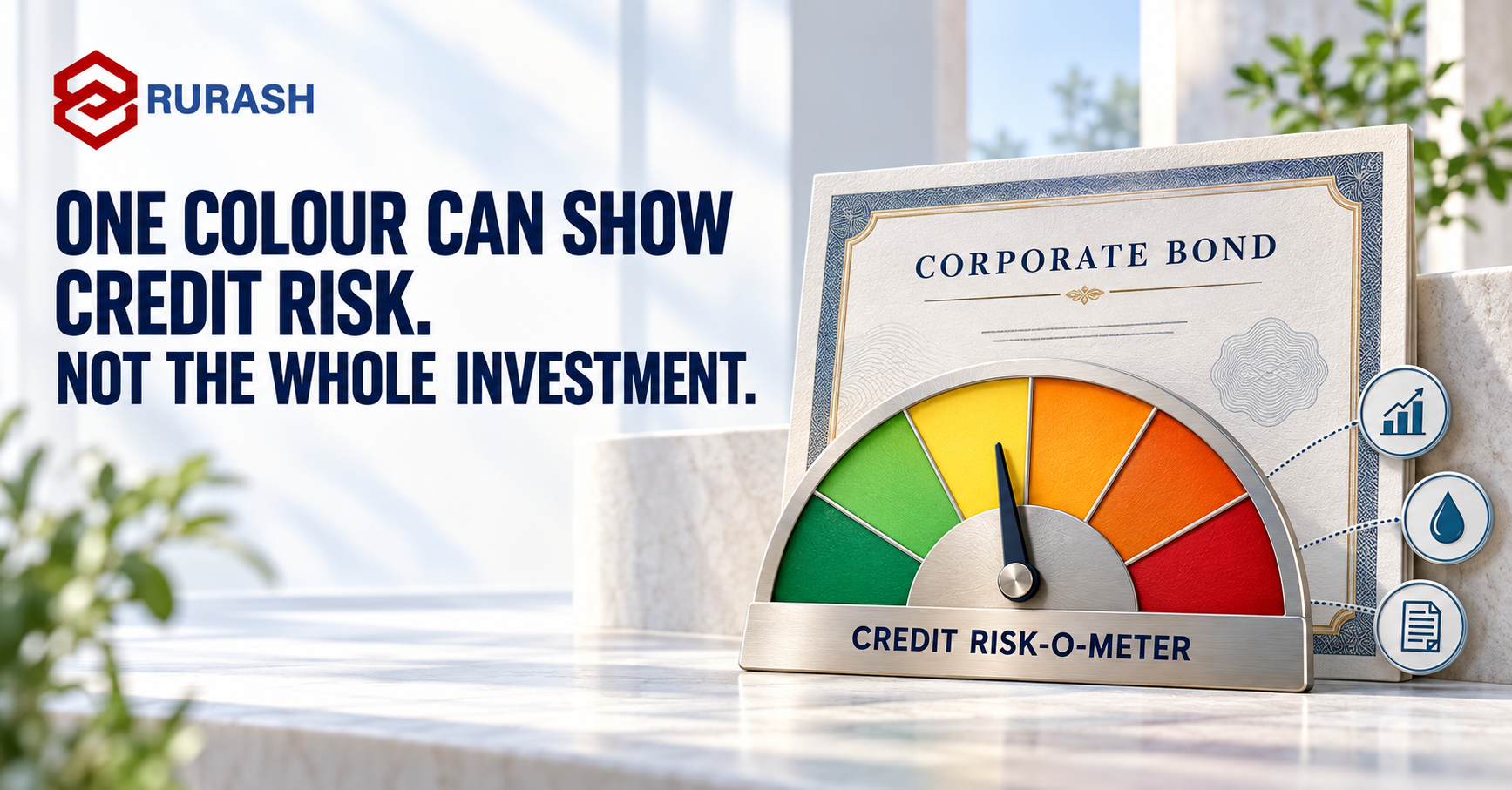
Credit Risk-o-Meter: What SEBI’s New Debt Disclosure Means for Investors
A bond may display an attractive yield and a familiar credit rating. But how clearly does it communicate the possibility of delayed payment or default?
SEBI has introduced a mandatory Credit Risk-o-Meter for listed and proposed-to-be-listed debt securities.
The colour-coded disclosure is intended to make the credit risk associated with a debt instrument easier to identify before an investor makes a purchase.
The Credit Risk-o-Meter will apply to listed or proposed-to-be-listed issuances of non-convertible securities, commercial papers, securitised debt instruments, security receipts and structured or market-linked debentures. It covers instruments issued through public issues as well as private placements.
The new visual can help investors compare debt products more quickly. But it should be treated as a starting point—not as a complete assessment of whether a bond is suitable.
Why has SEBI introduced the Credit Risk-o-Meter?
Debt securities are commonly presented using alphanumeric credit ratings such as AAA, AA+, A or BBB.
These ratings contain important information, but the differences may not be immediately clear to investors unfamiliar with the credit-rating system.
SEBI’s August 2026 consultation paper observed that alphanumeric ratings may not be readily understood by retail investors. It proposed a standardised colour-coded scale to translate the ratings into more visible credit-risk categories.
The objective is to help investors:
- Recognise the credit-risk category more easily
- Compare securities before investing
- Understand that two bonds offering similar yields may carry different credit risk
- Align an investment with their risk tolerance
- Notice changes when a bond’s rating is revised
The Credit Risk-o-Meter does not replace the underlying credit rating. It displays that rating in a more accessible visual format.
How will the Credit Risk-o-Meter work?
The framework maps existing credit ratings from AAA to D into six risk levels.
| Credit-rating range | Credit Risk-o-Meter classification |
|---|---|
| AAA | Lowest credit risk |
| AA+, AA, AA− | Very low credit risk |
| A+, A, A− | Low credit risk |
| BBB+, BBB, BBB− | Moderate credit risk |
| BB+, BB, BB− | Moderate risk of default |
| B+ to D | High to very high risk of default |
The categories will be differentiated using a standard colour scale.
This means an investor looking at a bond offer or online listing should be able to see both the actual credit rating and the corresponding Credit Risk-o-Meter category.
The categories remain relative assessments. “Lowest credit risk” does not mean that repayment is guaranteed or that the security is free from all investment risks.
Where will investors see the disclosure?
The Credit Risk-o-Meter is intended to appear at important points in the investment process.
The disclosure will be required in:
- Offer documents
- Abridged prospectuses
- Private-placement memoranda
- Issuer advertisements
- Online Bond Platform Provider advertisements
- Online bond-platform websites
- Online bond-platform mobile applications
SEBI’s framework also requires online bond platforms to position the disclosure on the bond-listing or bond-details page before the investment-action buttons.
This placement is important.
A risk disclosure may be less effective if it appears only after an investor has already focused on the coupon, yield or maturity. Showing the Credit Risk-o-Meter before the transaction stage can place credit risk closer to the investor’s decision.
What happens when a bond has more than one rating?
Some debt securities may be rated by multiple credit-rating agencies.
Under the framework, the Credit Risk-o-Meter will be based on the lowest rating assigned to the security. The other ratings must still be disclosed alongside it. sebi.gov.in
Suppose one agency rates a bond AA, while another rates it A+.
The Credit Risk-o-Meter should reflect the lower A+ rating rather than the higher AA rating.
This provides a more conservative visual indication, but investors should still investigate why the agencies reached different conclusions.
A rating difference may reflect varying assumptions, methodologies or views of the issuer’s financial position. The difference itself can be relevant information.
What does the meter actually measure?
The Credit Risk-o-Meter represents the credit risk of the debt security.
Credit risk is the possibility that the issuer may fail to pay interest or repay principal according to the promised terms.
The meter does not provide a complete assessment of every risk attached to the investment.
In particular, investors still need to consider:
Interest-rate risk
When market interest rates rise, the price of an existing fixed-rate bond can fall.
A highly rated long-duration bond may have relatively low credit risk but still experience meaningful price movement when interest rates change.
Liquidity risk
A bond may be listed but trade infrequently.
If the investor needs to sell before maturity, there may not be enough buyers at the expected price.
Reinvestment risk
Coupon payments or maturity proceeds may need to be reinvested at lower prevailing rates in the future.
Structural risk
Subordinated, perpetual, callable or market-linked instruments can contain features that materially affect repayment and investor outcomes.
Concentration risk
Investing a large portion of the fixed-income allocation in one issuer, group or industry can create exposure that the meter does not capture.
SEBI’s prescribed disclosure specifically clarifies that the Credit Risk-o-Meter concerns credit risk and does not constitute investment advice. Debt securities remain subject to market and liquidity risks. sebi.gov.in
Why unsecured debt requires attention
Under the framework, an unsecured debt instrument must be identified prominently below the Credit Risk-o-Meter.
Secured and unsecured instruments can both carry a credit rating, but their legal and recovery characteristics may differ.
“Secured” does not automatically mean that an investor will recover the full amount without delay. Investors should examine:
- Which assets secure the issue
- The value and quality of those assets
- Whether the charge is exclusive or shared
- The priority of the investor’s claim
- Whether other creditors rank ahead
- The process that would apply in an enforcement situation
For unsecured securities, repayment depends more directly on the issuer’s general financial capacity and the investor’s position within the creditor hierarchy.
The security structure should therefore be reviewed alongside the rating and meter.
Perpetual and AT1 bonds need a separate review
SEBI’s framework requires an additional warning for unsecured perpetual bonds such as Additional Tier 1, or AT1, instruments.
The Credit Risk-o-Meter may reflect the issuer’s credit rating, but it may not capture all the structural risks of a perpetual bond.
Depending on the instrument terms and applicable regulatory framework, these risks can include:
- No conventional maturity date
- Discretionary or conditional coupon payments
- Call options controlled by the issuer
- Loss absorption
- Write-down or conversion provisions
- Subordination to other creditors
- Potential loss of invested capital
An apparently favourable risk category should not be used as a substitute for reading the information memorandum.
How should investors use the new disclosure?
The meter can become the first step in a structured bond-review process.
Step 1: Check the meter and rating
Identify the credit-risk category, actual rating and rating agency.
Step 2: Compare the yield
Ask whether the additional yield over a government security or a higher-rated bond reasonably compensates for the additional risk.
Step 3: Understand the issuer
Review the issuer’s business model, cash flows, debt obligations, profitability, refinancing requirements and repayment history.
Step 4: Read the instrument terms
Check maturity, coupon structure, security, ranking, call or put options and other special conditions.
Step 5: Review liquidity
Determine whether the bond is actively traded and whether selling before maturity may be difficult.
Step 6: Match the investment horizon
A bond’s maturity and cash flows should be considered in relation to when the investor expects to need the money.
Step 7: Avoid concentration
Even a highly rated security should not automatically become an excessively large part of the investor’s fixed-income portfolio.
A higher yield still needs an explanation
The Credit Risk-o-Meter may make one relationship easier to notice:
Higher yield can sometimes be compensation for higher risk.
However, yield differences may arise from more than credit risk. Maturity, liquidity, tax treatment, call features, market conditions and the structure of the instrument can all influence the yield.
Consider two bonds with similar maturities.
One offers 7.5%, while another offers 10%.
The higher coupon or yield should not automatically be treated as the better opportunity. Investors should ask what explains the additional return:
- Is the issuer rated lower?
- Is the bond unsecured?
- Does it trade less frequently?
- Is it subordinated?
- Does it contain a complex repayment structure?
- Is the market pricing in a deterioration in the issuer’s position?
The meter can alert the investor to credit risk, but it cannot answer every question behind the yield.
Can the Credit Risk-o-Meter change?
Yes.
The Credit Risk-o-Meter is linked to the security’s credit rating. If the rating changes, the displayed risk category may also change.
SEBI’s proposed operating framework requires online bond platforms to communicate changes and update the meter following rating information received through the depository infrastructure.
Investors should not treat the category shown on the original purchase date as permanent.
After investing, continue monitoring:
- Rating upgrades or downgrades
- Rating outlook and watch status
- Delayed-payment information
- Issuer financial results
- Changes in borrowing or leverage
- Regulatory disclosures
- Material corporate developments
A downgrade does not automatically dictate one course of action, but it should trigger a review of the original investment case.
Is this the same as the mutual-fund Risk-o-Meter?
No.
The new Credit Risk-o-Meter applies to individual debt securities and focuses on their credit risk.
A mutual-fund Risk-o-Meter represents the risk level of an entire mutual-fund scheme based on the applicable regulatory methodology. Debt mutual funds also provide portfolio-level disclosures such as the Potential Risk Class matrix.
Investors should therefore avoid comparing the two visuals as though they measure precisely the same thing.
When buying an individual bond, the investor carries exposure to the specific issuer and security. When investing through a debt fund, risk is distributed across the fund’s portfolio, subject to its concentration, duration and credit strategy.
Ranjit Jha’s Perspective — Draft for Approval
Unapproved proposed perspective; not an authorised quotation.
From the investor-education perspective of Ranjit Jha, MD & CEO of Rurash Financials, the Credit Risk-o-Meter can make an important part of bond evaluation easier to identify, particularly for investors who may not be familiar with the differences between rating categories.
But a colour or rating should not become the entire investment decision. Investors should still understand the issuer’s repayment capacity, the instrument’s security and ranking, its liquidity and whether its maturity matches the intended holding period.
The disclosure can improve the first question an investor asks. Sound fixed-income evaluation still depends on the questions that follow.
Connect With Rurash Financials
Evaluating corporate bonds, non-convertible debentures or other fixed-income opportunities?
Rurash Financials can help you examine the credit profile, yield, maturity, security structure and portfolio fit before making an investment decision.
Explore Rurash → Connect with Rurash Financials
Credit ratings and Credit Risk-o-Meter classifications may change. They do not guarantee repayment or eliminate market, liquidity, interest-rate or structural risk. This article is intended for investor education and is not a recommendation to invest.