
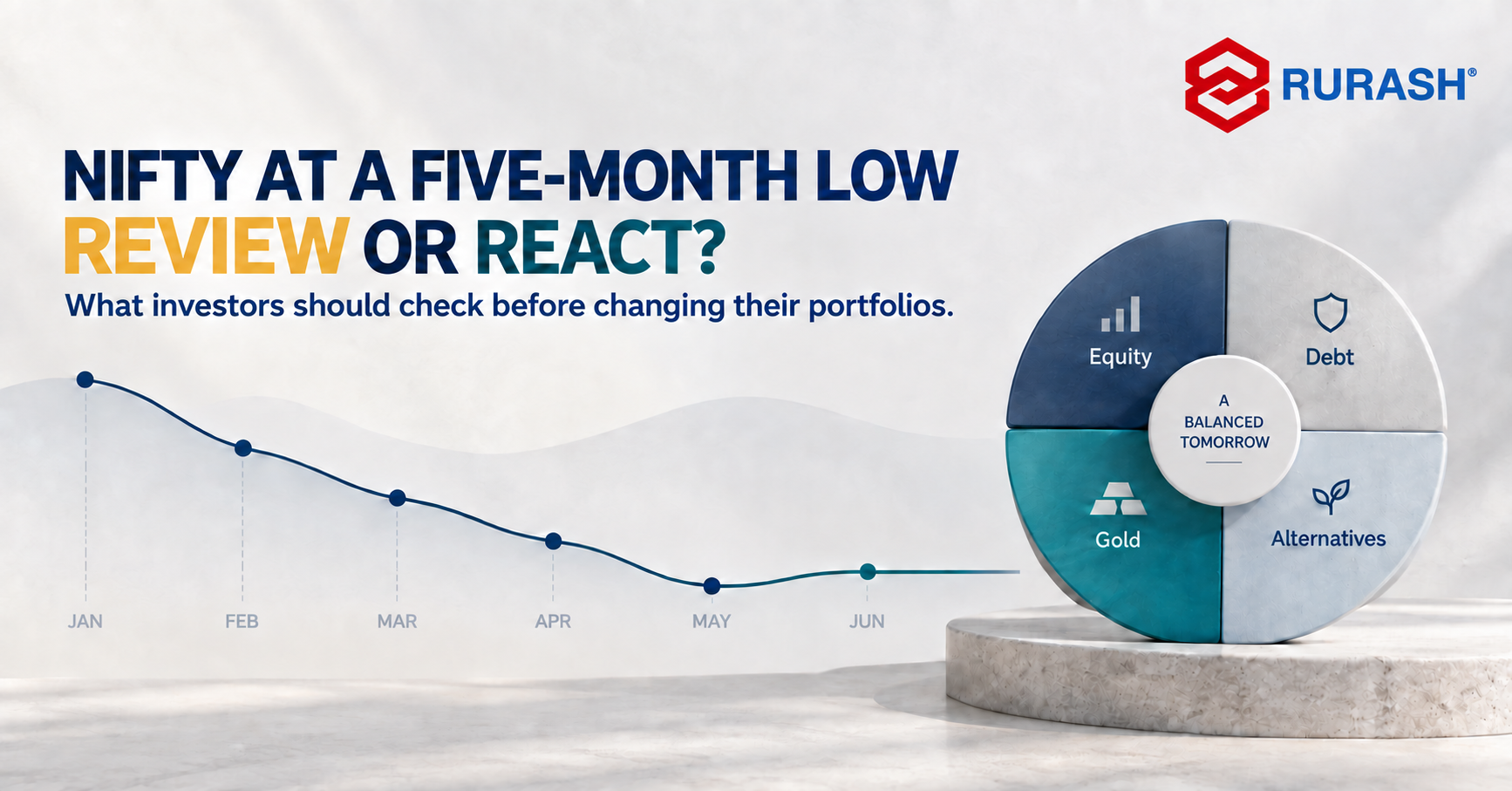
On 15 September 2026, Indian equity markets faced a broad sell-off. The Nifty 50 declined 1.19% to close at 23,118.60, its lowest closing level in five months. The BSE Sensex fell 1.04% to 74,003.82.
The fall was driven largely by rising crude-oil prices, increasing global bond yields and renewed concerns about inflation and interest rates. Brent crude climbed close to $108 per barrel, while the US 10-year Treasury yield moved above 5%.
Financial and automobile stocks were among the weakest areas of the market. Mid-cap and small-cap indices also declined by more than 2%, indicating that the pressure extended beyond benchmark companies. Reuters
Hero insight: A market decline can reveal weaknesses in a portfolio, but it should not automatically trigger an exit.
Why Did the Nifty Fall?
The fall was influenced by a combination of global and domestic concerns rather than one company-specific development.
Higher Crude-Oil Prices
India imports a significant share of its crude-oil requirements. A sustained increase in oil prices can affect the economy through:
- Higher import costs
- Pressure on the rupee
- Increased inflation
- Higher transportation and production expenses
- Lower profit margins for oil-sensitive businesses
Brent crude rose to approximately $107.8 per barrel amid escalating geopolitical tensions and concerns about energy supplies.
Higher oil prices do not affect every company equally. Energy producers may benefit under certain conditions, while airlines, logistics companies, paints, chemicals and other fuel-dependent businesses may face higher operating costs.
Rising Global Bond Yields
The US 10-year Treasury yield moved above 5%, reaching its highest level since 2007. Rising bond yields can make fixed-income assets comparatively more attractive and reduce the valuation investors are willing to pay for equities.
They can also influence:
- Foreign institutional flows
- Corporate borrowing costs
- Equity valuations
- Currency movements
- Expectations about future interest rates
Growth companies with earnings expected far into the future can be particularly sensitive to higher interest rates.
Inflation and Interest-Rate Concerns
Higher energy prices may add to inflation. If inflation remains elevated, central banks may keep interest rates higher for longer or consider further tightening.
This can affect companies through higher financing costs and potentially weaker consumer demand.
It can also affect households with loans, businesses planning expansion and investors comparing equities with bonds and deposits.
Pressure on the Rupee
The Indian rupee declined to approximately ₹95.92 per US dollar, its weakest level in more than a month. Rising oil prices increase India’s demand for dollars because crude imports are generally paid for in foreign currency. Reuters
A weaker rupee may benefit certain export-oriented companies, including some technology and pharmaceutical businesses. However, it can increase costs for companies dependent on imported fuel, raw materials or equipment.
Which Parts of the Market Were Most Affected?
The sell-off was not limited to a few index-heavy companies.
Automobile stocks declined by approximately 2%, while financial stocks fell around 1.8%. Mid-cap and small-cap indices also lost more than 2%, showing increased risk aversion across the broader market.
Technology stocks moved differently. The Nifty IT segment gained approximately 2.2%, partly supported by the weaker rupee and changing sentiment around artificial-intelligence investment.
This variation is important. Even during a broad decline, sectors may respond differently to the same economic developments.
Diversification cannot prevent all portfolio losses, but it can reduce dependence on one sector, theme or market segment.
Does a Five-Month Low Mean Investors Should Sell?
Not necessarily.
A lower index level explains what has happened to the broader market. It does not determine whether an individual investor should sell, hold or invest more.
The appropriate response depends on:
- Investment horizon
- Financial goals
- Portfolio valuation
- Asset allocation
- Liquidity requirements
- Risk tolerance
- Quality of the underlying investments
- Exposure to vulnerable sectors
- Availability of an emergency fund
An investor who requires money within the next few months faces a different decision from someone investing for a goal ten years away.
The decision should therefore begin with the portfolio—not with the index headline.
Portfolio Review and Panic Selling Are Different
Panic selling is generally driven by fear and short-term price movements. A portfolio review is based on financial goals, valuation, risk and suitability.
A structured review asks:
- Has the original investment reason changed?
- Are company fundamentals weakening?
- Is the portfolio concentrated in one sector?
- Has equity exposure moved beyond the intended allocation?
- Is sufficient liquidity available for near-term needs?
- Are high-risk investments occupying too much of the portfolio?
- Does the current allocation still match the investor’s time horizon?
If the answers reveal a genuine weakness, changes may be justified. If the portfolio remains aligned with long-term goals, immediate action may not be necessary.
Should Investors Rebalance Now?
Rebalancing means bringing a portfolio back towards its intended asset allocation.
For example, an investor may have selected a long-term allocation across equity, debt, gold and cash. Market movements can cause these weights to move away from the original plan.
Rebalancing may be appropriate when:
- Equity exposure exceeds or falls below the planned range
- One sector has become excessively dominant
- Small-cap or thematic exposure is too high
- Near-term goals do not have sufficient debt or cash allocation
- The investor’s risk tolerance has changed
- The investment horizon has shortened
However, rebalancing should not be confused with predicting the market’s next move. Its purpose is to control portfolio risk—not to identify the exact market bottom.
What Should SIP Investors Do?
A falling market does not automatically mean systematic investment plans should be stopped.
SIPs are designed to invest regularly across different market levels. During a decline, the same contribution may purchase more mutual-fund units. However, rupee-cost averaging does not guarantee returns or protect against losses.
Before changing an SIP, investors should review:
- Whether the financial goal remains unchanged
- Whether the selected scheme is still suitable
- Whether the investment horizon is adequate
- Whether the investor can continue the contribution comfortably
- Whether emergency savings are available
- Whether too many overlapping funds are held
Stopping an SIP solely because the market has fallen can convert temporary uncertainty into a permanent interruption of the investment plan.
Should Investors Buy More During the Decline?
A market fall can create opportunities, but every lower price is not automatically an attractive valuation.
Before investing additional money, investors should check:
- Whether their emergency fund is adequate
- Whether near-term financial commitments are covered
- Whether the portfolio already has sufficient equity exposure
- Whether the chosen company or fund remains fundamentally suitable
- Whether the investment is diversified
- Whether the decision is based on a financial plan or market excitement
Deploying available funds gradually may reduce the risk of committing the entire amount at one uncertain market level.
Investors should also avoid borrowing money or using emergency savings to take advantage of a market correction.
What Should Mutual-Fund Investors Examine?
A mutual fund should not be assessed only through a few days of negative returns.
Investors should examine:
- Performance across complete market cycles
- Comparison with the appropriate benchmark
- Consistency of the investment approach
- Portfolio concentration
- Sector exposure
- Risk-adjusted performance
- Fund-category suitability
- Expense ratio and portfolio overlap
A fund can fall because the entire market is declining. That is different from consistently underperforming because of problems in its strategy or portfolio.
What Should PMS Investors Review?
Portfolio Management Services may hold concentrated portfolios and can therefore move differently from broad market indices.
PMS investors should review:
- Concentration across companies and sectors
- Exposure to mid-cap and small-cap businesses
- Portfolio turnover
- Investment strategy
- Cash position
- Drawdown compared with the benchmark
- Consistency with the investor’s risk capacity
- Reasons provided by the portfolio manager for major changes
Short-term underperformance alone may not justify an exit. However, unexplained strategy changes, excessive concentration or persistent weakness deserve closer evaluation.
Why Does Asset Allocation Matter During Volatility?
Different asset classes respond differently to economic conditions.
Equities may offer long-term growth but can experience significant short-term fluctuations. Bonds may support income and relative stability, although they carry credit and interest-rate risks. Gold may provide diversification but does not generate regular income. Cash supports liquidity but may lose purchasing power over time.
A well-structured portfolio assigns each investment a specific role:
- Growth
- Income
- Liquidity
- Capital preservation
- Diversification
- Future financial goals
When every investment has a defined purpose, investors are less likely to make decisions based only on daily market movements.
What Should Investors Watch Next?
Key developments that may influence Indian markets include:
- Movement in crude-oil prices
- Middle East geopolitical developments
- US Federal Reserve policy
- Global bond yields
- RBI’s response to inflation and currency pressure
- Movement in the Indian rupee
- Foreign and domestic institutional flows
- Corporate earnings and management guidance
- Valuations across large-, mid- and small-cap shares
These factors can create continued volatility. However, investors should avoid changing long-term portfolios in response to every new data point.
Practical Portfolio Checklist
Following the market decline, investors can take five practical steps:
- Review asset allocation instead of checking only daily returns.
- Confirm that near-term goals have sufficient liquid or lower-volatility assets.
- Identify excessive exposure to individual companies, sectors or themes.
- Reassess investments whose fundamentals or original purpose have changed.
- Rebalance only when the portfolio has moved materially away from the financial plan.
The objective is not to predict tomorrow’s index level. It is to ensure that the portfolio remains capable of supporting the investor’s goals.
Ranjit Jha’s Perspective
Market declines naturally create concern, but they also provide an opportunity to understand how a portfolio behaves under pressure.
Investors should distinguish between temporary market volatility and a permanent change in investment fundamentals. Instead of reacting to the index alone, they should review concentration, liquidity, asset allocation and alignment with their financial goals.
Volatility may require attention, but every market movement does not require action.
Explore More with Rurash
If recent market volatility has changed your portfolio’s risk, allocation or liquidity position, connect with Rurash Financials Pvt. Ltd. to review your mutual funds, PMS and broader investment portfolio through a structured, goal-based approach.
Frequently Asked Questions
Why did the Nifty fall on 15 September 2026?
The fall was primarily associated with rising crude-oil prices, increasing global bond yields, inflation concerns and expectations of tighter interest-rate conditions.
Should investors sell when the Nifty reaches a five-month low?
Not automatically. The decision should depend on investment fundamentals, valuation, financial goals, time horizon and portfolio suitability.
Is this a good time to rebalance a portfolio?
Rebalancing may be appropriate if the portfolio has moved materially away from its intended asset allocation. It should be based on a plan rather than short-term market predictions.
Should SIPs be stopped during a market decline?
A market decline alone is generally not sufficient reason to stop an SIP. Investors should first review their goals, time horizon, cash flow and fund suitability.
Are mid-cap and small-cap investments riskier during volatility?
They can experience sharper price movements and lower liquidity than larger companies. Investors should check whether their allocation matches their risk capacity and investment horizon.