
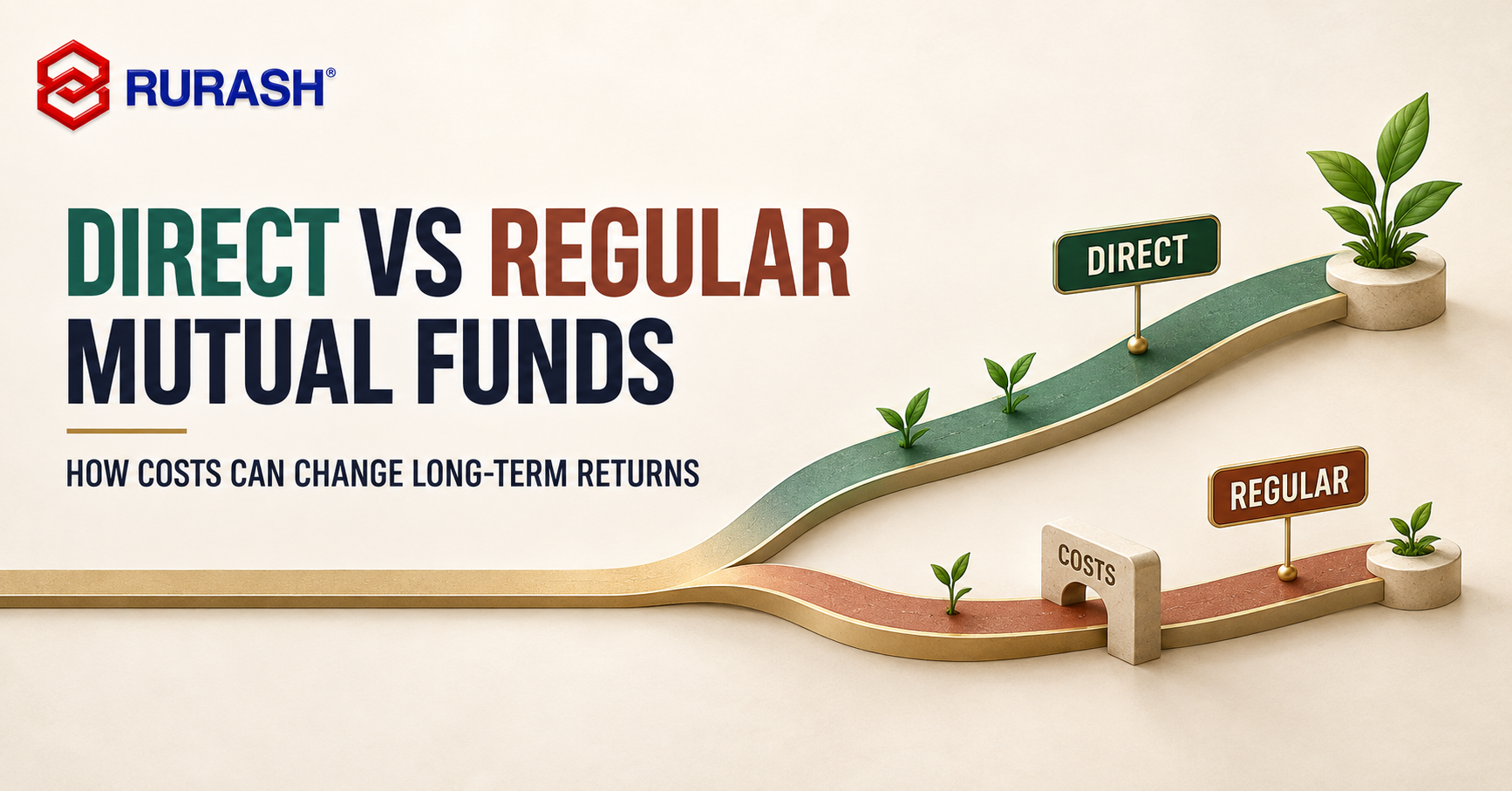
Two investors can invest the same amount in the same mutual-fund scheme, follow the same portfolio and remain invested for the same period—yet accumulate different amounts.
The reason is the difference in costs between direct and regular plans.
A recent analysis illustrated this through a ₹10,000 monthly SIP in the same small-cap scheme over approximately 13 years. The direct plan reportedly accumulated ₹61.09 lakh, while the regular plan reached ₹54.45 lakh—a difference of around ₹6.65 lakh. The example used an expense ratio of 0.50% for the direct plan and 1.41% for the regular plan.
These figures are scheme- and period-specific. They should not be treated as a universal return projection.
Hero insight: A small annual cost difference can become a large wealth difference when it compounds over many years.
What is the difference between direct and regular mutual funds?
Direct and regular plans are two routes for investing in the same mutual-fund scheme.
They generally share the same:
- Investment objective
- Fund manager
- Underlying portfolio
- Risk level
- Benchmark
The main difference is their expense structure.
A direct plan is purchased without routing the investment through a distributor. A regular plan includes distribution-related expenses or commissions within its total expense ratio.
AMFI confirms that direct plans have lower expense ratios because distribution costs are not included. (AMFI)
What is an expense ratio?
The total expense ratio, or TER, represents the recurring operating expenses charged by a mutual-fund scheme as a percentage of its average net assets.
These expenses are reflected in the scheme’s daily NAV. Investors do not receive a separate bill, but the cost reduces the return retained by them. (AMFI)
Even a difference of less than one percentage point can become meaningful when compounded over a long period.
Why can the return difference become so large?
Suppose two versions of a scheme generate the same gross portfolio return, but one charges a higher annual expense ratio.
The difference may appear small in the first year. Over time, however, the investor loses not only the additional cost but also the return that amount could have generated in subsequent years.
The effect becomes more visible when:
- The investment horizon is long
- SIP contributions continue consistently
- The expense-ratio difference is significant
- The portfolio generates positive compounded returns
Does this mean direct plans are always better?
Direct plans are less expensive, but cost should not be the only consideration.
A direct plan may suit investors who can independently:
- Select an appropriate fund
- Understand asset allocation
- Assess risk
- Monitor performance
- Rebalance the portfolio
- Avoid emotional investment decisions
A regular plan may include distributor guidance and service. Its value depends on the quality and relevance of that support.
The correct question is not simply, Which plan is cheaper? It is, Does the investor receive useful guidance that justifies the additional cost?
Is a distributor the same as an investment adviser?
Not necessarily.
A mutual-fund distributor and a SEBI-registered investment adviser operate under different regulatory and compensation frameworks. Investors should understand whether the person assisting them is being paid through product commissions, advisory fees or another permitted arrangement.
They should also ask what service is included:
- Initial product selection
- Goal planning
- Asset allocation
- Portfolio monitoring
- Rebalancing
- Behavioural guidance
- Tax-related coordination
- Ongoing reporting
Transparent costs make it easier to evaluate the value of the relationship.
Can investors switch from regular to direct?
A switch from a regular plan to a direct plan is generally treated as a redemption from one plan and a fresh investment into the other.
Depending on the scheme and holding period, the switch may trigger:
- Capital-gains taxation
- Exit load
- Changes to SIP instructions
- Loss of ongoing distributor support
- Portfolio-management responsibility
Investors should calculate the immediate cost of switching against the potential long-term benefit.
What should investors compare before choosing?
Before selecting direct vs regular mutual funds, review:
Total expense ratio
Check the current TER of both plans. Expense ratios can change.
Advisory requirement
Consider whether you can independently make and maintain appropriate investment decisions.
Portfolio complexity
A single, straightforward fund may require less supervision than a portfolio involving multiple goals, asset classes and tax considerations.
Investment horizon
The longer the holding period, the greater the potential compounding impact of recurring costs.
Quality of support
Assess whether the distributor or adviser provides meaningful ongoing value rather than only facilitating transactions.
Switching consequences
Review exit load and capital-gains tax before changing an existing plan.
Ranjit Jha’s Perspective
The conversation around direct and regular mutual funds should go beyond a simple comparison of expense ratios.
Costs matter because they compound. At the same time, unsuitable fund selection, poor asset allocation or emotional decision-making can have a larger impact on an investor’s outcome than the expense difference alone.
Investors should understand both what they are paying and what value they are receiving.
Explore More with Rurash
At Rurash, investors can review mutual-fund selection, costs, portfolio overlap, risk and asset allocation in the context of their financial goals.
Because a well-constructed portfolio should be both suitable and cost-aware.