Loan Against Securities: What to Check Before Accepting a Quote
A loan quote may show an attractive interest rate. But does it explain what borrowing will actually require?
A Loan Against Securities, commonly called LAS, can provide liquidity against eligible investments such as shares, mutual-fund units and certain other financial securities.
This can allow an investor to meet a funding requirement without immediately selling the underlying investments. However, retaining an investment while borrowing against it creates a repayment obligation and places the pledged holdings under the lender’s security arrangement.
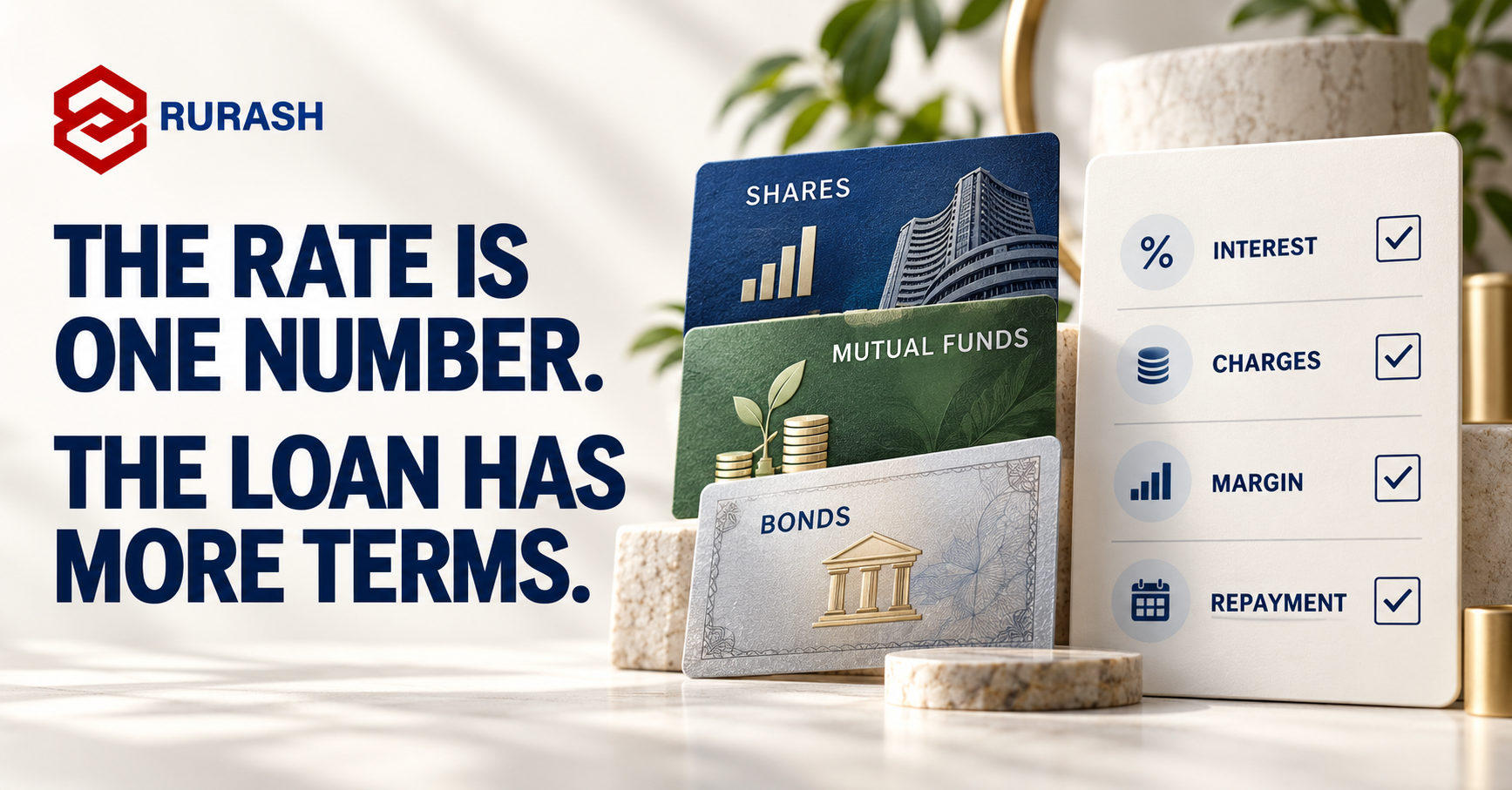
The interest rate is therefore only one part of the decision.
Before accepting a Loan Against Securities quote, investors should understand what can be pledged, how the available limit is calculated, what the facility will cost, what happens if collateral values decline and how the borrowing will eventually be repaid.
Start with the amount you actually need
Begin by defining the purpose of the borrowing, the amount required and the expected borrowing period.
The maximum facility offered by a lender should not automatically become the amount you borrow. A larger available limit may create flexibility, but it can also encourage borrowing beyond the original requirement.
If the need is temporary, identify the expected source of repayment. This could be a future receivable, business cash flow, a scheduled bonus or another planned source of funds.
The repayment plan should also consider delays.
For example, a professional expecting a payment in three months should ask what happens if that payment arrives after five months. The borrowing decision should account for that possibility rather than relying only on the expected repayment date.
Investors should also confirm that the intended use of funds is permitted under the facility. A Loan Against Securities should not be assumed to support every possible purpose.
Confirm which holdings are eligible
Prepare a current list of the securities you intend to offer as collateral.
Ask the lender to identify which shares, mutual funds or other securities are acceptable and whether any concentration restrictions apply.
Not every investment in a portfolio will necessarily qualify. Even when a security is accepted, the lender may assign a different margin or lending value to it based on factors such as liquidity, volatility and internal risk policies.
Check whether any of the holdings are:
- Already pledged or subject to a lien
- Locked in or restricted from transfer
- Held jointly
- Subject to additional approvals
- Held in an account that cannot support the proposed pledge process
Your portfolio statement and the lender’s eligible-collateral list answer different questions. The portfolio statement shows what you own. The collateral list helps establish what the lender is prepared to accept.
The company or fund name should also be matched carefully with the exact security, folio or depository holding involved.
Understand how the available limit is calculated
The market value of the securities and the applicable margin together influence how much an investor may be able to borrow.
Suppose eligible investments have a market value of ₹20 lakh. A lender will generally not treat the entire ₹20 lakh as the available borrowing limit. A margin or haircut may be applied to provide a buffer against changes in value.
Ask the lender to explain:
- The value assigned to each security
- The applicable margin or haircut
- Whether the limit is indicative or sanctioned
- What conditions remain before funds become available
- How frequently the collateral will be revalued
- Whether eligibility and margins can change
HDFC Bank’s published LAS guidance, for example, states that the final limit depends on the value and quantity available when the securities are pledged. Its guidance also explains that a decline in the pledged value may require the borrower to provide additional collateral or repay part of the outstanding amount.
This illustrates why the available limit should always be considered alongside the lender’s security-cover requirements.
Compare the complete cost—not just the rate
An attractive interest rate does not necessarily mean the facility has the lowest overall cost.
Request the schedule of charges and proposed sanction terms together. This makes it easier to evaluate the complete arrangement rather than examining individual numbers separately.
Check whether the quoted interest rate is fixed or floating. If it is floating, ask what benchmark or internal rate it follows, how revisions are communicated and how frequently the rate can change.
If the facility operates as an overdraft, clarify whether interest is charged only on the amount used and for the period it remains outstanding. Also confirm the billing cycle, payment date and treatment of unpaid interest.
Additional costs may include:
- Processing or renewal charges
- Annual maintenance charges
- Pledge-creation and release charges
- Depository-related charges
- Documentation or valuation fees
- Statutory taxes
- Penal charges for delayed payments
- Charges connected with excess drawings or shortfalls
Publicly displayed rates and charges can help investors prepare questions, but the written offer or sanction letter should establish the terms applicable to the individual facility.
Published charges may change, and a historical rate range should not be treated as a current personal quote.
Read the collateral-shortfall provisions carefully
A Loan Against Securities is backed by market-linked assets. Their value can rise or fall while the amount borrowed remains payable.
If the collateral value declines, the security cover available to the lender may fall below the required level. This can create a margin or collateral shortfall.
Ask the lender to explain the shortfall process in plain language:
- How will the borrower be notified?
- What action will be required?
- Can the borrower provide additional eligible securities?
- Can part of the outstanding amount be repaid instead?
- How much time will be available to respond?
- What rights does the lender have if the shortfall is not corrected?
Do not rely exclusively on the possibility of a future market recovery.
Consider whether you would have accessible funds or additional acceptable collateral if the market moved against the pledged portfolio. Also examine whether pledging a highly concentrated or volatile portfolio could increase the probability of a shortfall.
Investors should understand that the lender’s enforcement rights will depend on the agreement and applicable terms. These provisions deserve the same attention as the headline interest rate.
Check whether you retain access to the investments
Pledging securities does not mean the investments stop being exposed to the market. Their prices may continue to change, and the investor may continue to experience the economic gains or losses associated with them, subject to the facility’s terms.
However, pledged investments may not remain freely available for every transaction.
If you expect to sell shares, redeem mutual-fund units or restructure the portfolio, ask how the lender’s approval and pledge-release process will work.
Clarify:
- Whether partial release is permitted
- What security cover must remain after a release
- How long the release process may take
- Whether substitution with another eligible security is possible
- What charges may apply
This is particularly important when the pledged portfolio is also part of a longer-term investment strategy.
Review repayment, renewal and closure
Confirm how the principal will be repaid and whether the facility has a defined tenure.
If the loan or overdraft may be renewed, ask whether renewal is automatic or subject to another review. The lender may reassess the borrower, collateral, interest rate, limits or documentation at renewal.
Investors should also understand how the facility will be closed.
Ask what amount must be paid, when the pledge or lien will be released and what documents will confirm that the lender no longer has a claim over the securities.
Keep copies of the sanction letter, facility agreement, pledge confirmation, payment records, account statements and closure communication.
Compare LAS with the available alternatives
A Loan Against Securities may be useful in some circumstances, but it should still be compared with other financing options.
The appropriate comparison could include a personal loan, business facility, loan against property, planned investment redemption or another source of liquidity.
Selling an investment may create tax consequences or interrupt a long-term investment plan. Borrowing, meanwhile, creates interest costs, shortfall risk and repayment obligations.
The decision should therefore consider the complete financial effect—not merely whether borrowing allows the investor to avoid selling today.
Before accepting the quote
A useful Loan Against Securities quote should allow you to explain five things clearly:
- Which investments are eligible as collateral?
- How has the available limit been calculated?
- What is the complete cost of the facility?
- What happens if the collateral value falls?
- How will the borrowing be repaid and the pledge released?
If any of these remain unclear, request a written explanation before proceeding.
The rate matters. But so do the conditions attached to the pledged investments.
Ranjit Jha’s Perspective — Draft for Approval
Unapproved proposed perspective; not an authorised quotation.
From the investor-education perspective of Ranjit Jha, MD & CEO of Rurash Financials, a liquidity decision should begin with the requirement and the repayment plan—not with the maximum available limit.
The interest rate is important, but investors should also understand the conditions attached to their pledged investments. Collateral eligibility, market-linked valuation, shortfall obligations and the release process can materially affect how the facility works in practice.
A Loan Against Securities should therefore be evaluated as part of the investor’s wider financial position rather than as an isolated borrowing decision.
Explore More With Rurash
Considering borrowing against shares or mutual-fund investments?
Rurash Financials can help you understand potential eligibility, collateral considerations and the questions that should be addressed before proceeding.
Share your liquidity requirement, expected borrowing period and a summary of your holdings only through an approved private channel.
Explore Rurash → Connect with Rurash Financials
Loan availability, eligible securities, interest rates, margins and charges are subject to lender policies, documentation and approval. Borrowing against market-linked investments involves repayment and collateral-shortfall risks.